Private Drinking Water in West Virginia
This Science & Technology Note highlights the higher than average use of private drinking water systems in West Virginia, notes common contaminants for the region, provides information on recommended well testing, and proposes a policy option that could lead to an increase in the number of West Virginia’s wells that undergo recommended annual testing.
Updated June 11, 2026
Many private drinking water systems contain high levels of contaminants. Unlike community drinking water systems, private wells are not required to be tested for contaminants. This Science & Technology Note describes use of private drinking water systems in West Virginia, highlights contaminants that are often found in regional wells, and provides a policy option that could help to enhance drinking water safety for West Virginians who use private water systems.
Private Drinking Water Well Quality
21% of West Virginians are not served by a community drinking water system, and are instead reliant on private wells, springs, or other sources of drinking water. Nationally, 11% of people use private drinking water systems, typically private wells. Private drinking water systems are not subject to the same regulatory requirements as public drinking water systems, and private systems often lack safety and health testing.
Testing demonstrated that many private wells in the region experience contamination that would be in excess of federal Safe Drinking Water Act standards, if they applied to private wells. As private wells are not required to be tested, few studies exist on well quality in West Virginia.
One study of private wells in southwest Virginia found that 33% of wells contained harmful bacteria, 33% contained high levels of metals, and 11% had high concentrations of nitrate, a compound that often signals contamination from agricultural runoff. Bacteria in drinking water can cause gastrointestinal illnesses, metals can contribute to cancer development, and nitrates can reduce the body’s ability to carry oxygen. 20% of private wells in Virginia contained lead, which can lead to learning and behavioral problems in children. In northern West Virginia, per- and polyfluoroalkyl substances (PFAS) were detected in 60% of private wells. PFAS may contribute to developmental delays in children, increased cancer risk, and increased rates of obesity.
Research Highlights
Many private drinking water wells contain contaminants that exceed recommended levels, however, these systems are not required to be tested or treated.
More West Virginians use wells and other unregulated sources of drinking water than the national average.
West Virginia is one of the few states in the Appalachian region that does not provide well testing assistance for people with private drinking water systems.
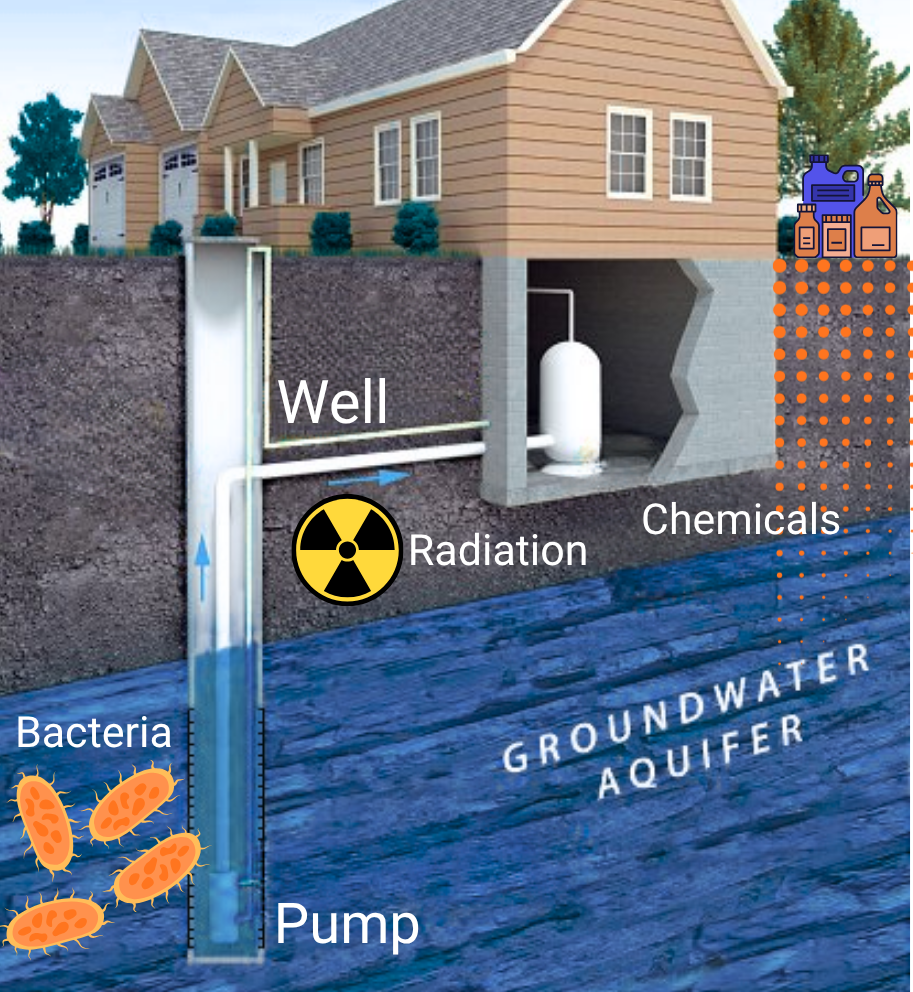
Drinking water from private wells is not required to be tested. Private wells can be contaminated with bacteria, radioactive materials, chemicals, and more, making water potentially unsafe to drink. Adapted from US Environmental Protection Agency.
The West Virginia Department of Health recommends testing wells annually for fecal bacteria, metals, sodium, and combined nitrates and nitrites. Repeat testing is recommended after any work is performed on a well. If well owners are experiencing specific problems, additional testing is recommended.
Some people in the region use natural springs as their source of drinking water. Springs can be especially susceptible to bacterial contamination, with nearly 80% of Central Appalachian natural springs exceeding the recommended level of fecal bacteria. As an alternative to private drinking water systems or natural springs, some people opt to purchase bottled water.
Private Well Testing Policies
One concern among private well owners is a lack of information on the quality of water in their well. Private well testing is one way well owners can obtain this vital information. Paid tests are available through health departments, often costing between $75 and $110 for a basic test (testing for bacteria, metals, and nitrates), but additional recommended testing would add costs.
West Virginia is one of the few Appalachian states that lacks a subsidized private well testing program. Cost and accessibility may contribute to low testing rates, as ~10% of well owners reported testing their well in the past year. North Carolina and New York also require homeowners to pay for their own well testing, while Tennessee provides free testing after flood disasters. All other states in the region provide subsidized well testing through their Cooperative Extension programs. If well testing reveals an issue with water quality, various treatment and filtration methods can often resolve the problem.
One option that may help to increase the number of people regularly testing their wells could be to provide funding for comprehensive annual well testing for West Virginians with private wells. Funding well testing could result in improved public health measures.
A study from North Carolina, where homeowners need to pay for their own well testing, found that 30% of private wells tested positive for fecal bacteria, while 1% of community water systems did. The study estimated that 20% of emergency room visits could be avoided if private well owners were tested and treated promptly, or connected to community water supplies.
Alternatively, the state could choose to fund only basic annual well testing, or only fund an initial test for new wells. The state could also continue to rely on citizens to pay to test their own wells. Of these options, providing comprehensive annual well testing would be the most expensive to the state, but would provide the most information about drinking water quality for West Virginians with wells.
This Science and Technology Note was prepared by Madison Flory, PhD, West Virginia Science & Technology Policy Fellow on behalf of the West Virginia Science and Technology Policy (WV STeP) Initiative. The WV STeP Initiative provides nonpartisan research and information to members of the West Virginia Legislature. This Note is intended for informational purposes only and does not indicate support or opposition to a particular bill or policy approach. Please contact info@wvstep.org for more information.
Related Notes
West Virginia’s Public Drinking Water Systems