
West Virginia Vehicle Tax
The majority of passenger vehicles registered in West Virginia are gas-powered, but an increasing number of hybrid and electric vehicles are registered each year. Different vehicles have varying taxes and costs, like gasoline or energy costs, associated with them due to their specific fuel type. This Science and Technology Note explores major differences between these types of vehicles, why different taxes and fees are applied, and different policies the Legislature could seek to impose.
Research Highlights
Instead of relying solely on gasoline, hybrid and electric vehicles use electric energy as a power source.
West Virginia, similarly to other states, imposes increased vehicle registration fees to hybrid and electric vehicles to supplement lost revenue from motor fuel taxes.
The Legislature could seek to adjust electric vehicle registration fees to more closely align with the average motor fuel tax revenue generated per person.
Types of Vehicles
Passenger vehicles are generally classified as one of three types of vehicles, depending on their fuel source. About 85% of cars registered in West Virginia use gasoline as their fuel source. Hybrid electric vehicles (HEVs) use both gasoline and electric power stored in a battery, helping to increase fuel efficiency. Standard HEVs charge their batteries by regenerative braking, a process by which the energy from slowing down the vehicle is transferred back to the battery. Plug-in hybrid electric vehicles (PHEVs) are similar to HEVs but can charge their batteries by regenerative braking or by being plugged into an outside power source, like a wall outlet. PHEVs generally have larger batteries than HEVs and are able to rely solely on electricity for moderate distances like city driving. Electric vehicles (EVs) rely solely on electricity and charge their batteries using both regenerative braking and outside power sources. EVs generally have a shorter driving range on a fully charged battery than a conventional gas-powered vehicle has per tank of gas due to current battery constraints.
The number of HEV, PHEV, and EV vehicle registrations is increasing at a slower pace in West Virginia than in the US. One possible reason for this is cost. EVs are often several thousand dollars more expensive than their gas-powered equivalent. One possibility to help navigate higher costs was the federal government’s New and Used Clean Vehicle Credits. These provided up to $7,500 in tax credits when purchasing EVs and PHEVs, however, the program was discontinued after the passage of HR 1 (2025).
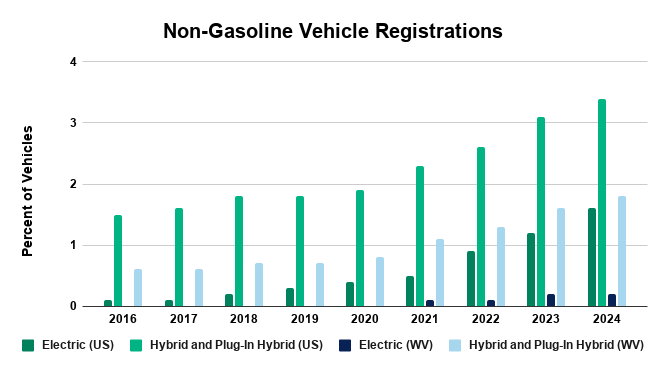
Based on data from the US Department of Energy. Gasoline-powered vehicles account for ~83-85% of registered vehicles in both the US and West Virginia.
It may also be difficult for some to charge EVs and PHEVs. Vehicle owners may charge at their homes, however many people do not have driveways or garages to do so, and therefore must rely on public charging stations. West Virginia joined the Mid-Atlantic Electrification Partnership (MAEP) with Maryland, Virginia, and DC in 2020. Through various funding sources, MAEP sought to support EV and PHEV infrastructure in the region. The project concluded in 2025. There are currently 221 public charging stations in West Virginia compared to 992 gas stations reported in 2021. Charging time varies depending on the charger and vehicle but can take between 30 minutes to several hours compared to filling a gas tank in a couple of minutes.
Registration Fees
Registration fees vary depending on the type of vehicle. Like other states, West Virginia imposes additional costs to register HEVs, PHEVS, and EVs. This is to supplement the revenue the state loses from motor fuel taxes. Fees collected for vehicle registration are allocated to the State Road Fund, which is used to repair and maintain roads and highways throughout the state.
Average motor fuel tax revenue is based on an average American driving 13,476 miles per year and the average vehicle driving 27.1 miles per gallon.
Vehicle Gasoline and Electricity Costs
There are both federal and state taxes imposed on gasoline. Federal tax is 18.4 cents per gallon of gasoline. West Virginia further imposes a state motor fuels tax of 35.7 cents per gallon, which is about 1 cent higher than the national average, though lower than the average state motor fuel tax in the region. Revenue from the motor fuel tax goes toward West Virginia’s State Road Fund and averages about $420 million per year.
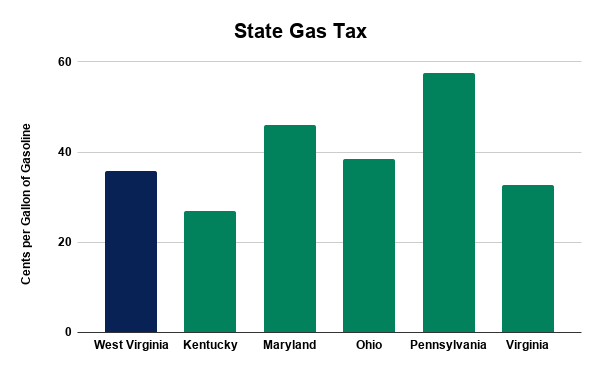
From West Virginia, Kentucky, Maryland, Ohio, Pennsylvania, and Virginia.
Charging costs at home depend on residential utility rates. American Electric Power (AEP), an electric company providing electricity to West Virginia and 10 other states, announced rates specific to PHEV and EV charging in West Virginia, Ohio, and Virginia based off of charging with a sub-meter. They offer two different rates depending on when charging occurs. Standard rates apply Monday-Friday from 6am-8pm, when the most energy is used during the day. Lower off-peak rates occur outside of those times and during the weekend. Based on an average American driving about 1,015 miles per month, the average EV would use about 338 kWh of electricity per month, which is about one-third of the amount of energy the average household uses per month.
State Policies
West Virginia could pursue tax incentives for purchasing HEVs, PHEVs, or EVs to offset their higher cost. This would be similar to 19 other states, including Pennsylvania, Maryland, and Virginia, that offer up to $7,500 to purchase an EV. Tax incentives for EVs could result in decreased state revenue. If EV purchases increased, the state could lose money that would be generated through motor fuel taxes, however this may be offset by the increased vehicle registration fees West Virginia already imposes.
An increase in electric vehicles would likely require additional charging infrastructure around the state. It is unclear who would fund public charging stations, though previous projects, including MAEP, received federal grants and funding from nonprofits and industry organizations. West Virginia could seek additional funding to construct more of this infrastructure. Increased demand for electricity to charge vehicles could also put a strain on West Virginia’s electric generation and transmission capabilities, requirements for which are already expected to grow.
The Legislature could adjust EV registration fees to match the revenue generated from the average West Virginia driver. Most states have additional yearly registration fees for hybrid or electric vehicles to compensate for the lack of motor fuel tax generated with these vehicles. West Virginia’s electric vehicle registration fee is greater than the average revenue generated from the motor fuel tax. The Legislature could decrease electric vehicle registration fees to match the motor fuel tax revenue. This would likely decrease fees generated from registering an electric vehicle for the state, though may incentivize car buyers to select an electric vehicle. The Legislature could alternatively increase the motor fuel tax so the average annual revenue generated per person from motor fuel taxes is equal to the EV registration fee. This would result in higher gas prices and would likely be unfavorable due to the recent increases in gas prices.
This Science and Technology Note was prepared by Nathan G. Burns, PhD, West Virginia Science & Technology Policy Fellow on behalf of the West Virginia Science and Technology Policy (WV STeP) Initiative. The WV STeP Initiative provides nonpartisan research and information to members of the West Virginia Legislature. This Note is intended for informational purposes only and does not indicate support or opposition to a particular bill or policy approach. Please contact info@wvstep.org for more information.