
Electric Transmission in West Virginia
Moving electricity from where it’s generated to a home or business requires transmission lines. West Virginia’s transmission region is experiencing a lack of transmission capacity, one factor contributing to rising electricity prices. This Science & Technology Note provides information on transmission capacity and planning in West Virginia, explains capacity expansion technologies, and analyzes legislative options to expand transmission capacity in West Virginia.
Updated April 24, 2026
Research Highlights
By 2035, PJM needs to grow its internal transmission capacity by 60% and its connections with external transmission grids by 500% to meet forecasted demand.
Advanced transmission technologies can expand existing transmission capacity relatively quickly and cheaply.
West Virginia introduced advanced transmission bills in 2026, but none became law.
Transmission Reliability & Capacity
More than 2500 GW of generation capacity across the nation is waiting to be connected to the grid, primarily because transmission capacity is lacking. Electric transmission moves power over long distances on high-voltage lines, while the electric distribution system moves power the short distance from a substation to individual consumers using low-voltage wires. Predictions from the US Department of Energy’s National Transmission Needs Study found that PJM, West Virginia’s regional transmission operator, will need to grow its internal transmission capacity by 60% and its connections with other transmission grids by 500% by 2035 to meet forecasted electricity demands. There are more than 80 needed projects in West Virginia currently listed in PJM’s 2025 Regional Transmission Expansion Plan (RTEP), compared with 4 in the 2019 RTEP. However, transmission line construction across the US has slowed. In the 2010s, nearly 2000 miles of transmission was built per year, while from 2020-2025, approximately 1100 miles were built yearly. While transmission capacity growth slowed, and existing infrastructure is aging, electricity demand has continued to grow.
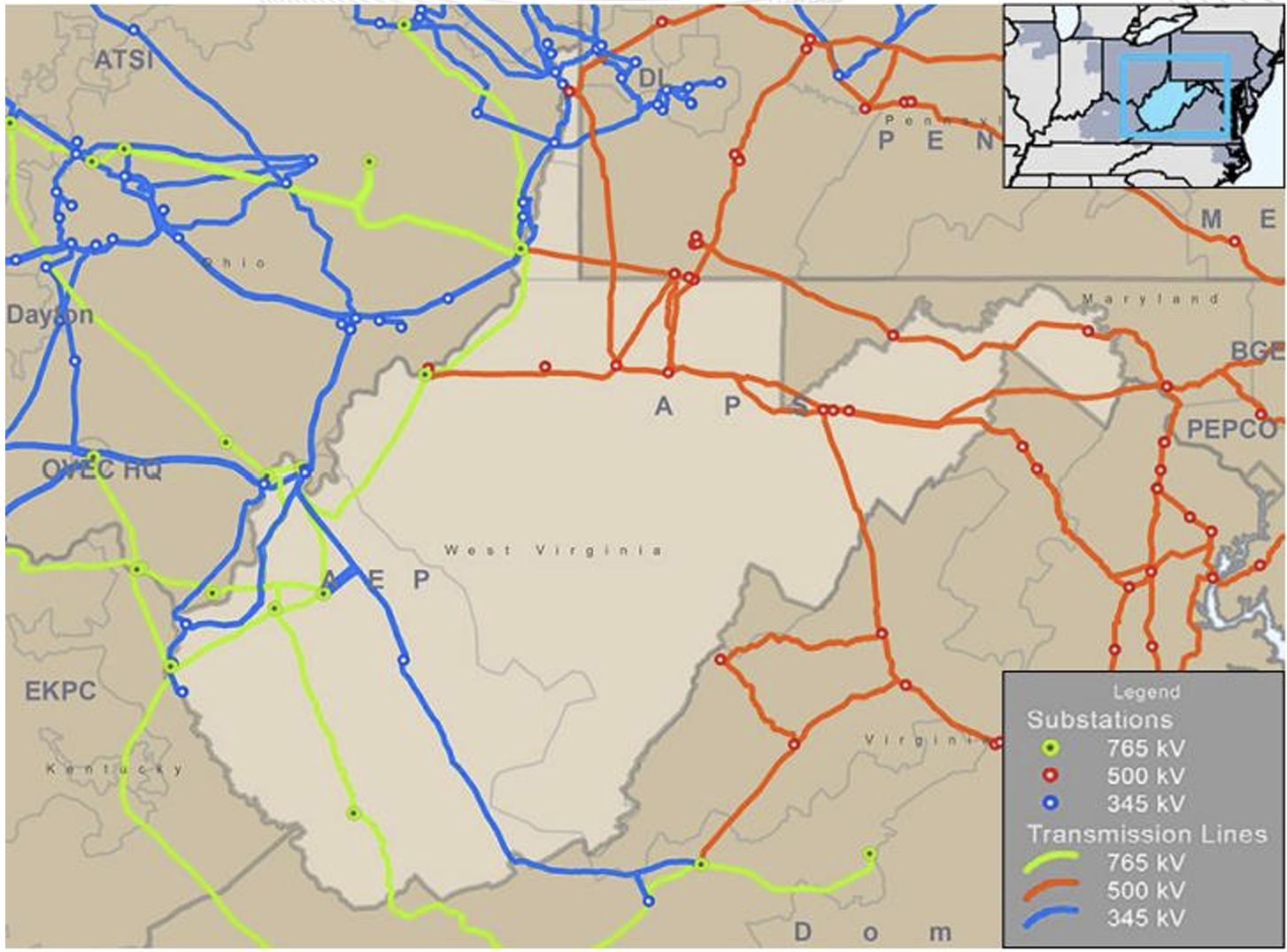
Map of transmission lines in West Virginia and surrounding region. Higher voltage transmission lines and substations can transfer more electricity. From PJM.
Grid congestion occurs when one area does not have enough transmission capacity to safely move the electricity that is being produced, often due to the physical limits of the lines. If one transmission line is at capacity, another generator that uses a different transmission line can be brought online to produce power. The need to bring online alternative generators in order to reduce congestion may result in the use of more expensive generation sources, increasing the price of electricity. In 2023, grid congestion resulted in an additional $1 billion in electricity costs for PJM customers. Much of the regional congestion is due to the increase in data centers. Grid congestion can also contribute to delays in new generation projects. If nearby transmission lines are already congested, bringing a new generation site online without also investing in new or upgraded transmission infrastructure can prevent the new site from being connected to protect existing transmission lines.
Several transmission lines in West Virginia are approaching safety limits due to overloading. The wider PJM region is projected to experience transmission overloads on 30-50 high-voltage transmission facilities and lines by 2028, prompting some of the projects laid out in the RTEP. Lines can handle temporary overloads, but long-term or repeated overload can result in faults in a line, leading to unexpected blackouts. To relieve these overloads, new transmission lines can be built, or advanced transmission technologies (ATTs) can increase existing capacity.
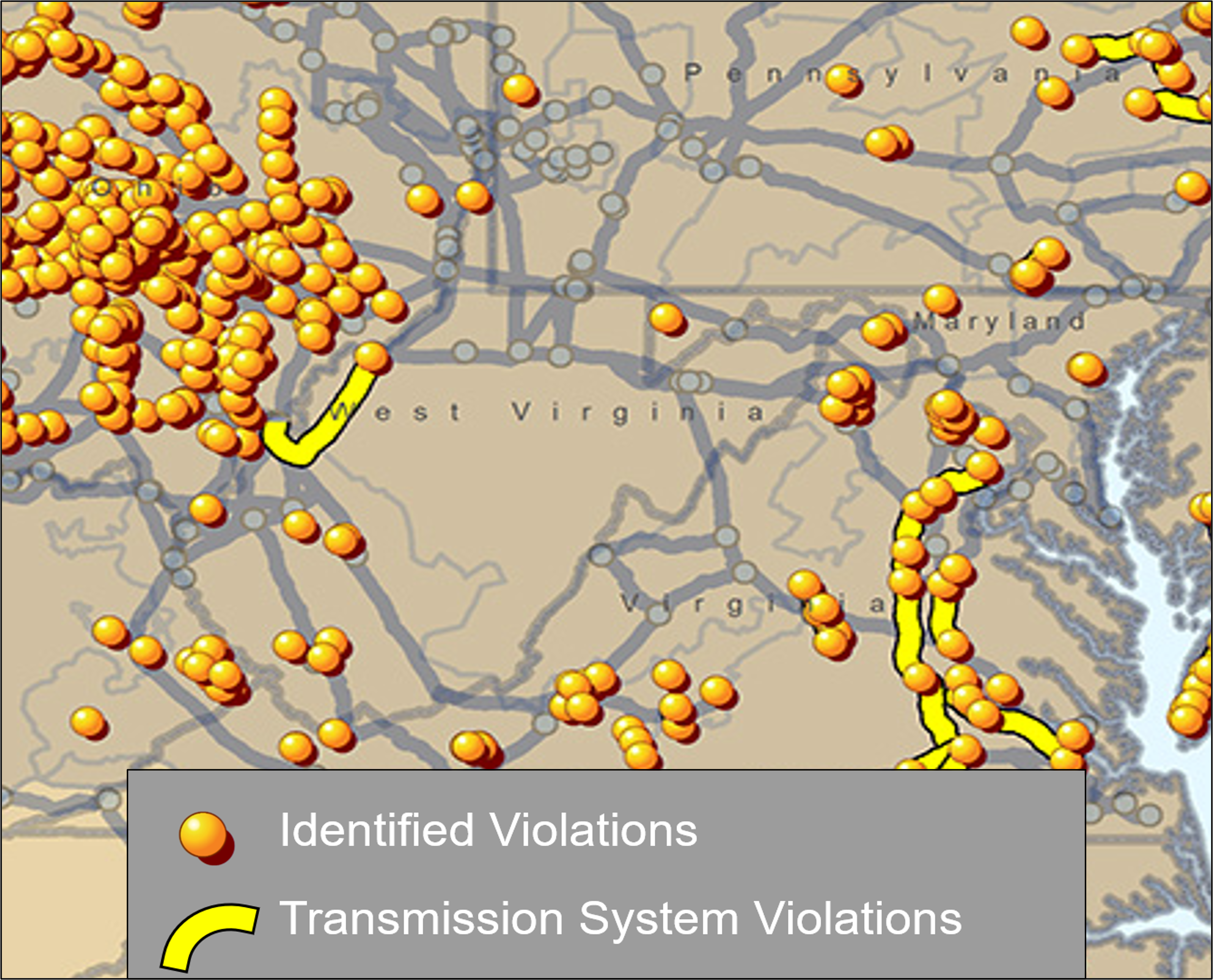
Map of PJM’s projected transmission system overloads in WV and the surrounding region by 2030. Identified Violations represent all faults that impair system reliability, while Transmission System Violations represent transmission system-specific reliability faults. From PJM 2025 RTEP.
Several transmission lines in West Virginia are approaching safety limits due to overloading. The wider PJM region is projected to experience transmission overloads on 30-50 high-voltage transmission facilities and lines by 2028, prompting some of the projects laid out in the RTEP. Lines can handle temporary overloads, but long-term or repeated overload can result in faults in a line, leading to unexpected blackouts. To relieve these overloads, new transmission lines can be built, or advanced transmission technologies (ATTs) can increase existing capacity.
Expanding Transmission Capacity
Building new transmission lines can be difficult due to complex US permitting requirements. A transmission project in the US takes an average of 8 years, while a similar project in China takes around 1.5 years, primarily due to differences in permitting requirements. Projects often experience public pushback due to sight lines and land loss, further complicating their construction. Supply chain issues also complicate projects. Procurement time for transmission supplies has doubled since 2021 due to increased demand, and prices have increased 75%.
There are several new technologies that can be used to increase transmission capacity without building entirely new infrastructure. Although initial installation of ATTs can be expensive, they often prove economically beneficial for consumers. In 2018, equipment designed to allow dynamic ratings was installed on a 25-mile section of PJM transmission line. In a 10-month period, PJM estimated over $15 million in congestion costs were saved, compared to a $500,000 cost to install the technology.
State ATT Policies
Many states are working to improve transmission capacity. One option states have utilized is to require analysis of the feasibility, cost, and timeline for implementing ATTs in their utilities’ long term planning process. West Virginia’s HB 4026 (2026) would have required utilities to include ATTs in their planning process, but the bill died in a conference committee in the final days of the session.
Some states, including Indiana, allow utility cost recovery for ATTs. West Virginia previously allowed cost recovery for these technologies, but the Public Service Commission rule allowing it was repealed in 2018. West Virginia HB 4379 would have allowed rate recovery for ATTs, but the bill did not make it out of committee. West Virginia could opt to reintroduce these bills in future sessions, or could attempt to rely on utility companies’ independent implementation of ATTs. If the bills passed, they could provide additional incentives for utilities to use ATTs, knowing they could recoup their costs. Alternatively, allowing utilities to independently install ATTs may result in fewer electric bill increases due to rate recovery.
This Science and Technology Note was prepared by Madison Flory, PhD, West Virginia Science & Technology Policy Fellow on behalf of the West Virginia Science and Technology Policy (WV STeP) Initiative. The WV STeP Initiative provides nonpartisan research and information to members of the West Virginia Legislature. This Note is intended for informational purposes only and does not indicate support or opposition to a particular bill or policy approach. Please contact info@wvstep.org for more information.