Unhoused Youth in West Virginia
Youth experiencing homelessness affects people all over the country, including in West Virginia, and the causes are varied. This Science and Technology Note explores rates and some causes of unhoused youth, as well as federal and state efforts to combat this.
Updated January 22, 2026
Research Highlights
West Virginia has a higher rate of unhoused youth than all surrounding states.
Many factors can contribute to youth homelessness including poverty, high housing prices, and family conflict.
The McKinney-Vento Act provides federal assistance to schools to help unhoused students.
West Virginia could revisit legislation to provide free ID documents to unhoused youth to help them obtain jobs and housing like other states.
Rates of Unhoused Youth
The US Department of Education (US ED) considers youth to be unhoused when they do not have a regular, fixed, and adequate (includes factors such as heat and electricity) nighttime residence. This includes those who are doubled up (staying at a friend or family member’s home) and those living in hotels/motels, campgrounds, or shelters. The rate of unhoused youth in West Virginia increased from 3.9% in 2019 to 5.4% (15,101 individuals) in 2025. Some believe that this is due to increased efforts to identify and report each case, though West Virginia’s rate is higher than all other states in the region and the US average. Youth homelessness leads to higher rates of school absenteeism and lower high school graduation rates compared to housed peers, and homelessness and poor education outcomes are correlated with higher rates of unemployment, crime, and poverty.
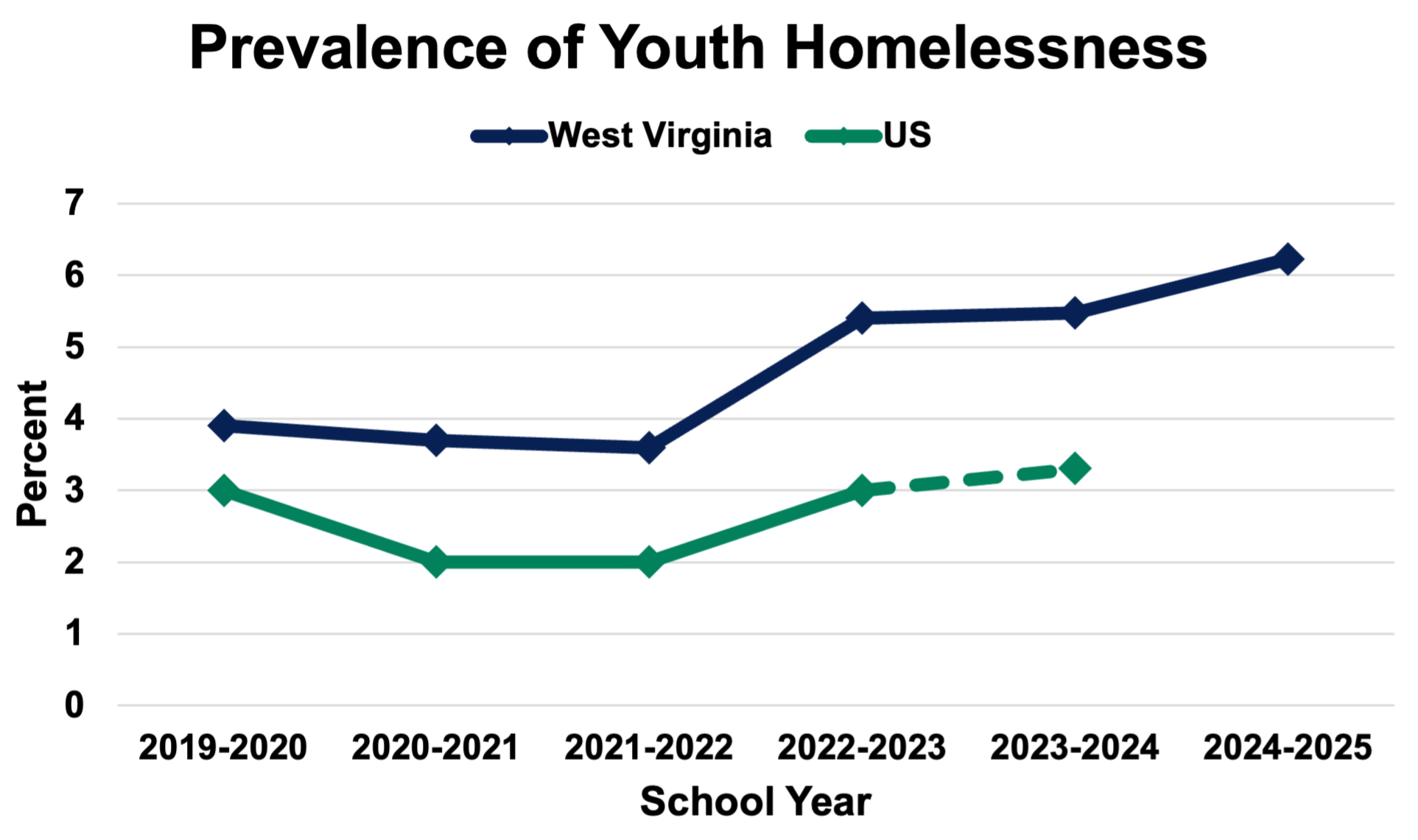
2019-2023 data based on data from SchoolHouse Connection. West Virginia data for school years 2023-2024 and 2024-2025 from WV Department of Education reports. US data for school year 2023-2024 (dashed line) extrapolated from US Department of Housing and Urban Development estimates.
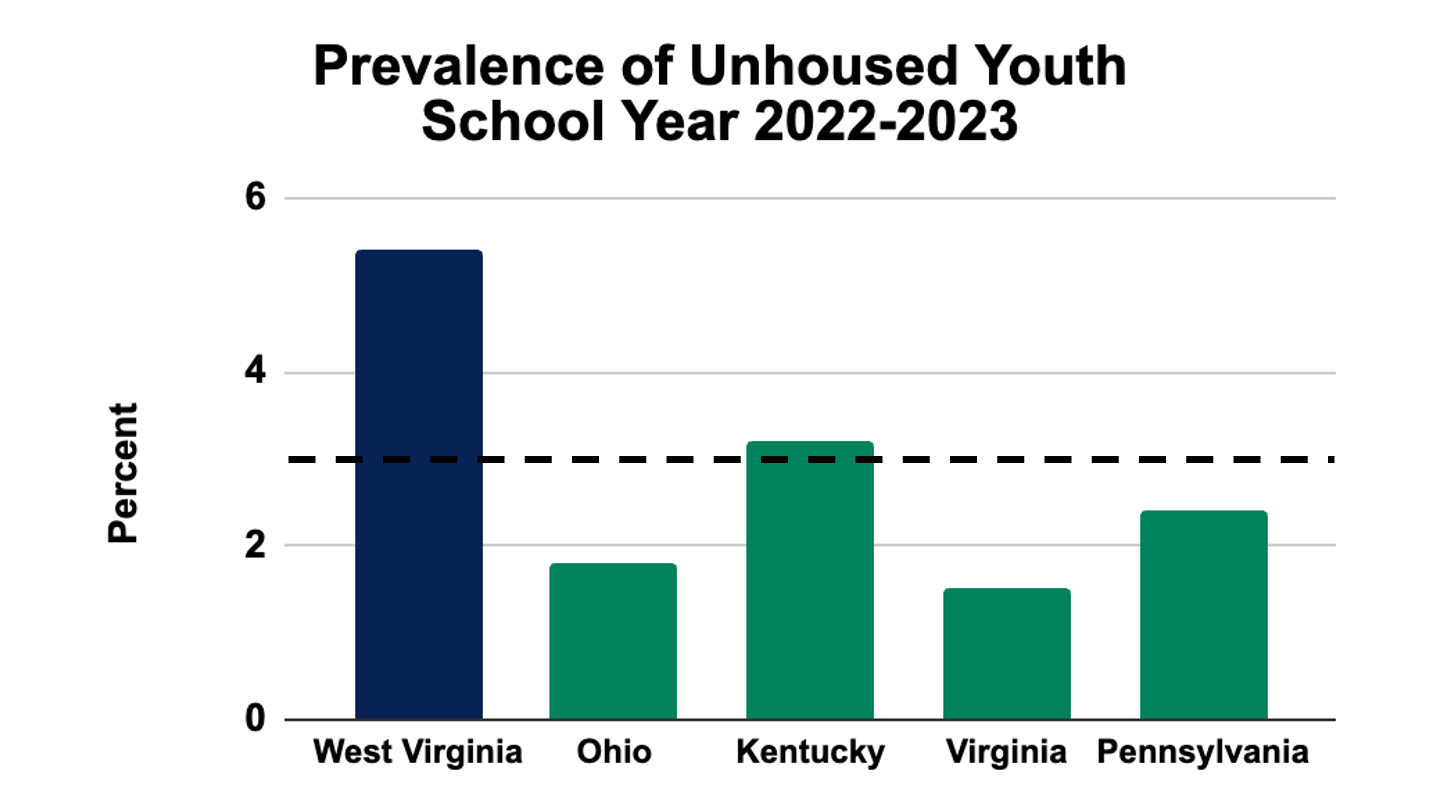
Dashed line indicates the average rate in the US. Based on data from SchoolHouse Connection.
Causes of Youth Homelessness
Youth homelessness is generally thought of as a multi-faceted issue. However, contributing factors likely include rising housing costs and increased financial instability that may lead to families who can no longer afford to remain in their homes.
An analysis from Chapin Hall, a children, youth, and families policy research center, found that there is not a difference in the prevalence of unhoused youth between urban and rural communities. They do indicate, though, that youth homelessness in rural communities is more likely to be hidden due to their sleeping outside or in cars. Unique rural challenges are also acknowledged, including being more disconnected from schools, job opportunities, and support systems.
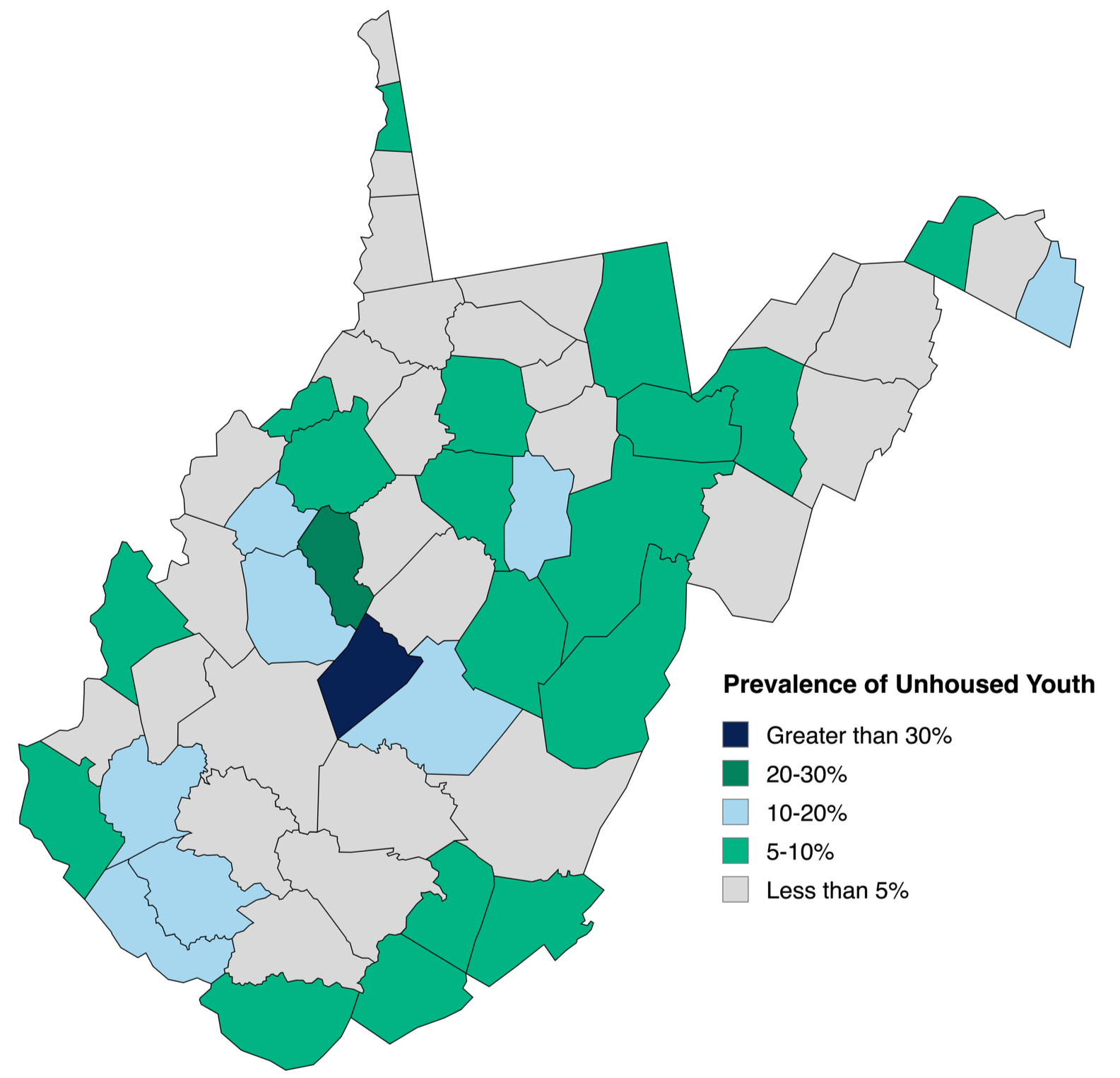
Based on data from SchoolHouse Connection.
Young people may choose to or be forced to leave their homes due to conflict. Some may run away from home because they are no longer comfortable living there due to abuse. While it is unclear how many of West Virginia’s youth leave home for this reason, the number of reported child mistreatment victims has decreased from about 6,700 in 2019 to about 4,850 in 2025.
Certain populations are over-represented in unhoused youth. Though 7% of youth identify as LGBTQ+, up to 40% of unhoused youth identify as such. One idea advocates recommend to decrease the number of unhoused LGBTQ+ youth includes ensuring there is inclusive and supportive mental health support for these individuals in schools and shelters. Another common group among unhoused youth is pregnant girls. Chapin Hall found that 10% of unhoused girls in the US under the age of 18 are pregnant, higher than the US average of 5.5%. Several girls indicated that becoming pregnant led to their experiencing homelessness after conflicts with their parents. West Virginia reported that 237 girls under 18 gave birth in 2021, though their housing status was not indicated. Advocates recommend increasing sexual education for youth and providing care for unhoused minor parents.
Federal Assistance for Unhoused Youth
The McKinney-Vento Act is administered by US ED to offer assistance providing rights and services to educate unhoused youth. This law requires each state to have a McKinney-Vento coordinator and each public school district to have a liaison. The district liaison identifies unhoused youth, including through outreach and coordination with other agencies. They also provide referrals for medical, dental, mental health, and housing services. All identified youth are required to be enrolled in school immediately, even without proper identification documents. The child may attend their original school, even if housing is found outside of district bounds, and the liaison arranges their transportation.
At the December 2025 Joint Committee on Children and Families, the Kanawha County Schools liaison indicated she can provide mattresses, bus passes, cell phones, and iPads with internet connectivity for students. Though each district has a liaison, they are often teachers unable to dedicate enough of their time to this work and may not be able to effectively assist unhoused youth. SB 214 (2025) sought to establish a dedicated homelessness coordinator in each county, but did not pass out of committee.
Funding for the McKinney-Vento Act is allocated to states by, which distribute funds to school districts. Schools receiving Title 1, Part A funding, which is allocated to schools with the highest percent of students from low-income families to help them meet academic standards, must also reserve some of that allocation to support Mckinney-Vento services. Over 350 schools in all 55 districts in West Virginia receive this type of funding.
State Legislation
There have been recent efforts on homelessness initiatives. Advocates cite getting an ID as a major hurdle, as it is required for jobs, housing, and benefit programs. Pennsylvania’s House recently approved waiving fees for ID cards or licenses for unhoused youth, and is awaiting Senate approval. Students without a permanent address would be able to use their school address on their documents. A similar bill was introduced in Ohio and is in committee. HB 2983 (2025) and SB 432 (2026) were bipartisan efforts in West Virginia seeking to waive fees for unhoused individuals to obtain an ID, driver license, or birth certificate, but did not pass out of committee. Currently, a West Virginia youth ID card is valid for 2 years and costs $10, while an adult ID or driver license is $15 for the first year and another $5 for each additional year. The legislature could revisit this legislation to provide free IDs for unhoused individuals. While the state would forfeit income normally generated by providing these documents, it would likely be nominal and benefits may be derived from providing IDs, like income taxes generated by individuals able to obtain work.
This Science and Technology Note was prepared by Nathan G. Burns, PhD, West Virginia Science & Technology Policy Fellow on behalf of the West Virginia Science and Technology Policy (WV STeP) Initiative. The WV STeP Initiative provides nonpartisan research and information to members of the West Virginia Legislature. This Note is intended for informational purposes only and does not indicate support or opposition to a particular bill or policy approach. Please contact info@wvstep.org for more information.
Addendum: Unhoused Youth Living Arrangements
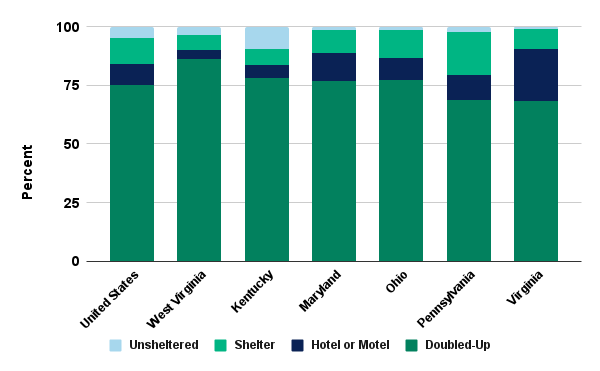
West Virginia has a higher percent of unhoused youth than all surrounding states and the US. Youth experiencing homelessness may be staying overnight in a variety of places. This Science and Technology Note Addendum follows-up on a previous Note and explores the breakdown of where unhoused youth in West Virginia and surrounding states reside.
Unsheltered- May be sleeping in vehicles, abandoned buildings, or outside
Shelter- Sleeping in a temporary living facility, often referred to as a homeless shelter
Hotel or Motel- Sleeping in a hotel or motel
Doubled-Up- Staying with friends or family, couchsurfing