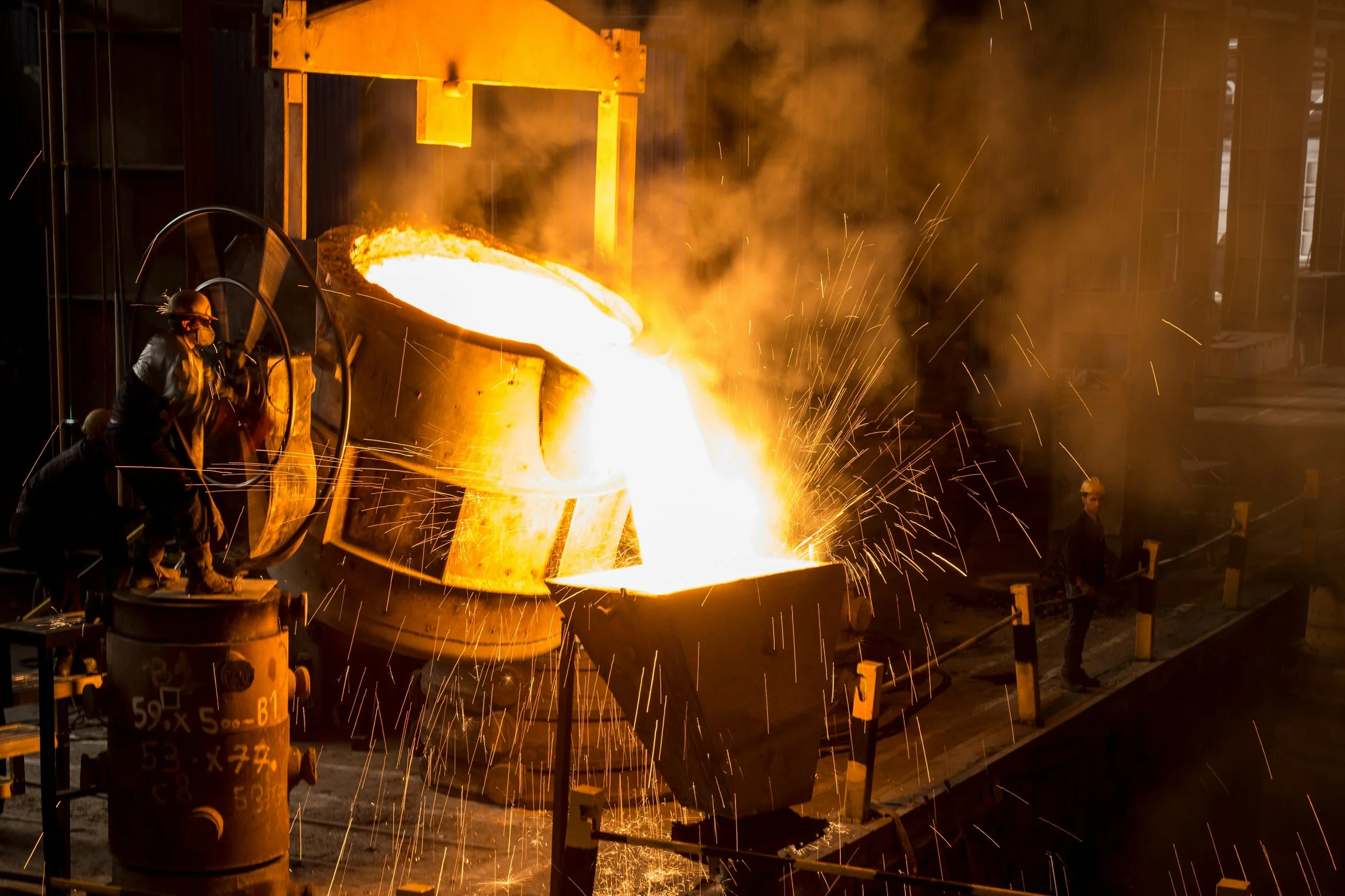
Steelmaking in West Virginia
Steel is an essential material that is versatile, durable, and recyclable. It is used in a wide variety of applications, from buildings to vehicles. Steelmaking in West Virginia has been decreasing in recent years due to increased foreign competition and the decline in manufacturing in the United States. This Science and Technology Note explores the current status of steelmaking, policies affecting the industry in West Virginia, and gives policy options from other states that West Virginia lawmakers could consider regarding the future of steelmaking in the state.
Updated November 16, 2026
Research Highlights
West Virginia’s steel industry has declined in recent years as part of a broader decline of U.S. steelmaking. The United States produced 117 million tons in 1975 compared to 82 million tons in 2025.
The state’s last conventional steel mill closed in 2024. Present-day steelmaking in West Virginia uses electric arc furnaces, a newer method that can recycle old scrap metal and reduce carbon dioxide (CO2) emissions.
West Virginia requires steel used in state construction projects to be made in the United States.
West Virginia has considered legislation to provide tax credits for steel manufacturers in the state and to encourage coke production from metallurgical coal for use in steelmaking.
Current Status of Steelmaking in WV
Steel production in the United States peaked in the 1970s and has since been in decline, largely due to competition from imported steel. The United States is the world’s third-largest producer of steel (82 million tons in 2025) after China (980 million tons) and India (160 million tons). While traditional steelmaking has declined in West Virginia, the state is receiving multibillion dollar investments to construct new steel mills in the state. Nucor has announced plans for a $4 billion steel mill just south of Point Pleasant in Apple Grove. Another announced project is the Commercial Metals facility in Berkeley County, which will produce steel used in highway construction, bridges, and industrial structures. Both of these projects will use electric arc furnaces to melt scrap metal for steelmaking.
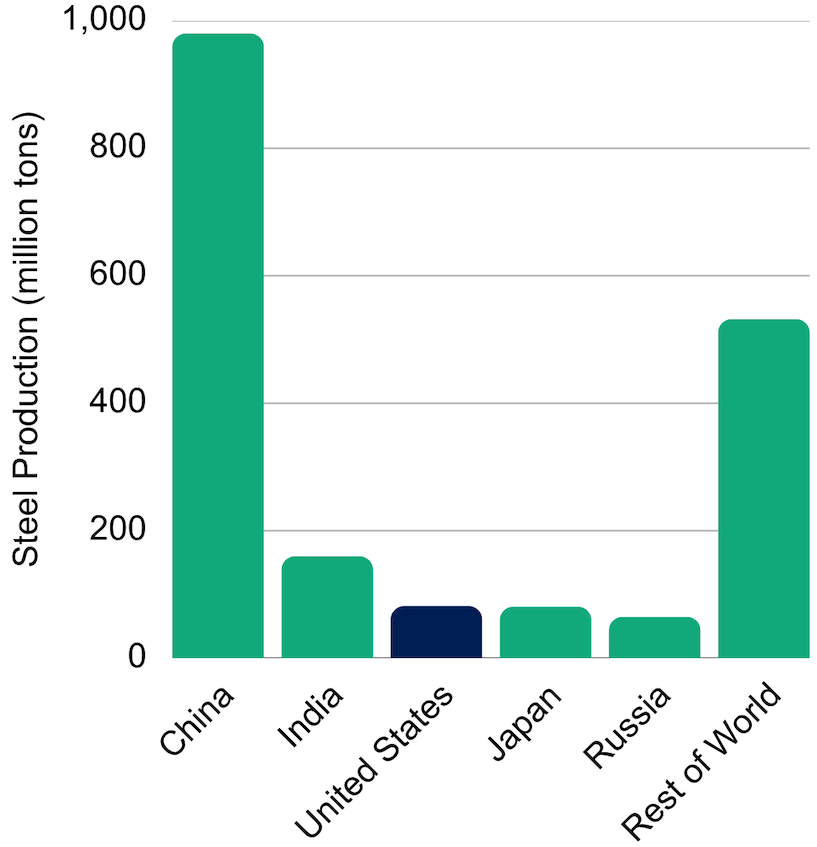
World steel production in 2025 (million tons). Source: USGS
While steel mills have historically relied on large blast furnaces to produce steel by burning coke and melting iron ore, West Virginia’s last traditional steel mill located in Weirton closed in 2024. West Virginia’s currently operating steel mills use newer electric arc furnace technology. Compared to traditional blast furnaces, electric arc furnaces do not require iron ore or coke made from metallurgical coal as fuel, instead using electricity to melt scrap metal. Electric arc furnaces can be smaller in size and do not have to be run continuously, which makes them more economical to operate compared to large blast furnace operations. Traditional blast furnaces require iron ore for operation. West Virginia’s iron ore deposits are small and difficult to access compared to the Lake Superior region and the state does not currently mine iron ore. This means that electric arc furnaces could allow for steelmaking without relying on raw materials imported from out of state or attempting to restart iron ore production, which could be expensive and impractical. However, some traditional steelmaking will still be needed.
Steel demand in the United States was 98 million tons and scrap metal output was 59.2 million tons in 2021, meaning that electric arc furnace steelmaking using scrap metal cannot yet replace traditional steelmaking using iron ore and metallurgical coal. This is likely to change in the future, with electric arc furnace steelmaking projected to increase from 70% to 90% of all U.S. steelmaking by 2040. Electric arc furnaces also produce significantly lower carbon dioxide (CO2) emissions, producing 0.69 tons of CO2 per ton of steel compared to 2.34 tons of CO2 per ton of steel in traditional blast furnaces. This means that electric arc furnace adoption could decrease CO2 emissions from steelmaking, which is responsible for 7-9% of global CO2 emissions.
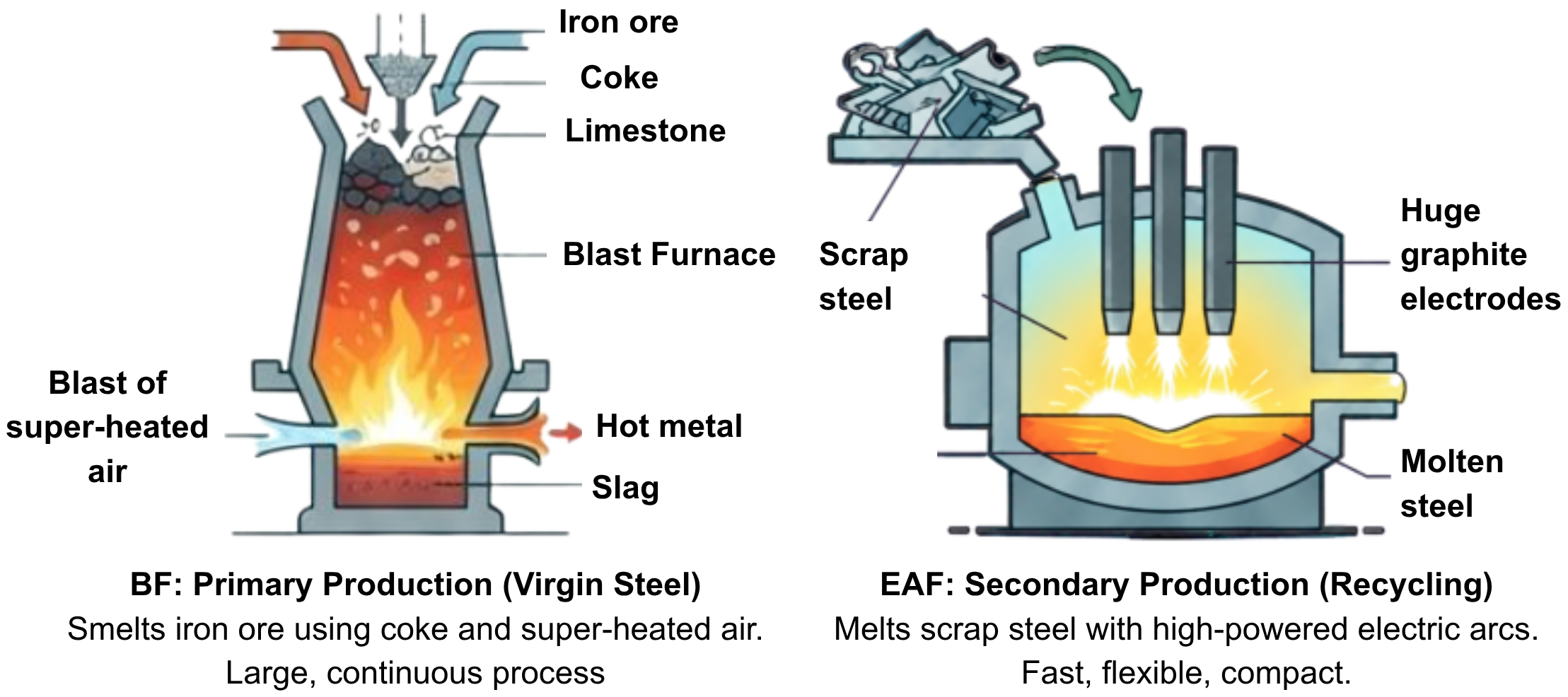
Comparison of traditional steelmaking using a blast furnace (left) with electric arc furnace steelmaking (right). Image source: KinTek Solution
Steelmaking Regulation in West Virginia
Current state policy encourages domestic steelmaking by requiring state construction and public works projects to use steel made in the United States. There are exemptions to this requirement if the cost of foreign steel does not exceed 10% of the total contract cost or $2,500, whichever is greater. In addition, foreign-made steel can be used if the price difference with domestic steel is more than 20% (30% if produced in a substantial labor surplus area).
From 1998-2002, West Virginia encouraged in-state steelmaking by giving companies a tax credit of $250 for each new job created at steelmaking facilities. West Virginia also had a Steel Futures Program from 1997 until its repeal in 2015. This program’s purpose was to provide financial and technical assistance to promote steelmaking employment and increased productivity in West Virginia. The Steel Futures Program also focused on workforce development through identifying and encouraging partnerships between state colleges and universities and the steel industry.
West Virginia lawmakers proposed the Affordable Electricity and Economic Growth Act of 2026 (HB 5038), which would have encouraged developing coke production plants for the production of steel throughout the state using metallurgical coal. Coke produced in West Virginia would be used to fuel conventional blast furnace steel mills, which West Virginia currently does not have. HB 4654, proposed in 2022, would have encouraged steelmaking in West Virginia by providing tax credits for companies who invested in manufacturing steel and steel products in-state. This would have reduced the severance and corporation net income taxes by 5% of the qualified manufacturing investment (over $2 million). Neither of these bills made it out of committee.
Policy Options from Other States
Options that the West Virginia Legislature could consider regarding steelmaking include providing tax incentives for new and existing steelmaking operations, clarifying the definition of domestic steel for use in state projects, and encouraging the adoption of new steelmaking technologies. West Virginia could consider defining the composition of steel made in West Virginia as in Pennsylvania HB 1749, which was proposed in 2025, and requires Pennsylvania steel to contain at least 75% of the cost of materials and supplies mined, produced, or manufactured in-state. Including similar language in future legislation could spur the development of West Virginia steelmaking, particularly if current regulations are updated to require the use of West Virginia steel for state projects.
Other states mainly address steelmaking under manufacturing incentives and “buy American” rules to spur domestic steelmaking. A recent example of this is in Iowa, where lawmakers are considering providing $1.4 billion in state tax breaks to a Minnesota-based company planning to build a $15 billion steel plant in southeast Iowa. Pennsylvania introduced the Fueling Opportunities for the Revitalization, Growth, and Efficiency of Steel (FORGES) Act in 2025. This bill was supported by the United Steelworkers Union and would have created tax exemptions for investments improving steelmaking facilities in the state of at least $50 million and that create at least 100 full-time equivalent jobs. This is similar to West Virginia’s tax credit that expired in 2002. West Virginia could consider re-introducing the tax credit or similar legislation on a case-by-case basis to entice companies to build steelmaking facilities and create jobs in the state.
West Virginia could also consider incentivizing increasing steel production using newer steelmaking technology that is potentially cheaper and easier to establish, including electric arc furnaces. The federal Advanced Industrial Facilities Deployment Program (part of the 2022 Inflation Reduction Act) made $5.8 million in financial assistance available through September 2026 for the purchase and installation of advanced industrial technology, which included steelmaking technologies. A similar incentive program offering grants to steel producers in West Virginia could spur the development of new, smaller steel mills in the state that are not as reliant on out-of-state supply chains for raw materials including iron ore, however, these would not use metallurgical coal mined in the state.
This Science and Technology Note was prepared by David Ramotowski, PhD, West Virginia Science & Technology Policy Fellow on behalf of the West Virginia Science and Technology Policy (WV STeP) Initiative. The WV STeP Initiative provides nonpartisan research and information to members of the West Virginia Legislature. This Note is intended for informational purposes only and does not indicate support or opposition to a particular bill or policy approach. Please contact info@wvstep.org for more information.