Metallurgical Coal in West Virginia
Coal for use in the steelmaking industry, known as metallurgical coal, or met coal is an important part of the overall coal industry in West Virginia. This type of coal is found in abundance in West Virginia, and is known as metallurgical coal, or met coal in contrast with thermal, or steam coal used for power generation. West Virginia is the top producer of met coal in the United States. This science and technology note explores the status of met coal in West Virginia, met coal-specific state and federal policy, and the future outlook of met coal production.
Updated August 20, 2026
Research Highlights
Met coal is an important component of the steelmaking industry.
West Virginia is the top producer of met coal in the United States, producing 58% of the nation’s supply.
West Virginia is currently considering legislation to expand production and decrease taxes on met coal.
Coal production for use in the steelmaking industry is an important part of the overall coal industry in West Virginia. This type of coal is found in abundance in West Virginia, and is known as metallurgical coal, or met coal in contrast with thermal, or steam coal used for power generation. Met coal is valued for its low ash and sulfur content compared to thermal coal and is useful for several aspects of the steelmaking process such as producing coke, which is needed to fuel blast furnaces and as an additive in the refining process to convert raw iron into steel. West Virginia is the top producer of met coal in the United States.
What is Metallurgical “Met” Coal?
Coal is found in abundance in West Virginia and is recognized as an integral part of the economic and social fabric of the state. Coal comes in several different types, or ranks, based on its chemical properties including energy content and carbon percentage. The majority of met coal is bituminous coal, which is the second-highest rank of coal after anthracite. Coal is also divided into grades, or categories for specific uses, defined by the United States Geological Survey as being determined by the sulfur content and amount and type of ash. Met coal typically has less than 1% sulfur and less than 8% ash. Because of these requirements, suitable met coal costs more and is harder to find than thermal coal, which may be from a lower grade.
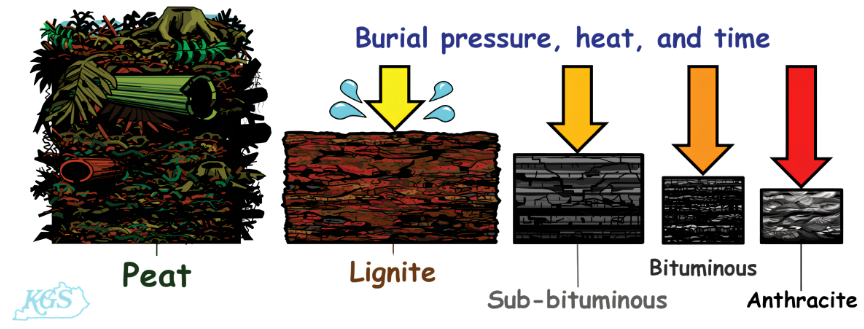
Ranks of coal ordered from least to most energy-dense (lignite to anthracite). From University of Kentucky.
According to the 2024 United States Energy Information Administration Annual Report, West Virginia is the nation’s second-highest coal producer after Wyoming. However, coal from Wyoming is subbituminous and is exclusively used as thermal coal. All West Virginia coal is bituminous and more suitable for use as met coal. In particular, coal from southern West Virginia is a low-volatile bituminous coal with a lower sulfur and ash content. Six states (WV, AL, VA, PA, KY, MD) produced met coal in 2024: West Virginia (58% of US production), Alabama (16%), Virginia (13%), Pennsylvania (10%), Kentucky (2%), and Maryland (1%).
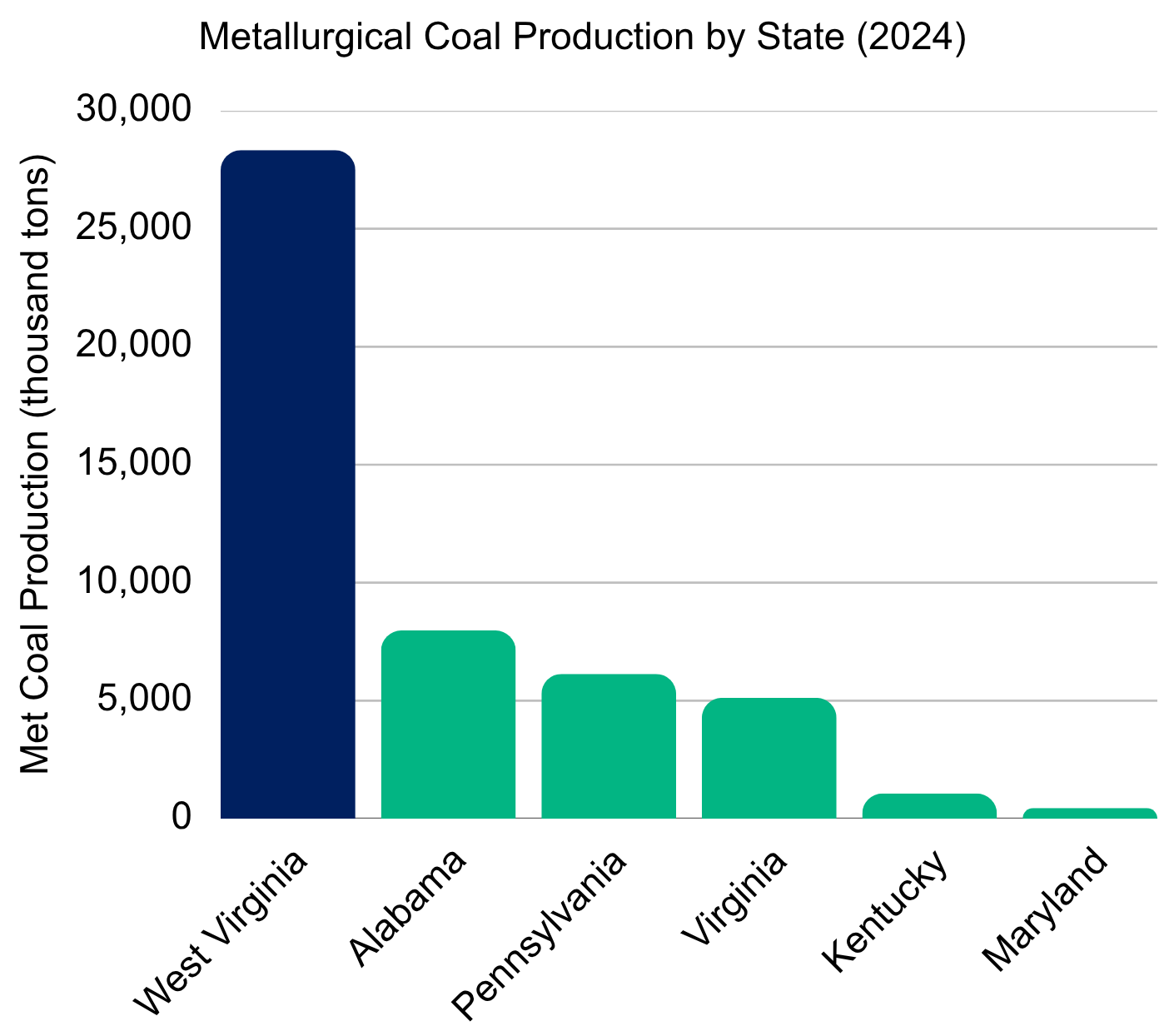
Source: EIA
Status of Met Coal in West Virginia
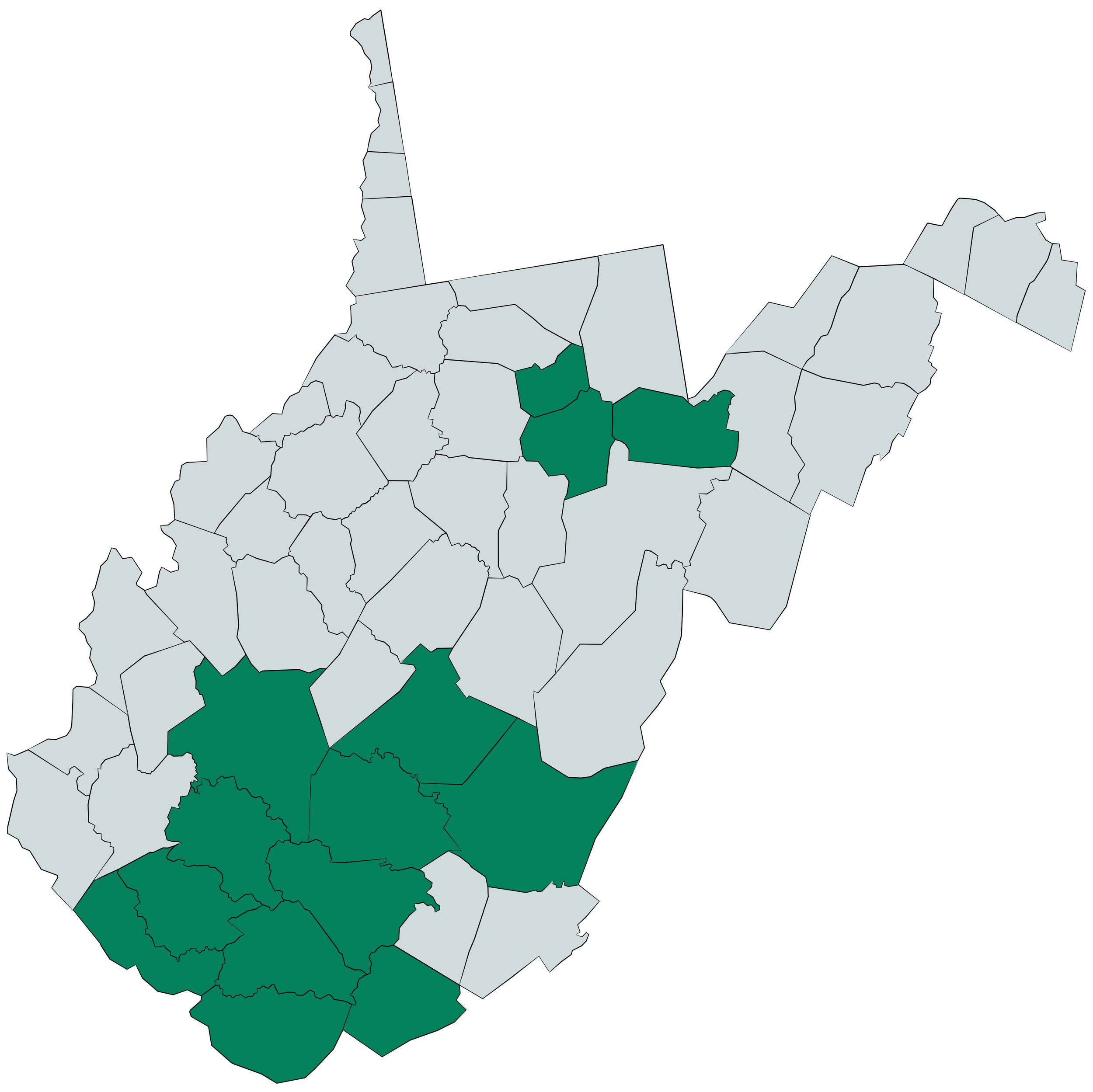
There are currently 164 active coal mines in West Virginia, primarily in southern West Virginia. All West Virginia mines produce bituminous coal, with 36% of West Virginia coal production (28,331,000 tons) being met coal. According to a report published by West Virginia University in 2023, the top met coal producing counties in West Virginia (more than 2 million tons) were Logan, Wyoming, McDowell, Raleigh, and Fayette in southern West Virginia, and Taylor in northern West Virginia. Met coal was estimated to have a broad economic impact in the state, being responsible for $9.6 billion in total economic impact and approximately $550 million in tax revenue. Nationwide, West Virginia met coal production was estimated to be responsible for $195.6 billion in output , 577,500 jobs , and $5.9 billion in tax revenue. 66% of met coal produced in West Virginia is exported for use in steelmaking and other related industries. Since 2017, overall coal mining jobs in West Virginia have remained stable at between 12,000 and 13,000 jobs except for a decrease in 2020-2021, likely related to the COVID-19 pandemic. The share of met coal jobs versus thermal coal jobs is increasing, with met coal accounting for 57% of coal mining jobs in West Virginia in 2024 versus 51% in 2017.
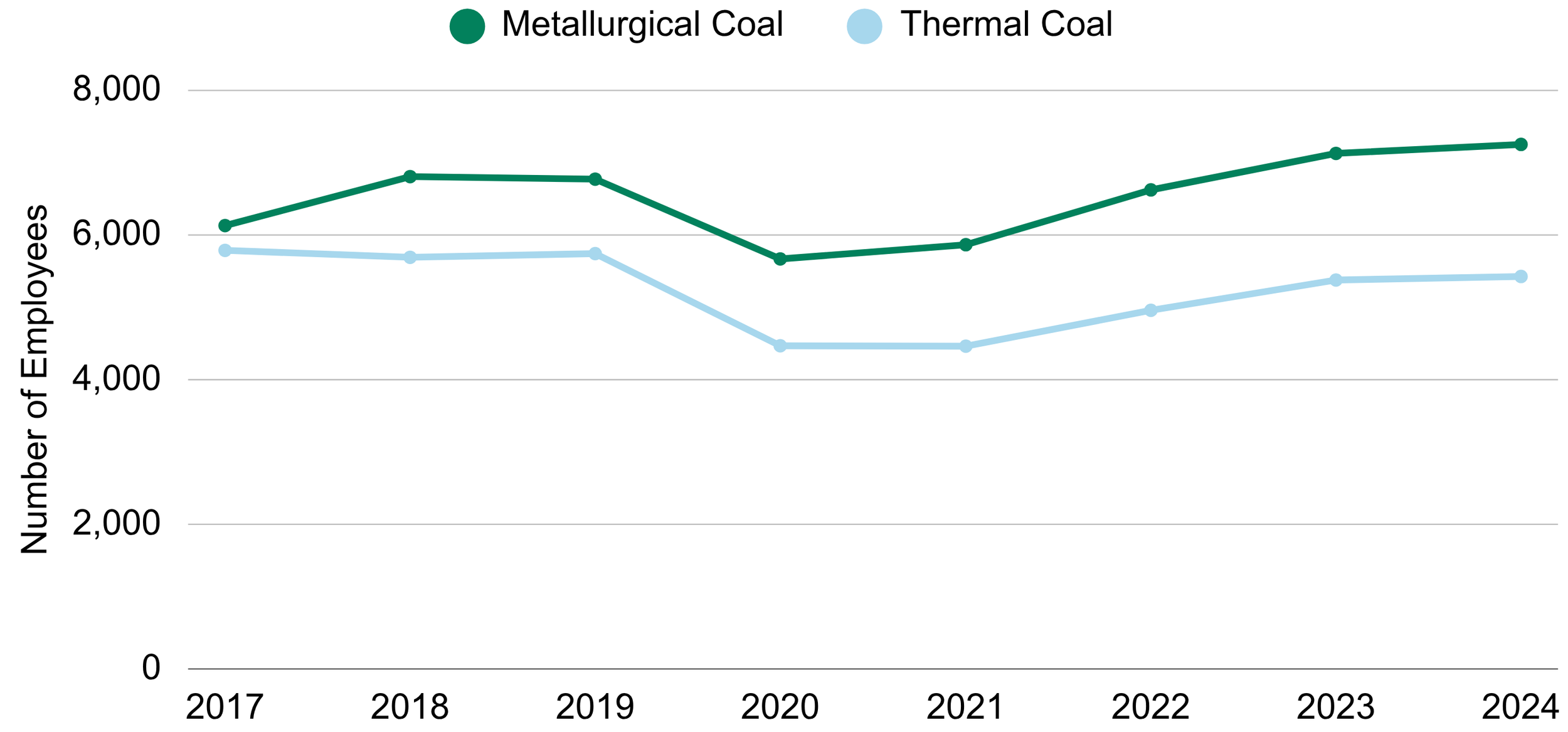
Average number of met vs. thermal coal mining employees in West Virginia from 2017-2024. From EIA.
Met Coal Legislation
The West Virginia Legislature considered policies in the 2026 legislative session to encourage production of met coal and to more evenly distribute production across the state. The Affordable Energy and Economic Growth Act of 2026 (SB 424) would have directed the Division of Economic Development to identify four suitable locations for met coal production. To diversify production across the state, two locations would have been north of Interstate 64, and two would have been south of the interstate, with no more than 60% of future sites allowed to be on one side of I-64. The West Virginia Legislature also considered the Severance and Business Privilege Tax Act (HB 5687), which would have encouraged met coal production by reducing the tax on the gross value of metallurgical coal from 4.5% in 2026-27 to 4% from 2027-28, and 3.5% for 2028 and beyond.
At the federal level, met coal production is also being encouraged. H.R.1, known as “The One Big Beautiful Bill Act”, passed by Congress in 2025 specifically exempted met coal from a planned phase-out of the Advanced Manufacturing Production Credit program for applicable critical minerals produced after 2030. Met coal was given a 2.5% production credit. In West Virginia, the Bureau of Land Management (BLM) is considering an application for a proposed coal lease at R.D. Bailey Lake in Mingo and Wyoming Counties. The plan is projected to make about 4.55 million tons of met coal available for mining and would allow for expansion of current met coal mines into federally controlled mineral deposits while limiting surface land disturbance to two acres, according to the BLM.
Future Outlook
The US Energy Information Administration’s 2026 Annual Energy Outlook forecasts coal consumption in the United States from 2025 to 2050. Consumption of thermal coal is projected to sharply decrease by 77% from 2025 to 2032 and then gradually decline to near zero in the late 2040s. On the other hand, met coal consumption is projected to increase by 7% by 2027 and then gradually decline over the next 25 years, falling back to current consumption levels by 2030 and ultimately declining by 39% from 2025 to 2050. While overall coal consumption is projected to decrease across all sectors, the decline in met coal consumption is not forecasted to be as severe, likely due to a lack of materials that can replace it in the steelmaking process.
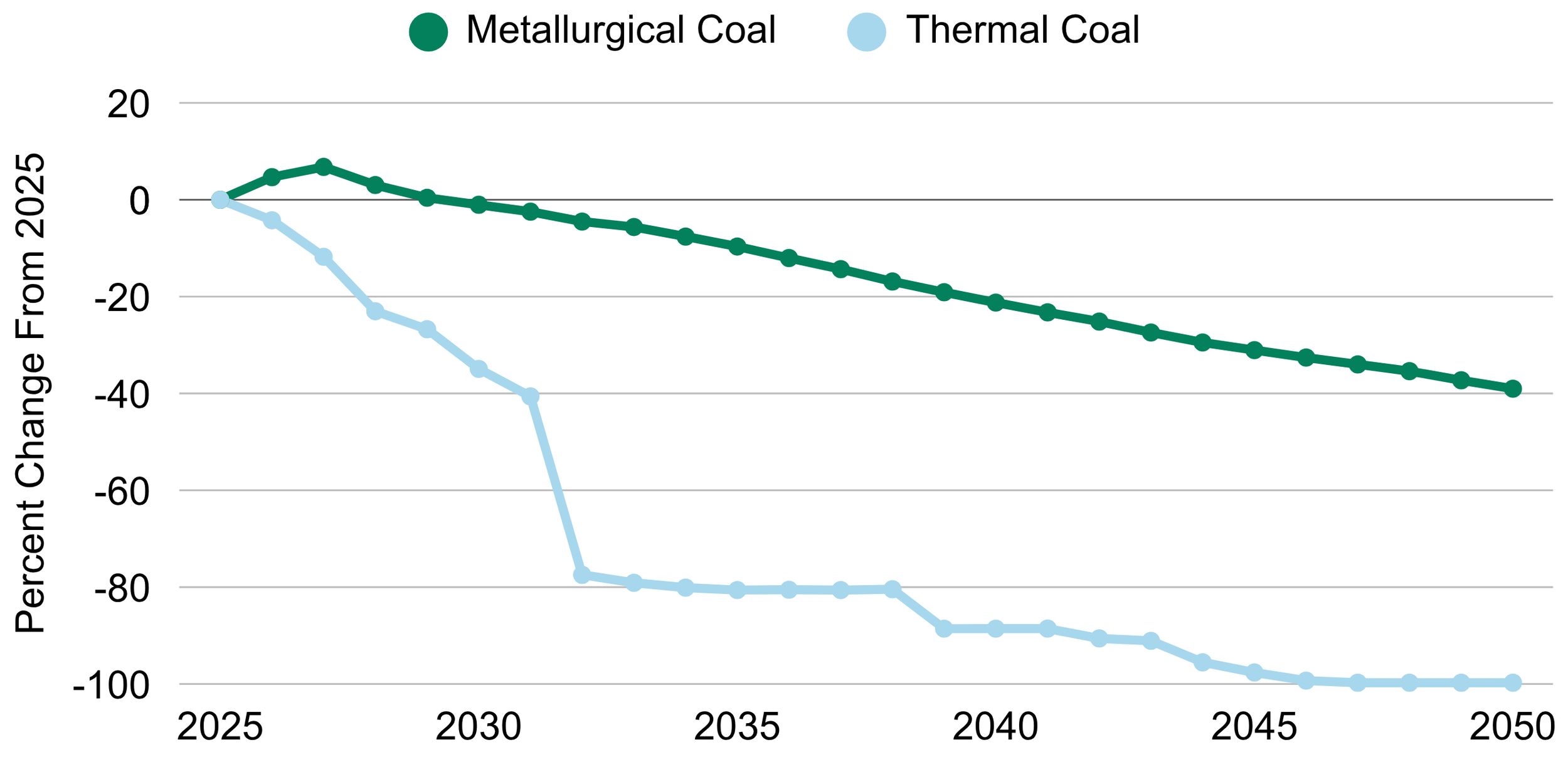
Projected outlook of thermal and met coal consumption in the United States from 2025 to 2050. From EIA.
This Science and Technology Note was prepared by David Ramotowski, PhD, West Virginia Science & Technology Policy Fellow on behalf of the West Virginia Science and Technology Policy (WV STeP) Initiative. The WV STeP Initiative provides nonpartisan research and information to members of the West Virginia Legislature. This Note is intended for informational purposes only and does not indicate support or opposition to a particular bill or policy approach. Please contact info@wvstep.org for more information.