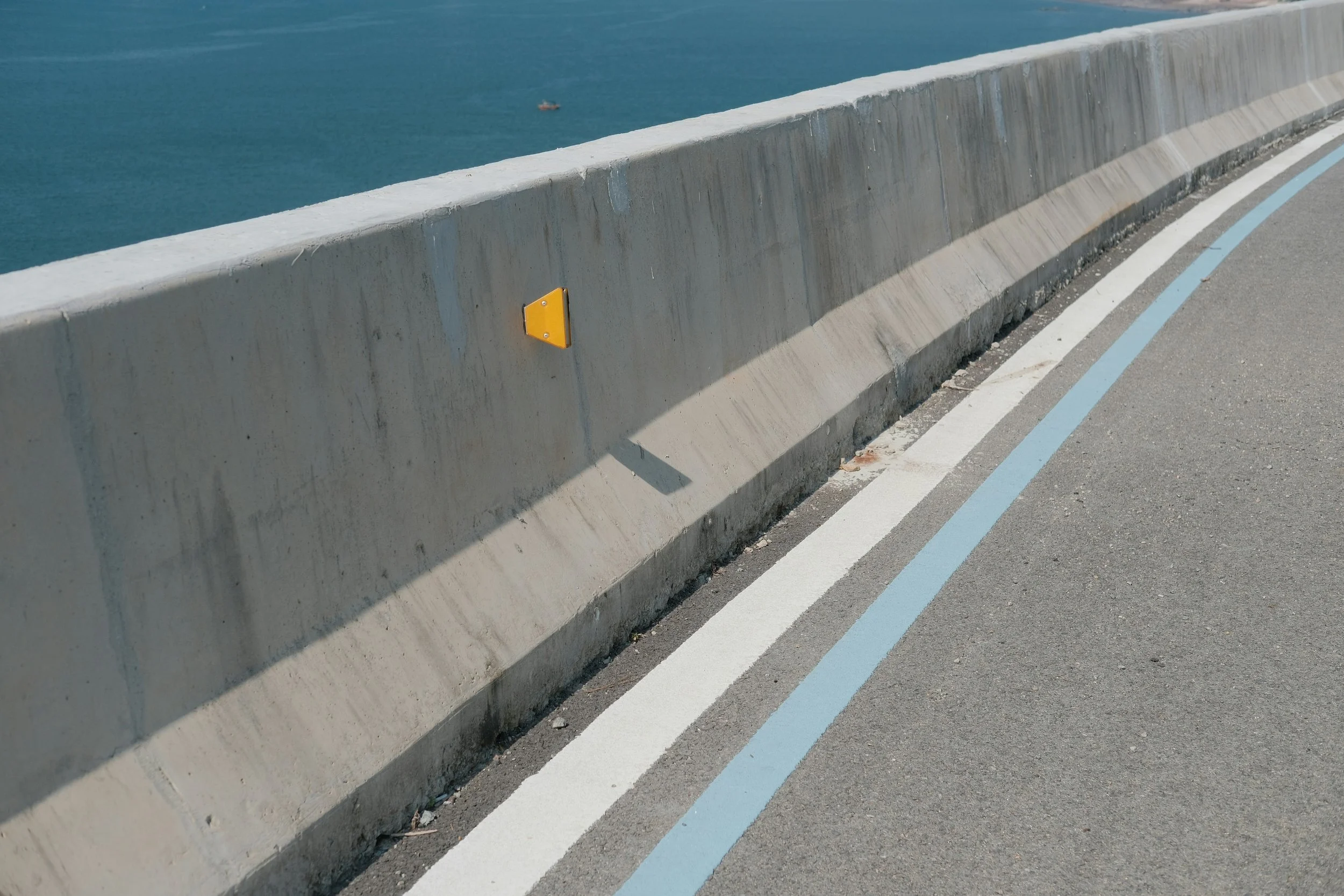
Interstate Highway Barriers in West Virginia
Barriers and guardrails on West Virginia’s elevated interstate highways have recently come under scrutiny due to a spate of accidents involving vehicles going over or nearly going over barriers on elevated interstates in the Charleston area. This Science and Technology Note explains the latest federal standards for interstate highway barrier construction and maintenance and discusses policy options that the West Virginia Legislature could consider regarding barriers on the state’s interstate highway system, potentially preventing future accidents and loss of life.
Updated October 1, 2026
Research Highlights
West Virginia’s major interstate highways were built prior to the latest federal safety standards.
Federal highway construction standards adopted in 2016 mandate installing flexible, crash tested barriers for all new highway construction, but do not mandate replacing old, noncompliant barriers.
The West Virginia Department of Transportation has been directed to investigate barrier improvements due to a number of recent accidents on elevated interstates.
Texas lawmakers have designated funds specifically to study and implement barrier construction and replacement.
Current Interstate Barrier Standards
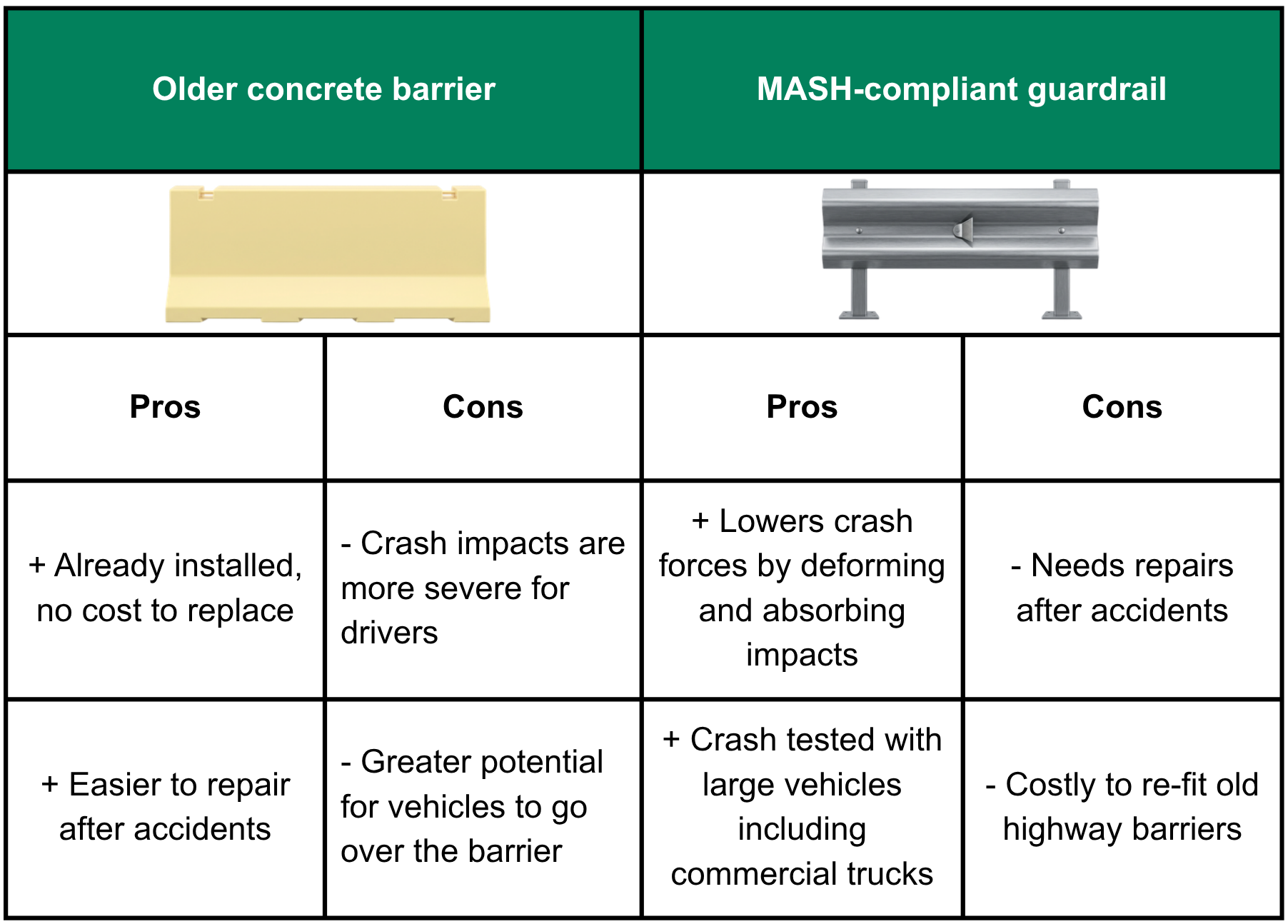
The current federal standard for interstate highway barrier construction, the Manual for Assessing Safety Hardware (MASH), was adopted in 2016. This standard applies to all barriers on national and interstate highways in West Virginia. MASH-compliant guardrails are designed to reduce crash severity by flexing and absorbing impact energy. These barriers allow vehicles to be redirected along the barrier rather than breaking through, vaulting over, or rebounding into traffic. MASH-compliant barriers are designed and tested for larger modern vehicles. Trucks and SUVs made up 66% of new production in 2024 compared to 45% in 2016. The West Virginia Division of Highways currently lists eight approved guardrail manufacturers that produce MASH-compliant guardrails to be used for new construction projects or complete replacement of existing barriers.
West Virginia’s interstate highways were completed decades before federal MASH standards were adopted. Rigid concrete barriers were frequently used along West Virginia’s elevated interstate highways. These older barriers were not crash-tested using larger vehicles travelling at highway speeds. The MASH Implementation plan encourages, but does not require, replacement of noncompliant barriers. Installing MASH-compliant barriers is currently mandatory for new capital construction projects, full replacements of an entire road section, and when existing barriers are damaged beyond repair.
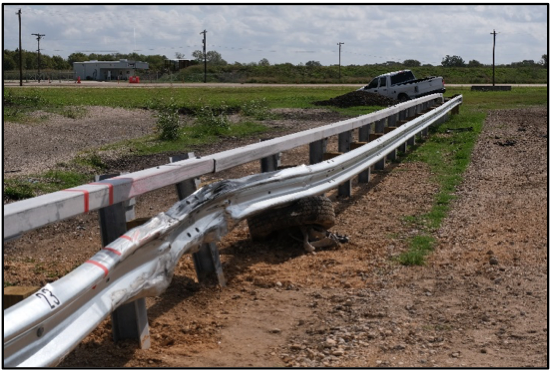
Example of a deformed guardrail following a collision. Source: Texas A&M Transportation Institute
[1] Testimony from Todd Rumbaugh, Secretary of WV DOT, to the Joint Legislative Oversight Commission Hearing on Department of Transportation Accountability on September 15, 2026
State Action on Interstate Barriers
In a statement provided to WSAZ following several accidents on elevated interstates in Charleston, Governor Morrisey directed the West Virginia Department of Transportation to identify reasonable measures that can make elevated sections of interstate in the state safer. The West Virginia Division of Highways stated that it will determine additional countermeasures that could be taken following completion of crash investigations. The division plans to install high-friction surfaces on elevated highway shoulders in Charleston in the fall of 2026. This aims to slow vehicles before they would impact the barrier, which would decrease impact forces in a crash. According to the Secretary of the West Virginia Department of Transportation, the department plans to preserve the 32-inch barriers on the elevated interstates in Charleston, as raising them to 42 inches would not be feasible.1 West Virginia’s approach of delegating investigative authority to the Division of Highways mirrors approaches taken in other states that have largely delegated authority to their departments of transportation or equivalents.
Policy Options
Tennessee lawmakers passed the Hannah Eimers Memorial Tennessee Roadside Safety Hardware Act in 2022, mandating that any new barrier types have been crash tested by the Federal Highway Administration before they can be installed. Similar guardrail-testing language was included in the federal Infrastructure Investment and Jobs Act in 2021. This is similar to the West Virginia Division of Highways revised standards, which require that guardrail systems on interstate highways meet MASH standards and have an eligibility letter from the Federal Highway Administration before they can be used. While older barriers were grandfathered into the MASH standards, the West Virginia Legislature could consider requiring all barriers to be MASH-compliant and tested. However, this would likely require additional state funding to be directed to the Department of Transportation. The standard federal share is 90% of the total cost for a project on the interstate highway system, meaning that West Virginia would still need to fund the remaining 10%. West Virginia could choose to apply for a 100% federal share, however, only a limited number of projects are eligible.
While no states have passed legislation explicitly mandating the replacement of all guardrails and barriers on interstate highways with MASH-compliant ones, state legislatures have directed their departments of transportation to fund studies on the subject. In 2017, Texas required the Texas Department of Transportation to conduct a study regarding the inspection, maintenance and repair of guardrails on state highways. The study involved crash testing existing barriers with an 80,000 lb tractor trailer van to assess whether they were MASH-compliant or needed to be replaced. The Texas Department of Transportation also worked with researchers at Texas A&M to develop a new type of MASH-compliant guardrail for Texas highways. The West Virginia Legislature could consider funding a similar study. The study results could be used to identify high-risk areas where replacing barriers could be most impactful.
State funding for studies and potential infrastructure improvements would likely come from the State Road Fund, which is funded through federal reimbursements (47% of estimated collections in FY2027), registration fees (7%), sales (privilege; 16%), motor fuel tax (21%), litter (<1%), and miscellaneous sources (9%). According to the Secretary of the West Virginia Department of Transportation [1], West Virginia would have to raise the money for any new construction before being able to receive any federal reimbursements. West Virginia could consider raising fees or taxes to raise additional funds for barrier replacement, however, this would likely be unpopular with motorists. As drivers of larger and heavier vehicles such as EVs and commercial trucks would see a greater benefit from new MASH-compliant interstate highway barriers, raising registration fees on these classes of vehicles could be an option.
In addition to the initial capital cost required to replace noncompliant interstate highway barriers with MASH-compliant ones, newer barriers can cost more to maintain. This is because after an accident, damaged and deformed barriers need to be repaired or replaced. West Virginia invoices drivers found to be at fault for accidents that damage state infrastructure. However, taxpayers would still be responsible for repairs in cases where no drivers are found at fault.
This Science and Technology Note was prepared by David Ramotowski, PhD, West Virginia Science & Technology Policy Fellow on behalf of the West Virginia Science and Technology Policy (WV STeP) Initiative. The WV STeP Initiative provides nonpartisan research and information to members of the West Virginia Legislature. This Note is intended for informational purposes only and does not indicate support or opposition to a particular bill or policy approach. Please contact info@wvstep.org for more information.