Firefighter PFAS Exposure in West Virginia
Firefighters can encounter PFAS, man-made “forever chemicals”, through firefighting foam, protective gear, smoke and soot, and fire-station contamination. This Science & Technology note examines potential health effects, current West Virginia policy, and approaches states are using to monitor and reduce firefighter PFAS exposure.
Updated October 1, 2026
Research Highlights
Firefighters can encounter PFAS through multiple occupational sources, including firefighting foam, protective equipment, smoke and soot, and contaminated work environments.
West Virginia restricts the use of PFAS-containing foam outside specified circumstances, while continuing to allow emergency firefighting use and controlled training or testing.
States are using different approaches to understand or reduce exposure, including PFAS-containing foam restrictions, changes to protective equipment, and firefighter blood-testing programs.
Firefighters can encounter per- and polyfluoroalkyl substances (PFAS) through firefighting foam, protective gear, smoke and soot, and PFAS contamination within fire stations. PFAS are a type of synthetic chemicals that break down slowly and remain in the environment and human body. Studies found elevated levels of PFAS in firefighters’ blood compared to the general population. This Science & Technology Note examines PFAS exposure within firefighter populations, evidence on their potential health effects, and approaches to reducing PFAS exposure.
How Are Firefighters Exposed to PFAS?
Firefighters’ occupational exposure to PFAS can occur through aqueous film-forming foam (AFFF), a firefighting foam used to suppress fires involving flammable liquids. Common household products like carpet contain PFAS which is released when burned. According to a 2026 note, some turnout gear, the protective clothing worn by firefighters, contains PFAS due to its resistance to heat, water, and oil. PFAS is also in fire-station dust, where contaminated gear, fire debris, and past foam use may contribute to exposure. Studies have found higher blood levels of some PFAS among firefighters compared with the general population. However, PFAS are also present in drinking water, food, household products and dust.
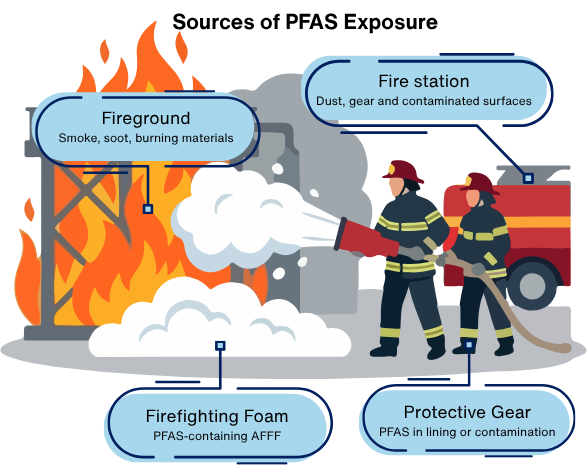
Firefighters may encounter PFAS through firefighting foam, protective gear, smoke and soot at the fireground, and contamination within fire stations. Adapted from NIOSH; PFAS Exchange
PFAS and Firefighter Health
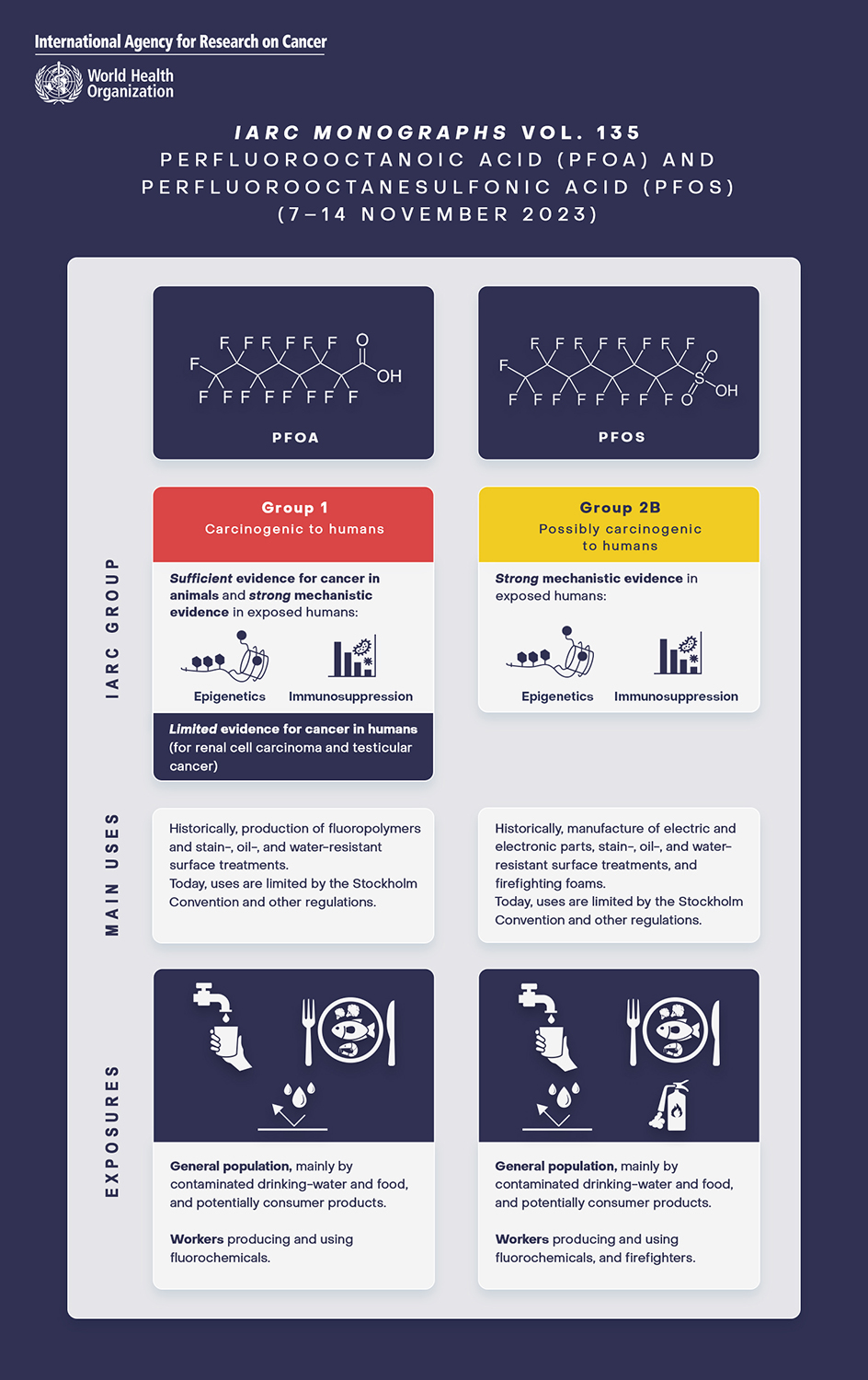
Research has associated exposure to certain PFAS with higher cholesterol, reduced immune response to some vaccines, changes in liver function, pregnancy-related high blood pressure, lower birth weight, and kidney and testicular cancers. The International Agency for Research on Cancer (IARC) classified PFOA as carcinogenic, or cancer causing, and PFOS as possibly carcinogenic. These classifications do not mean that PFAS-containing foam or gear causes every condition observed among firefighters. Firefighters encounter many harmful substances and it can be difficult to determine how much PFAS contributes to a firefighter’s overall health risk. Similarly, detecting PFAS in the blood indicates exposure, but does not establish that PFAS caused a current or future health condition. The National Institute for Occupational Safety and Health (NIOSH) continues to study occupational exposures to PFAS and potential health impacts.
Reducing Exposure and Transitioning Away from PFAS Foam
PFAS are one of many potentially harmful substances firefighters encounter, and their contribution to firefighters’ overall cancer and health risks remains uncertain. NIOSH recommends reducing exposure where practical, including limiting unnecessary contact with PFAS-containing foam and contaminated gear, cleaning gear and skin at the scene, bagging contaminated gear for transport, and keeping gear out of station living and office areas.
PFAS-free foams and protective materials have been developed and evaluated as alternatives. Another response to PFAS threats is biomonitoring, or measuring chemicals in people's bodies to better understand exposure. Biomonitoring cannot by itself identify where exposure occurred or predict whether an individual will develop a health condition, but it can help identify exposure patterns across groups of firefighters.
State Policies on PFAS Exposure
Currently, 16 states have enacted legislation regulating PFAS-containing foam. Policies include restrictions on the use or discharge of PFAS-containing foam, foam inventories and take-back or disposal programs, and reporting requirements when PFAS-containing foams are used. Some states like Connecticut and Massachusetts are also addressing other PFAS sources by banning its use in protective gear.
Indiana established a firefighter PFAS blood-testing pilot through an initial $200,000 state appropriation and a dedicated fund that can receive further public or private funding. The program has tested 316 firefighters so far and paired blood tests with questions about foam use, protective gear, station practices, firefighting tasks, and decontamination protocols. The study found that more frequent PFAS-containing foam use and contact with firefighting gear were associated with higher PFAS levels, while more frequent gear cleaning was associated with lower levels. The study could not determine that these activities caused the observed PFAS levels and suggested additional testing and research, standardized PFAS biomonitoring, transitioning away from PFAS-containing foam, improving decontamination, and separating clean living areas from contaminated gear.
West Virginia law currently focuses primarily on PFAS-containing firefighting foam. Under WV Code §29-3-5g, PFAS-containing foam may be used for emergency firefighting or fire prevention. Its use for training or equipment testing is permitted only at facilities with measures to contain, store, treat, and dispose of the foam to prevent uncontrolled releases into the environment. The law does not prohibit the manufacture, sale, or distribution of PFAS-containing foam. State law requires the State Fire Commission to identify a method for disposing of used or accumulated AFFF, but implementation remains ongoing. As of April 2026, the State Fire Marshal reported that the Commission was still awaiting cost estimates from disposal vendors.
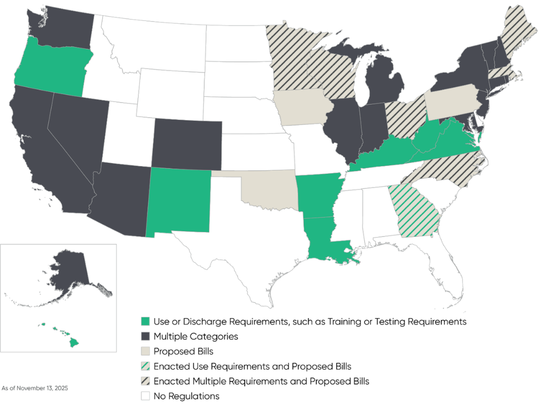
State policies include restrictions on foam use or discharge, disposal and take-back programs, reporting requirements, and restrictions on PFAS-containing protective equipment. “Multiple categories” indicates that a state has enacted policies in more than one of these areas; striped states also had proposed legislation as of November 2025. Source: BCLP Law.
Considerations for West Virginia
West Virginia’s existing foam restrictions provide a foundation for reducing PFAS exposure, but the broader evidence suggests that firefighting foam is only one potential source of occupational exposure. One option for the state is to focus on exposure prevention, including managing legacy AFFF, supporting transitions to PFAS-free foam where appropriate, and strengthening practices for cleaning and separating contaminated gear and station living spaces. Another approach is to first gather West Virginia-specific exposure data. The state has experience using blood testing and surveillance to monitor environmental exposures through its Childhood Lead Poisoning Prevention Program.
An Indiana-style pilot could draw on existing state experience with laboratory reporting and environmental-health surveillance, while recognizing that PFAS blood levels do not have the same established clinical interpretation as blood lead levels. PFAS blood testing is currently more useful for understanding exposure patterns across groups than for predicting an individual's health risk. Additional research is needed to establish standardized testing methods, clinically meaningful blood levels, and whether medical actions based on those levels improve health outcomes. Implementation costs and capacity could differ among departments, particularly because most West Virginia fire departments are volunteer or mostly volunteer.
This Science and Technology Note was prepared by Anika Zaman, PhD, West Virginia Science & Technology Policy Fellow on behalf of the West Virginia Science and Technology Policy (WV STeP) Initiative. The WV STeP Initiative provides nonpartisan research and information to members of the West Virginia Legislature. This Note is intended for informational purposes only and does not indicate support or opposition to a particular bill or policy approach. Please contact info@wvstep.org for more information.