
Tobacco Prevention and Cessation Programs in West Virginia
Tobacco use remains common in West Virginia and contributes to substantial health and economic costs. This Science & Technology Note examines tobacco use, cessation strategies, current state resources, and approaches other states use to fund prevention and cessation programs.
Updated August 31, 2026
Research Highlights
West Virginia has one of the highest adult smoking rates and the second-highest rate of tobacco-associated cancer.
In WV, smoking causes approximately 4,300 deaths, contributes to 37.8% of cancer deaths and results in $1.17 billion in annual tobacco-related healthcare costs annually.
West Virginia spends 5.6% of CDC-recommended funding levels for tobacco prevention and cessation.
States use different funding structures to balance tobacco-control funding with legislative flexibility.
Use of tobacco products including cigarettes, e-cigarettes, and smokeless tobacco, contributes to cancer, respiratory disease, cardiovascular disease, and other health conditions. West Virginia has one of the highest rates of tobacco use in the country, contributing to thousands of preventable deaths and more than $1 billion in healthcare costs annually. This Science & Technology Note reviews tobacco use and cessation in West Virginia, and approaches other states use to fund prevention cessation programs.
Tobacco Use & Impacts
Tobacco use is a leading cause of preventable disease and death. 21% of West Virginian adults smoke cigarettes while 9.3% use electronic tobacco products and 8% use smokeless tobacco. Cigarette smoking causes an estimated 4,300 deaths annually in West Virginia and accounts for approximately 38%of cancer deaths. Smoking also results in an estimated $1.17 billion in annual direct healthcare costs, including $298 million in Medicaid expenditures, and an additional $2.4 billion in lost productivity. Smoking-related costs amount to an estimated $1,574 in state and federal taxes per West Virginia household each year.
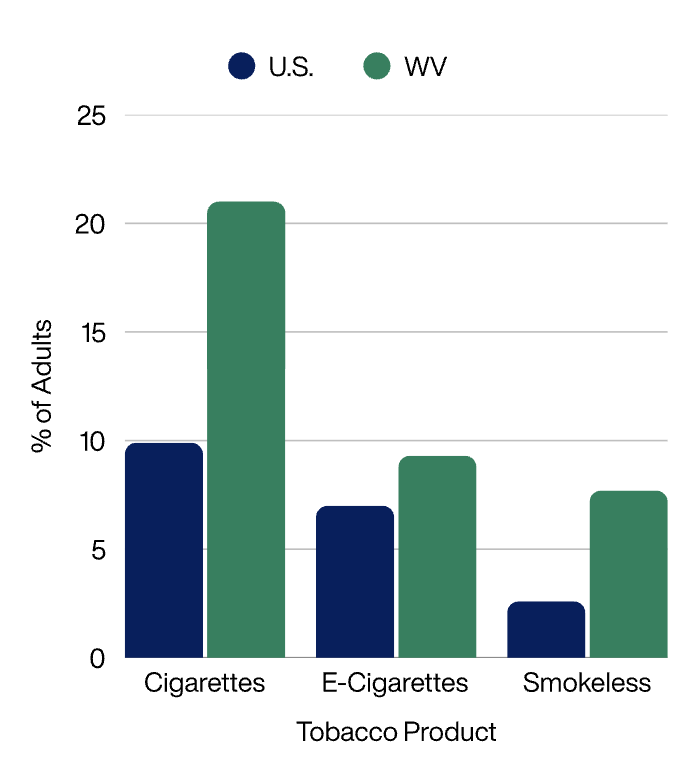
Adult use of cigarettes, e-cigarettes, and smokeless tobacco is higher in West Virginia than national estimates. Estimates are from the WV Division of Tobacco Prevention and Public Health Alert in NEJM Evidence.
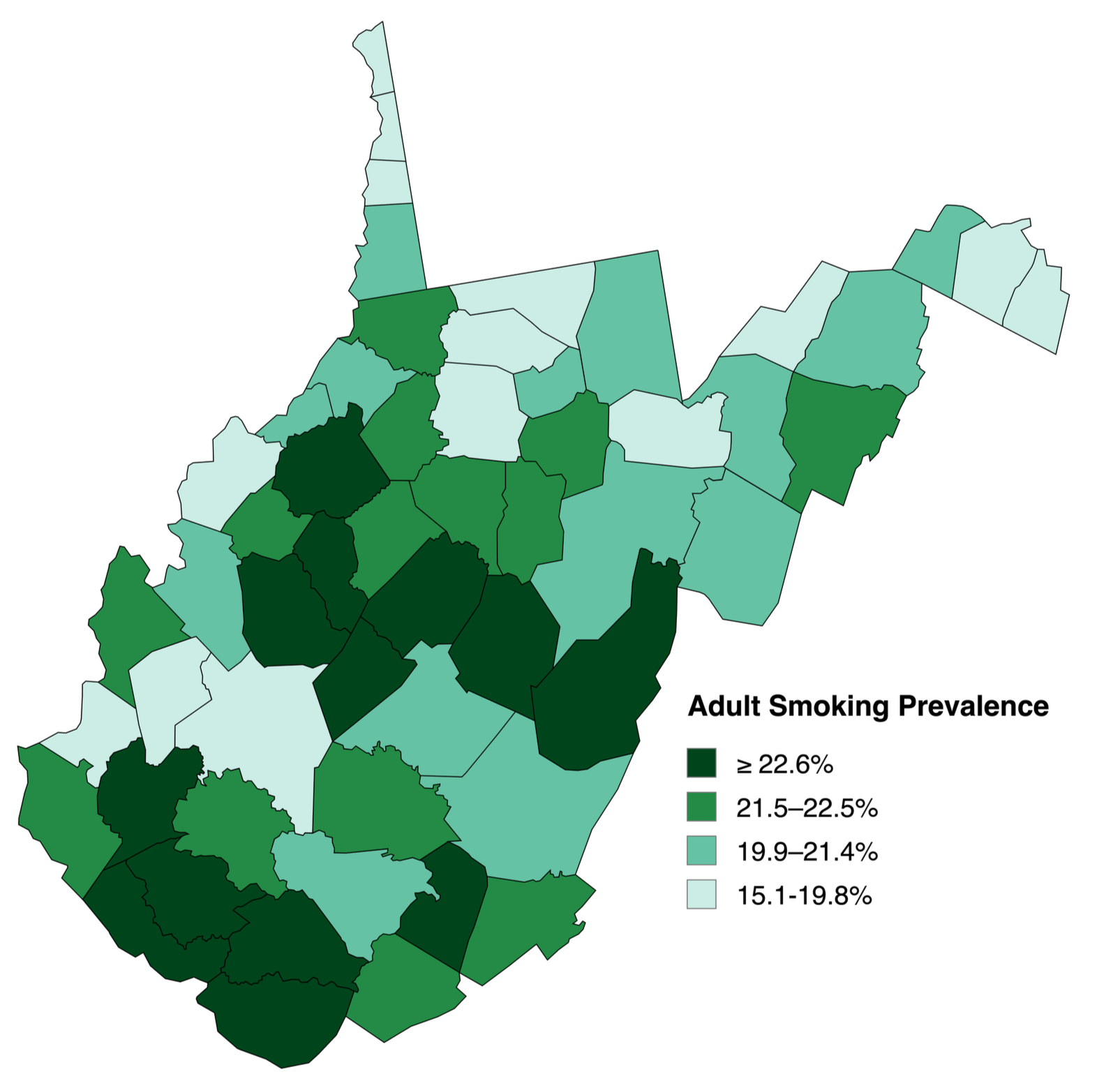
Prevalence of cigarette smoking among adults by West Virginia county. Data from CDC PLACES 2025.
Current Tobacco Cessation Resources
Evidence-based cessation treatment includes behavioral counseling and seven FDA-approved medications: bupropion, varenicline, and nicotine replacement therapy (NRT) such as the nicotine patch, gum, lozenge, inhaler, and nasal spray. These treatments reduce nicotine withdrawal symptoms and cravings or alter the brain's response to nicotine. West Virginia Medicaid covers these options, but it does not meet all criteria for comprehensive cessation coverage. Additionally, the state's comparatively high use of smokeless tobacco requires consideration.
The West Virginia Tobacco Quitline provides free counseling and NRT to eligible residents. An evaluation from WVU found that 32.7–33.1% of participants reported quitting tobacco at six-month follow-up, which is comparable to quit rates reported by other state quitlines. The Spit It Out – West Virginia Project addresses smokeless tobacco use through education and cessation workshops. 18% of participants reported quitting tobacco within the previous six months and all respondents reported reducing their tobacco use. Despite this, barriers to cessation remain, including limited state funding, aggressive tobacco marketing, lack of awareness of insurance coverage, cost-sharing and prior authorization requirements, and limitations on eligibility for some cessation medications.
Funding for Tobacco-Control Programs
West Virginia receives approximately $232.4 million annually from tobacco settlement payments and tobacco taxes combined, while providing $306,209 in state funding for tobacco prevention and cessation in FY2026. The state previously divided settlement payments between the Tobacco Settlement Fund and the Tobacco Settlement Medical Trust Fund, which preserves the principal while using investment earnings for health-related purposes. The remainder of the trust fund was transferred to the Revenue Shortfall Reserve-Part B.
Examples from Other States
Oklahoma established the Tobacco Settlement Endowment Trust (TSET) through constitutional amendment in 2000. The state deposits 75% of each tobacco settlement payment into the protected endowment. The principal is invested and only investment earnings are used to support tobacco prevention, cessation, research, and other health initiatives. TSET is estimated to have prevented 42,000 deaths and $1.24 billion in direct medical costs. Because the funding mechanism is constitutionally protected, it provides greater long-term stability but limits legislative discretion over the dedicated settlement revenue.
In Washington, tobacco settlement payments are deposited into a Tobacco Settlement Account and state law allows transfers into a dedicated Tobacco Prevention and Control Account. Expenditures remain subject to legislative appropriation. Following implementation of the state’s tobacco-control program, adult and youth smoking rates fell, and each $1 invested was estimated to save $5 in healthcare costs. Unlike Oklahoma's endowment, the statutory structure preserves greater legislative flexibility, but funding can change through subsequent budget decisions, as occurred following the 2008 recession.
Indiana established a Tobacco Use Prevention Trust Fund through state law in 2000. The fund can receive tobacco settlement distributions, appropriations, grants, donations, investment earnings, and remaining funds do not revert at the end of the fiscal year. In the following decade, adult and youth smoking rates fell and local smoke-free policies expanded. Declines in high school smoking were estimated to prevent 9,800 premature deaths and $1.5 billion in future healthcare costs. Unlike Oklahoma and Washington, Indiana's structure can draw on multiple revenue sources, which provides flexibility in how programs are financed but does not guarantee a particular level of annual funding.
Future Outlook for West Virginia
West Virginia has previously used elements of all three approaches. Its former Tobacco Settlement Medical Trust Fund most closely resembled the protected-principal feature of Oklahoma’s model because it preserved principal while using investment earnings for health-related purposes, but without constitutional protection. Washington's statutory model preserves greater legislative control over settlement revenue but allows funding to vary annually. Indiana's nonreverting fund can combine multiple revenue sources without guaranteeing annual funding and similarly depends on future funding decisions. The central tradeoff is between predictability of tobacco-control funding and flexibility to use state revenues for other priorities.
During the 2026 session, SB 1075 proposed a hybrid of these approaches, creating a non-reverting Tobacco Cessation Initiative Program Special Revenue Account funded by an annual $5 million transfer investment returns from the Revenue Shortfall Reserve Fund–Part B. Its account structure resembles Indiana’s, while its reliance on investment earnings resembles Oklahoma and West Virginia's former trust. The bill did not advance from committee.
This Science and Technology Note was prepared by Anika Zaman, PhD, West Virginia Science & Technology Policy Fellow on behalf of the West Virginia Science and Technology Policy (WV STeP) Initiative. The WV STeP Initiative provides nonpartisan research and information to members of the West Virginia Legislature. This Note is intended for informational purposes only and does not indicate support or opposition to a particular bill or policy approach. Please contact info@wvstep.org for more information.