
Social Media Regulation for West Virginia Teens
Social media can have both positive and negative effects on users, especially teenagers. This Science & Technology Note explains how social media can affect users, highlights current statistics on teen social media use, and identifies legislative strategies that states have used to address minors’ use of the technology.
Updated December 12, 2025
Research Highlights
At least 75% of teenagers use social media apps at least once per day, with nearly 40% reporting near constant use.
Teen social media use has been linked to eating disorders, anxiety, depression, and sleep disruption.
West Virginia proposed requiring parental consent for minors to use social media, among other restrictions, in the 2024 Child Social Media Protection Bill.
Many state laws regarding social media restrictions for minors have been defeated in court, with decisions citing 1st Amendment infringements.
Social media can have both positive and negative effects on users, especially teenagers. This Science & Technology Note explains how social media can affect users, highlights current statistics on teen social media use, and identifies legislative strategies that states have used to address minors’ use of the technology.
Teen Use of Social Media
At least 92% of teenagers use some form of social media, with 76% reporting use at least once a day. Additionally, nearly 40% of children ages 8-12 report social media use, despite most platforms requiring users to be at least 13. The most commonly used online platforms include YouTube, TikTok, Instagram, and Snapchat, each used by more than 50% of teenagers daily. Specific social media usage varies with demographics, with usage rates highest among Hispanic and Black teenagers. 45% of teens think they spend too much time on social media, and 44% have made an effort to reduce their social media usage.
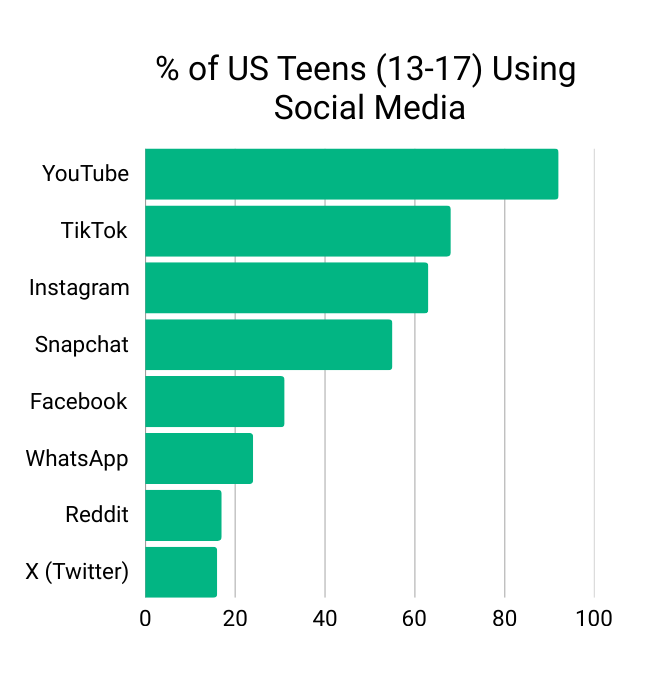
Number of US teenagers that have ever used social media platforms. Adapted from Teens, Social Media and AI Chatbots 2025
Benefits and Risks of Social Media for Teens
Young people are particularly susceptible to the effects of social media - both good and bad - due to their developing brains. A 2024 survey conducted by the Pew Research Center found that nearly 50% of teens think social media is primarily harmful, but few think that social media harms them personally. Some teenagers believe that social media have ‘mostly positive’ effects, including increased communication with friends, increased creativity, and the ability to find resources and connections that may not be easily available offline. Approximately 30% of teens report better friendships because of social media. A 2023 report from the US Surgeon General acknowledges these benefits, while noting that research shows that social media use can also cause harm.
An analysis of over 20 studies noted a link between social media use and eating disorder risk, and additional research has connected social media use to increased risk of depression and anxiety. In one study, limiting social media use to 30 minutes per day decreased depressive symptoms. Around 40% of teens say social media interferes with their sleep, and 20% report negative impacts on their grades. Parents name social media and technology as having the highest negative impact on teens, ahead of bullying and societal pressures.
Many tech companies have implemented some form of restrictions for teen accounts in an effort to reduce potential harms, but some, including the American Psychological Association, say these don’t go far enough. Meta (Facebook and Instagram, among others), TikTok, and Google (YouTube) all have some modifications to minors’ accounts, including stricter default privacy and data collection settings, the ability to set screen time limits, and restrictions on direct messaging.
State & Federal Efforts to Regulate Minors’ Use of Social Media
The Children’s Online Privacy Protection Act (COPPA) was the US’s first foray into increasing children’s online safety. COPPA requires notice and parental consent to collect data from children under 13. Increasing concerns about the impacts of social media on teenagers has led to the introduction of many bills designed to protect and restrict minors from social media use. The federal government is currently considering numerous bills to address the online safety of minors, and nearly every state has taken some form of action as well. Model legislation designed to reduce minors' access to social media typically falls into 3 categories: duty of care, hard gate, and privacy extension.
| Duty of Care | Hard Gate (Access Control) | Privacy Extension |
|---|---|---|
| Requires platforms to act in the best interest of minor users. This includes system design and operation to minimize the risk of harm (may include restrictions on autoplay, addictive algorithms, and infinite scrolling). | Requires age verification and parental consent for minor accounts. Age verification methods may include self-declaration, ID or credit card verification, and facial age estimation. | Would raise the age of existing privacy restrictions (typically 13) to minimize data collection from minors, allow easier data deletion, and restrict targeted advertising. |
West Virginia has made efforts to reduce the use of social media by children. In 2024, the Child Social Media Protection Bill (HB 5226) was introduced, but did not pass out of committee. This bill would have required parental consent for minors to have social media accounts, required age verification, banned advertising and targeted suggestions for minor accounts, restricted direct messaging for minors, allowed parents to request the passwords for minors’ accounts from social media companies, prevented minors from accessing social media between 10:30 pm and 6:30 am, required companies to not use addictive design features, and allowed individuals to sue social media companies for damages. The bill is similar to those that have been passed in Ohio, Arkansas, and Utah, although all have faced legal challenges.
In 2024, West Virginia also passed SB 466, establishing a Safety While Accessing Technology program, requiring schools to teach students about safe and responsible social media and internet use. In 2025, West Virginia passed HB 2003, enacting restrictions on cell phone use in schools.
Challenges to Social Media Regulation
Several states, including Ohio, have been sued by free speech or trade groups for their efforts to limit minors’ access to social media. In many cases, the courts have declared states’ efforts unconstitutional and blocked their laws from taking effect. In August 2025, the Supreme Court allowed Mississippi’s age verification law to go into effect while it is argued in lower courts. Laws that focus on controlling access to social media, such as Utah’s Social Media Regulation Act, face some of the strongest opposition.
NetChoice, a technology trade group, argues that policies such as age verification block access to free speech. Opponents to children’s use of social media say that restrictions are lawful because they target a form of communication, not free speech itself. Several civil liberties groups, including the American Civil Liberties Union and the Foundation for Individual Rights and Expression, state that although the goals of these laws are well-intentioned, their methods may lead to increased censorship and surveillance. Laws that regulate the underlying design of apps (controls on addictive algorithms, autoplay or infinite scrolling) or their data collection practices may be better able to survive legal challenges.
Additional barriers to implementing social media protection laws include a high compliance cost, especially for small and emerging social media platforms and current imperfections in noninvasive age verification technologies. If West Virginia wanted to resurrect its efforts to pass a social media protection law for minors, the state could update its previously introduced legislation in an attempt to strike a balance between protecting minors from harm, recognizing the benefits that social media may provide, and avoiding the legal challenges that other states have experienced.
This Science and Technology Note was prepared by Madison Flory, PhD, West Virginia Science & Technology Policy Fellow on behalf of the West Virginia Science and Technology Policy (WV STeP) Initiative. The WV STeP Initiative provides nonpartisan research and information to members of the West Virginia Legislature. This Note is intended for informational purposes only and does not indicate support or opposition to a particular bill or policy approach. Please contact info@wvstep.org for more information.