
West Virginia’s Teacher Preparation Programs
This Science & Technology Note highlights options for traditional and alternative teacher preparation programs in West Virginia, compares teacher and student outcomes from the different types of programs, and analyzes the policy option of teacher residency stipends for those in West Virginia’s traditional teacher preparation programs.
Updated July 22, 2026
Research Highlights
Teacher preparation programs provide future teachers with pre-professional skills in reading, writing, math, and technology; content specializations; and professional education in pedagogy and teaching standards in order to become effective educators.
West Virginia has received national recognition for the Grow Your Own program and West Virginia Residency Model, both part of traditional teacher preparation programs in the state.
There are several different alternative teacher preparation programs in West Virginia, including county-based programs, West Virginia Department of Education alternative programs, and independent Option 3 programs.
Research on teacher effectiveness and student outcomes between traditional and alternative teacher preparation programs is mixed.
West Virginia could consider reimplementing its teacher residency stipend to relieve some of the financial burden of completing teacher residency.
Completion of teacher preparation programs in West Virginia grew from 2021 to 2023, especially in alternative teacher preparation programs. Some are concerned that these alternative programs are lower quality than traditional teacher preparation programs, but research supporting this theory is inconclusive. This Science & Technology Note explains types of traditional and alternative teacher preparation programs in West Virginia, compares outcomes from traditional and alternative programs, and analyzes residency stipends as a policy option that may result in increasing numbers of individuals entering the teaching profession.
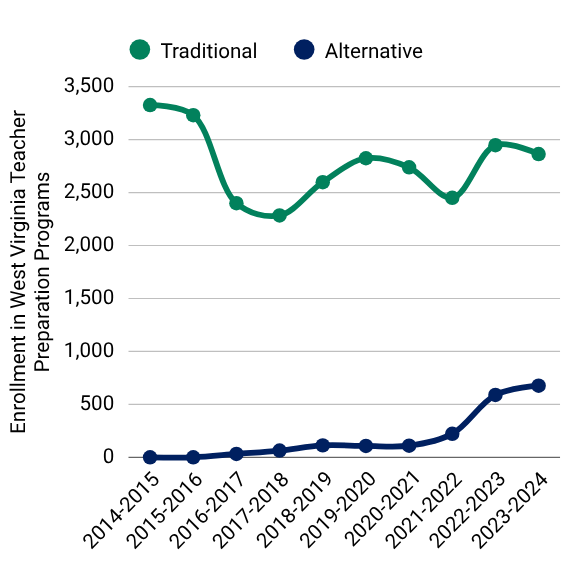
Enrollment in West Virginia’s alternative teacher preparation programs has grown significantly in the last 5 years. Data from 2025 Title II Reports, US Department of Education.
Traditional Teacher Preparation Programs
Traditional teacher preparation programs consist of bachelor’s or master’s degrees in education. There are 17 higher education institutions in the state that offer traditional teacher preparation programs. Traditional teacher preparation programs in West Virginia must ensure candidates’ competency in reading, writing, math, speaking, and technology pre-professional skills. They must also teach content specializations, including national and state standards and specific rules surrounding different content types. Finally, they must include professional education to help future teachers transform their knowledge into student learning.
Future teachers are required to have at least 125 hours of introductory field experience in the specializations they intend to teach. In addition, West Virginia implemented a year-long, 750 hour teacher residency program as the capstone experience in traditional teacher preparation programs in 2024. The West Virginia Residency Model is intended to integrate future teachers into the community for a full school year, giving them more experience than a traditional student teaching model. 92% of new teachers and principals thought that residency programs produced more effective and better prepared teachers than other student teaching experiences. Additionally, graduates from teacher residencies are 10% more likely to stay in the profession.
One unique pathway to traditional teacher preparation programs is West Virginia’s Grow Your Own Program, which has been highlighted as a model across the region. This program allows high achieving high schoolers to use dual enrollment and Advanced Placement classes to complete their traditional educator preparation program in 3 years after high school graduation, and provides them with preferential hiring in West Virginia school districts after program completion.
Alternative Teacher Preparation Programs
West Virginia’s alternative teacher preparation programs also produce certified teachers, but offer more variety in the types of programs that can produce new teachers. These programs are often cheaper and able to be completed in less time than traditional pathways. Enrollment in alternative programs has been growing; about 20% of teachers in West Virginia enter the field via alternative pathways. However, studies show that teachers trained in alternative programs are less likely to remain in the profession after 5 years. West Virginia’s 3 main types of alternative teacher preparation programs each generally require a candidate to have a bachelor’s degree for admission.
County-Based Alternative Certification Programs allow individuals to work as a teacher in a high-need position while they complete the county’s alternative certification program. Approximately half of West Virginia’s counties have this type of alternative certification program, and each program is unique to the county or counties that operate the program. Examples include the Teacher Launchpad Program in Boone County and Kanawha County Schools’ Alternative Certification Program.
West Virginia’s Option 3 Programs allow individuals to independently complete approved courses to obtain a teaching license. There are currently 6 approved programs in the state, including Teach for America Appalachia, a teacher training program through the AmeriCorps national service network. The majority of these programs are virtual, do not result in college credits, and do not require classroom experience. Some options require in-person classroom experience, but it is typically shorter than a traditional residency would be.
The West Virginia Department of Education’s Alternative Certification Program is designed for those who already have bachelor’s degrees to complete the necessary testing, training, and coursework to obtain their teaching certification. There are 7 approved providers across the state, each with their own unique requirements, but the programs can generally be completed in 1-2 years. These programs often require students to take courses in pedagogy, classroom management, and student evaluation, and typically require classroom experience for completion. Some also require completion of a teacher performance assessment.
Comparing Traditional and Alternative Teacher Preparation Programs
Research is mixed on both teacher and student outcomes for teachers who were trained in traditional versus alternative preparation programs. Some studies found no difference in teaching quality between training programs, and identified that the highest predictor of teacher quality was time spent in the profession, while others found that students whose teachers had gone through traditional preparation programs had larger learning gains. Specific characteristics of each program, including opportunities for observation, practice, and feedback, seem to be more defining than whether it follows a traditional or alternative model.
Policy Options
Since some research found that traditional teacher preparation programs produce higher quality teachers, if West Virginia wanted to increase the number of individuals going through those programs, the state could consider supplying stipends for teachers in their final residency year of traditional teacher preparation programs. In 2024, 11 states, including West Virginia, had teacher residency programs. 6 of these states require stipends for resident teachers - between $14,000 and $35,000, however, West Virginia does not. Previously, when the West Virginia Residency Program was in its pilot period, teacher residents received a $2000 stipend, but this ended after the residency program became a requirement for all traditional teacher preparation programs. As teacher residency programs are designed to place teaching candidates in classrooms over the full school year, teaching candidates may not be able to work another job and support themselves over their last year of their teacher preparation program. Reintroducing the residency year stipend at a higher amount, similarly to 6 other states, could help to alleviate cost burdens and may increase enrollment in traditional teacher preparation programs.
This Science and Technology Note was prepared by Madison Flory, PhD, West Virginia Science & Technology Policy Fellow on behalf of the West Virginia Science and Technology Policy (WV STeP) Initiative. The WV STeP Initiative provides nonpartisan research and information to members of the West Virginia Legislature. This Note is intended for informational purposes only and does not indicate support or opposition to a particular bill or policy approach. Please contact info@wvstep.org for more information.