Syringe Service Programs in West Virginia
People who inject drugs (PWID) are at increased risk of blood-borne diseases when they share needles. Syringe service programs (SSPs) provide disease testing, education, substance use disorder programs, and clean syringes and needles. There is stigma around SSPs; however, the majority of West Virginians are in favor of having them in their community. This Science and Technology Note explores SSPs services, their work in West Virginia, and options the legislature could pursue.
Updated August 7, 2026
Research Highlights
People who share needles to inject drugs are at higher risk of being infected with HIV and hepatitis C, which can be fatal.
Syringe service programs provide clean syringes, resulting in lower disease spread, decreased needle litter, and more people entering recovery programs.
The legislature could provide funding to counties for mobile SSPs, similar to those in Fayette County, which could increase SSP access for individuals in rural areas or those without reliable transportation.
What Are Syringe Service Programs?
Disease risk is increased for PWID due to unsafe injection practices like sharing needles from misuse of drugs like opioids, heroin, and fentanyl. PWIDs generally share needles due to social stigma around services that provide sterile needles, lack of knowledge of health risks associated with sharing needles, or less awareness of services that supply clean syringes. One way to help prevent transmitting infectious diseases between PWID is using sterile needles. SSPs provide sterilized syringes and needles and disposal for PWID with the goal of reducing their risk of harm.
Infectious Diseases in West Virginia
An analysis by the Centers for Disease Control and Prevention identified the top 220 US counties most at risk of HIV and Hepatitis C (HCV) outbreaks. 28 counties in West Virginia were identified as highest risk and the remaining 27 were considered to be at-risk of outbreaks.
HIV makes it harder for someone to fight other infections and leads to acquired immunodeficiency syndrome (AIDS). Early HIV symptoms are similar to flu symptoms (fever, chills, muscle aches) and can be diagnosed through testing. HIV is spread by bodily fluids, including blood from shared needles. President Trump announced a national initiative in 2019 to end the US HIV epidemic by 2030. One tool identified by the US Department of Health and Human Resources to help dramatically reduce HIV cases is SSPs. HIV rates in West Virginia are lower than all neighboring states and the national average. However, West Virginia has the highest percent (24.5%) of HIV-infected people in the region that attribute their infection to injection drug use.
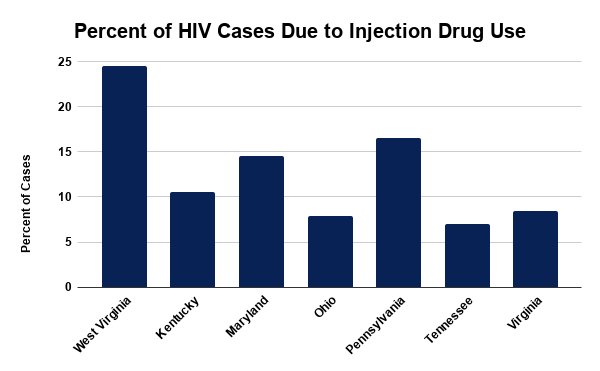
Based on 2023 data from AIDSVu.
HCV damages the liver, possibly leading to liver failure, though infection is curable with medication. Many people with HCV do not show symptoms of an infection and are only diagnosed when tested. HCV can spread through blood, including by shared needles. West Virginia’s HCV rates are higher than most states in the region and the national average, and infections increased 2016-2023. Data is not available to ascertain the manner in which HCV was spread, however, sharing needles among PWID is a known risk factor.
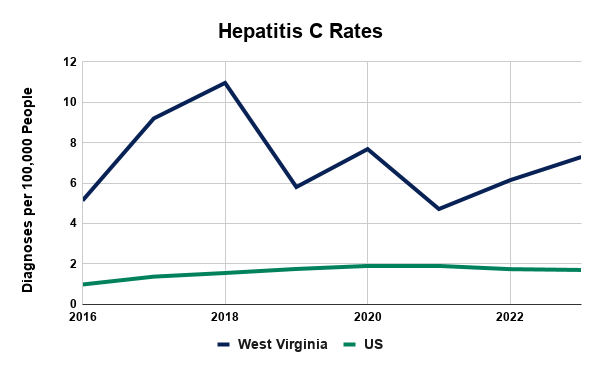
Based on data from the CDC’s National Notifiable Diseases Surveillance System database.
Syringe Service Programs In West Virginia
West Virginia has 19 SSPs in 11 counties. Of these, 2 SSPs in Fayette County operate out of a mobile unit, allowing staff to drive to different areas to increase accessibility to the programs. Since the passage of SB 334 (2021), all SSPs in West Virginia are required to be licensed by the Office for Health Facility Licensure and Certification and approved by local and county officials.
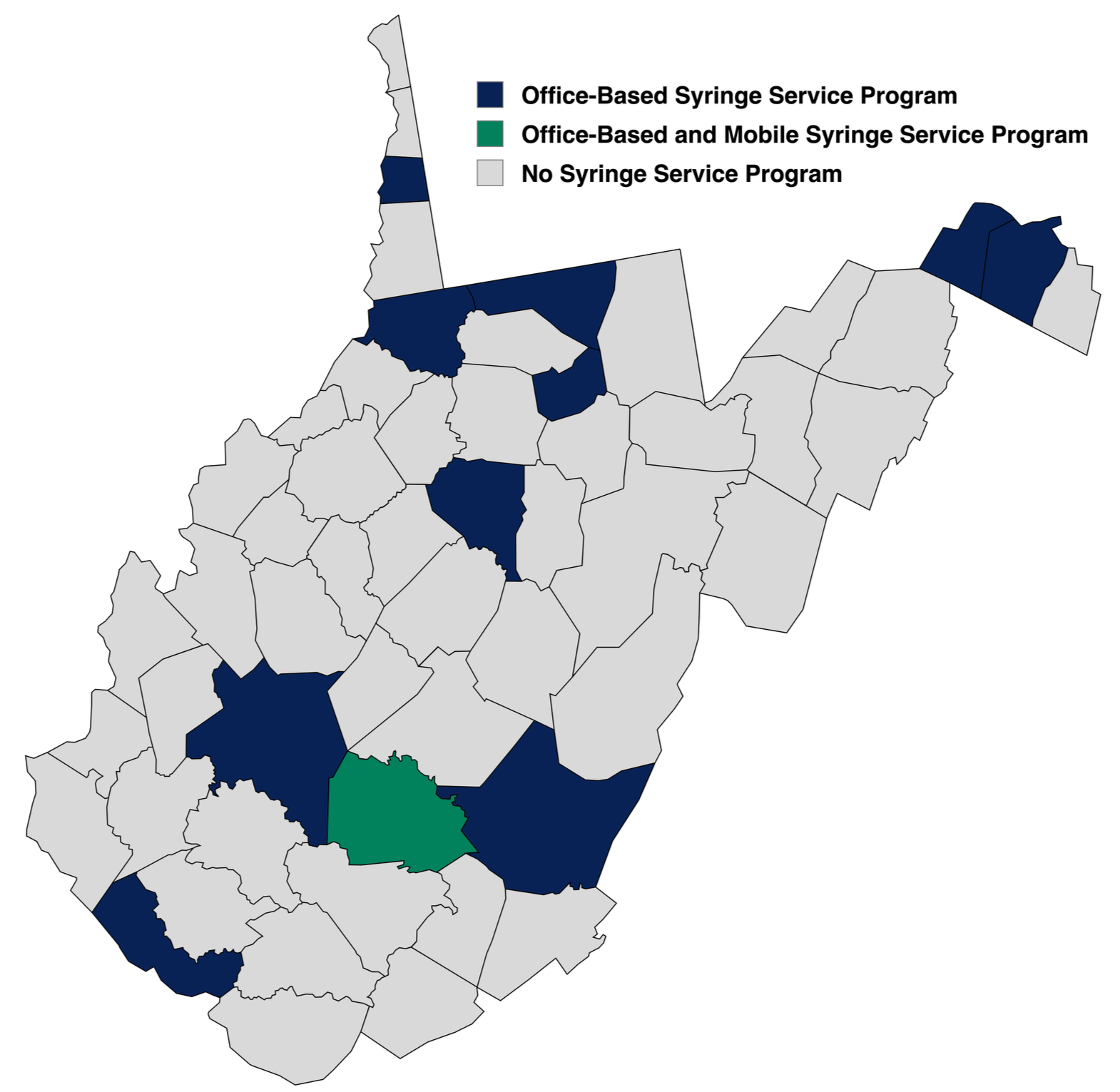
Based on data from the West Virginia Office of Health Facility Licensure & Certification.
SSPs in West Virginia collect, dispose, and distribute syringes and needles. They also offer additional services including HIV screening, overdose supplies and education, substance use treatment program referrals, and disease transmission education. Public perception among SSPs is mixed, possibly due to stigma with worries around increased crime or syringe and needle litter. Multiple studies suggest that SSPs decrease syringe and needle litter, increase PWIDs joining and staying in drug use treatment programs, and do not increase crime. A Mercer County SSP also reported less syringe litter and more people entering drug use treatment programs due to the SSP. A 2021 survey from the West Virginia Drug Intervention Institute found that 68% of West Virginians do not believe their communities have adequate resources for PWIDs and 61% believed there should be a SSP available for them in their communities.
There are multiple SSP funding sources, including federal grants. These funds may not be used to purchase syringes or needles, but may be used for other SSP services like HIV and HCV test kits, disposal services, education materials, and outreach activities. SSPs must seek out private donations to purchase syringes and needles. Some programs, including the Neighborhood Showers Healthcare Outreach Program in Charleston, are able to fund their SSPs through Opioid Settlement funds, however, few counties are opting to use these funds for SSPs. By reducing the need for HIV treatment costs, estimates suggest that SSPs have a 7x return on investment. One funding option SSPs could pursue is through the Rural Health Transformation Program (RHTP). Governor Morrisey announced a funding opportunity for prevention-focused, community-based health initiatives in June. Though this funding would likely not be able to be used for syringe or needle purchases, it may be able to be used for other SSP initiatives.
Policy Options
West Virginia has previously sought to end SSPs in West Virginia in 2026 (HB 4413), 2025 (SB 203), and 2024 (SB 296), however, none of these bills advanced out of committee. Outlawing SSPs from providing syringes in West Virginia would be similar to 13 other states, including Pennsylvania, that do not have legislation authorizing SSPs. This would prevent PWID from easily accessing clean syringes and needles in West Virginia. Pennsylvania, a state without SSPs, has higher rates of both HIV and HCV than West Virginia. Loss of access to clean syringes may lead to increased HIV and HCV infections among users similar to Pennsylvania.
West Virginia could provide funding for SSPs to acquire mobile units. This would enable SSPs to expand their services, which could be beneficial for PWID living in rural areas or who do not have reliable transportation to an SSP. Mobile units are already available in Fayette County and other states, including Virginia and North Carolina. Funding from the RHTP initiative seeking to address prevention-focused, community-based health initiatives may be applicable, especially because mobile SSPs could provide services in addition to syringe and needle exchanges like education, disease testing, and outreach programs similar to office-based SSPs.
This Science and Technology Note was prepared by Nathan G. Burns, PhD, West Virginia Science & Technology Policy Fellow on behalf of the West Virginia Science and Technology Policy (WV STeP) Initiative. The WV STeP Initiative provides nonpartisan research and information to members of the West Virginia Legislature. This Note is intended for informational purposes only and does not indicate support or opposition to a particular bill or policy approach. Please contact info@wvstep.org for more information.