Small Modular Reactors in West Virginia
Small modular reactors (SMRs) have been the focus of the majority of nuclear energy development projects in the last decade. Recent policy decisions in West Virginia have moved the state closer to incorporating nuclear power into its energy mix. This Science & Technology Note provides updated information on SMRs, explains technological and safety systems often present in SMRs, and highlights policy considerations for nuclear development in West Virginia.
Updated January 22, 2026
Research Highlights
Small modular reactors (SMRs) are smaller, more flexible in location, cheaper, and faster to construct than traditional nuclear power plants. While they are also safer and more efficient, they do still produce radioactive waste.
There are currently no operational SMRs in the United States, but a site in Oak Ridge, Tennessee is expected to be functional by the end of 2027.
While West Virginia has taken steps towards nuclear integration, the state could consider completion of the NRC Agreement application, development of traditional and SMR nuclear power sites, or consider a stepwise approach similar to what is being implemented in Kentucky.
Small modular reactors (SMRs) have been the focus of the majority of nuclear energy development projects in the last decade. Recent policy decisions in West Virginia have moved the state closer to incorporating nuclear power into its energy mix. This Science & Technology Note provides updated information on SMRs, explains technological and safety systems often present in SMRs, and highlights policy considerations for nuclear development in West Virginia.
SMR Technology
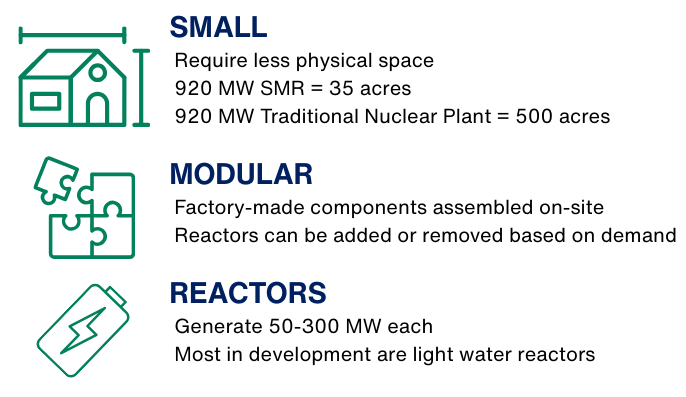
Approximately 20% of the US’s energy production comes from nuclear power, but development has slowed in recent decades. This may be changing with the development of SMRs, with more than 70 projects globally in various stages of development. SMRs differ from traditional nuclear reactors in several ways. They are generally 1/10-1/4 of the size of traditional reactors and produce 20-300 MW, while larger reactors produce >1,000 MW. For reference, the Canadian Nuclear Safety Commission projects that a 300 MW SMR could power 300,000 homes. SMRs are also designed so that they can be produced in bulk, much like cars on an assembly line, while traditional reactors often utilize designs unique to each site. These properties allow SMRs to have lower costs, less construction time, and increased flexibility compared to traditional reactors.
Many SMRs also utilize newer technologies and safety systems than traditional reactors. SMRs often utilize passive safety systems, which reduce risk by working without requiring any user input. Advances in fuel and cooling technologies can help to reduce risk as well. New fuel types can reduce the need for refueling and be more resistant to high temperatures or corrosion. Traditional water-cooled reactors operate at ~570°F and utilize high pressures to keep water liquid. Alternative cooling technologies, including salt-cooled reactors, can operate at significantly higher temperatures and much lower, safer pressures.

Light Water SMR Schematic. Water inside the reactor vessel is heated by nuclear fission in the reactor core. The steam generated is used to turn a turbine, which powers a generator connected to the electrical grid. All of this is housed within a containment structure, usually a steel vessel or concrete building. Size comparison to a 1.8m (~5’10”) tall person.
Image Source: Government Accountability Office
Long-term radioactive waste is a major concern with nuclear reactors. Due to the wide variety of SMR technologies and lack of operational data, it can be difficult to make accurate predictions about waste production. For example, a US Department of Energy (DoE) study estimated that SMRs would not cause any significant issues with waste disposal and may produce less radioactive waste than traditional reactors. However, similar research from the University of Pennsylvania suggests that SMRs could produce 5-35x the waste of traditional reactors, and that this waste may be more reactive than traditional radioactive waste. As more data on real-world use of SMRs becomes available, scalable estimates will likely become much more reliable.
Currently, the only places that have proceeded past the test SMR phase are China and Russia. The US has taken steps towards advancing SMR development, construction, and operation, including cost-sharing and technical support. Funding for SMR projects has also grown 81% from 2024-2025. Construction recently began on an SMR site in eastern Tennessee that is expected to be operational in 2027, though commercial operations are not expected to be ready until the 2030s.
Policy Status & Options
West Virginia has recently taken steps to open the potential for nuclear power in the state. A long-standing nuclear moratorium was overturned in 2022, followed by a 2023 application to enter into an agreement with the Nuclear Regulatory Commission (NRC) to split regulation of nuclear material between state and federal efforts. The legislature introduced additional bills targeting nuclear expansion, including HB 5150 (2024) to encourage nuclear development at former coal generation sites and HB 2205 (2025), which would give the Public Service Commission jurisdiction over SMRs in the state. Neither bill was passed.
There are several policy options the state could take concerning SMR and nuclear energy development. West Virginia could decide not to pursue any nuclear development, and continue its focus on coal and natural gas. This would likely be the cheapest and fastest option, as coal and natural gas infrastructure exists in the state, while nuclear infrastructure does not. However, nuclear power has the potential to help diversify West Virginia’s electric grid, an important consideration for improved grid resiliency and part of Governor Morrisey’s 50 by 50 Plan. Some have also suggested that former coal mine lands could be viable sites for SMR development in nearby Virginia. .
Kentucky has taken a sequential approach to nuclear development in the state, establishing the Nuclear Energy Development Working Group in 2023, the Nuclear Energy Development Authority in 2024, and the Nuclear Energy Development Grant Program in 2025. This stepwise approach could yield more site development time, technological advancement, and public conversations around an often contentious topic.
West Virginia could also pursue development of traditional nuclear power. Nuclear technologies have been used across the globe for many years, but require large capital investments and often face public opposition. Before West Virginia could fully pursue any type of nuclear power, it would have to finish the process to become an NRC agreement state. Although a letter of intent was submitted to the NRC in 2023, there have been no further advances in this process. Nuclear power, whether through traditional reactors or SMRs, reduces air pollution and carbon emissions compared to coal, but produces nuclear waste, which requires long-term containment and storage.
Finally, West Virginia could consider nuclear development via SMRs. SMRs have lower costs and increased siting flexibility compared to traditional nuclear plants, but have similar issues of waste management and decommissioning. SMRs may also have supply chain issues, as they typically utilize newer technologies that are not readily available, and limited production scale means that prices are still high. A DoE study estimated that SMRs could produce more jobs and tax revenue in comparison to coal plants, which could address some concerns about potential loss of jobs that may come with transitioning towards nuclear power in West Virginia. Tech companies have also expressed interest in using SMRs to power microgrids and data centers, which West Virginia has taken steps to expand.
This Science and Technology Note was prepared by Madison Flory, PhD, West Virginia Science & Technology Policy Fellow, and Kensey Bergdorf-Smith, PhD, on behalf of the West Virginia Science and Technology Policy (WV STeP) Initiative. The WV STeP Initiative provides nonpartisan research and information to members of the West Virginia Legislature. This Note is intended for informational purposes only and does not indicate support or opposition to a particular bill or policy approach. Please contact info@wvstep.org for more information.