
Student Mental Health in West Virginia
Reported mental health needs among West Virginia’s students have been increasing. Yet, the school mental health workforce in the state - primarily school counselors and psychologists - remains below the ratios recommended by professional organizations. This Science & Technology Note provides data on the increasing mental health concerns among West Virginia’s youth, explores mental health programming and successful implementation of mental health supports in some West Virginia schools, and highlights policy options various states have adopted in an effort to address mental health in young people.
Updated November 16, 2026
Research Highlights
West Virginia has 1 school counselor per 310 students, below the recommended ratio of 1 counselor for every 250 students. The state averages 1 school psychologist for every 1700 students, while 1 school psychologist per 500 students is recommended.
Between 2015 and 2025, West Virginia high school students reported a 7% increase in feeling sad or hopeless for more than 2 weeks. Over the same period, there was a 1% increase West Virginia high schoolers who considered attempting suicide, and a 1.5% increase in students who attempted suicide.
States have taken a variety of approaches to supporting student mental health, including specifying mental health as an excused absence or providing dedicated funding for mental health programming or mental health professionals in schools.
Trends in Student Mental Health
A 2023 US Department of Education report named student mental health as one of the top 5 priorities for education in the Appalachian region. Mental health needs of young people in the state have increased, with 15% of children reporting anxiety or depression in 2018, and 20% in 2023. West Virginia has the 5th highest rate of adverse childhood experiences in the country, including abuse, neglect, and household instability, raising children's future risks for mental health challenges. Half of all mental illnesses present by the time a child is 14, indicating student mental health may be an important component in supporting West Virginia’s youth.
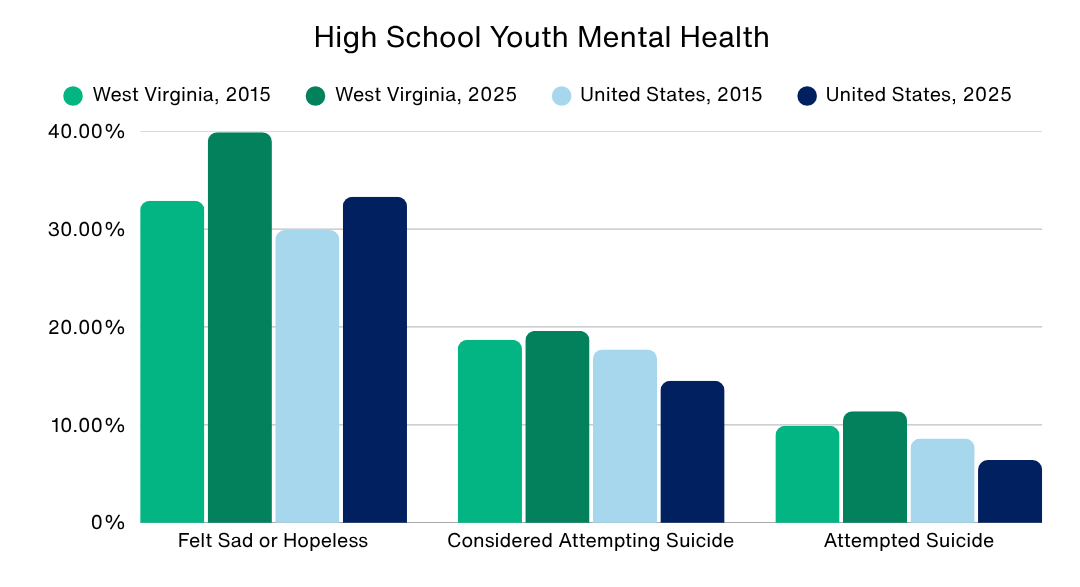
More West Virginia high school students than the national average report mental health concerns. Between 2015 and 2025, the number of West Virginia high schoolers who considered or attempted suicide rose, while nationally, those percentages decreased. Adapted from the Youth Risk Behavior Surveillance System.
Mental Health Support in Schools
School counselors, psychologists, and social workers often provide mental health support for students in schools. Nationally, there is an average of 1 school counselor for every 376 students, and 1 school psychologist per 1065 students. Professional associations recommend 1 school counselor for every 250 students and 1 school psychologist per 500 students. In the 2024-2025 school year, West Virginia had approximately 1 school counselor for every 310 students, and 1 school psychologist per 1700 students (calculated based on data from the National Center for Educational Statistics and the West Virginia Department of Education).
Students are 6 times more likely to receive mental health support if it is available in schools. In West Virginia, 158 school-based health centers allow eligible students to receive mental healthcare services on their school’s campus. An additional 72 school-based centers provide referrals to another behavioral health provider, often a nearby school-based health center that offers these services. The state Department of Human Services recently announced an expansion of school-based mental healthcare services by adding school counselors, licensed social workers, and board-certified behavior analysts to the eligible provider list.
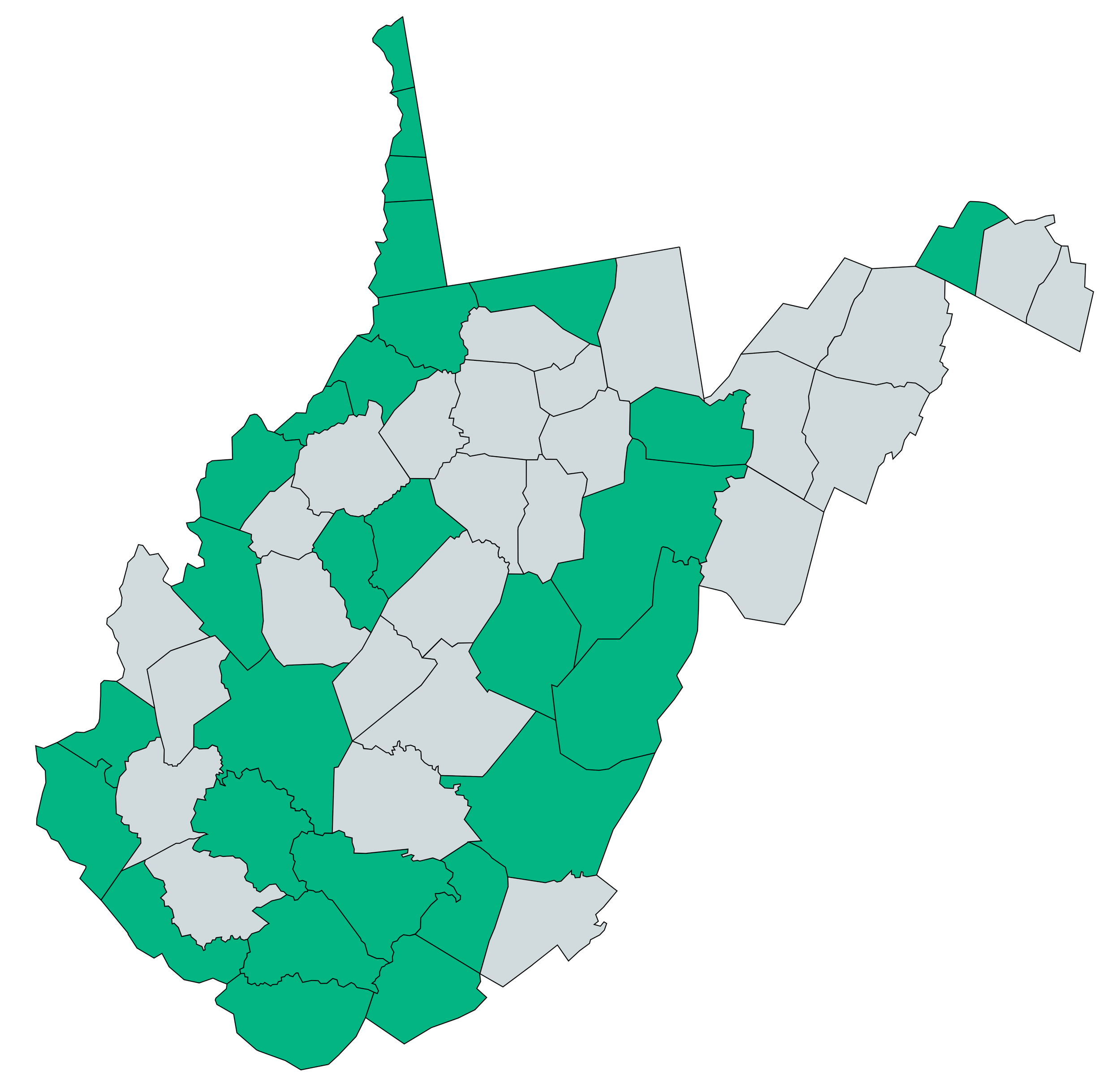
Additionally, 80 schools in 26 West Virginia counties provide mental health services through the West Virginia Expanded School Mental Health Initiative.This program aims to support the mental health of all students in a school through the Multi-Tiered System of Supports (MTSS) and Positive Behavior Interventions and Supports (PBIS) models. Out of school suspensions dropped by 38% 1 year after MTSS and PBIS models were implemented at a Boone County elementary school, according to West Virginia Behavior/Mental Health Technical Assistance Center. At a Cabell County middle school, adoption of the models resulted in a 28% decrease in office referrals and a 34% decrease in disruptive behaviors. There was a 72% reduction in students skipping school in a Lewis County high school, demonstrating success at multiple educational levels.
26 West Virginia counties have implemented MTSS and PBIS programs through the West Virginia Expanded School Mental Health Program. Adapted from Expanded School Mental Health.
Policy Options
There have been several recent laws aimed at addressing student mental health in West Virginia. HB 3209 (2025) implemented a 1:500 ratio for school counselors. However, this ratio remains above the recommended 1:250 ratio. Delaware codified the American School Counselor Association’s recommended ratio in 2022. West Virginia could take steps to further reduce its ratio to achieve the recommendations set by the American School Counselor Association. West Virginia also implemented HB 3218 (2023), requiring public schools serving 6th-12th graders include information about the Suicide & Crisis Lifeline to on student ID cards.
Many states allow illness as a reason for an excused absence from school, but some states, including Kentucky and Louisiana, have opted to explicitly name mental or behavioral health as excused absences in code. Louisiana additionally requires students to be referred to appropriate student support personnel after 2 mental health absences. West Virginia code does not classify mental health as an excused absence from school, although it provides for up to 10 excused absences per year, including for illness. Explicitly naming mental health as a reason for an excused absence is thought to help reduce stigmas associated with mental health concerns.
Some states have made efforts to provide funding for mental health programming in schools. Pennsylvania’s state budget includes $100 million for school physical and mental health services, including funding for mental health counselors. New Hampshire included $900,000 in the state budget for MTSS programming. West Virginia currently funds MTSS programming through the Expanded School Mental Health Program via the Department of Human Services Bureau for Behavioral Health. Dedicated funding for this programming in the state budget, especially in the context of reported successful implementation across the state, could be one option to support students’ mental health.
This Science and Technology Note was prepared by Madison Flory, PhD, West Virginia Science & Technology Policy Fellow on behalf of the West Virginia Science and Technology Policy (WV STeP) Initiative. The WV STeP Initiative provides nonpartisan research and information to members of the West Virginia Legislature. This Note is intended for informational purposes only and does not indicate support or opposition to a particular bill or policy approach. Please contact info@wvstep.org for more information.