Recovery of Rare Earth Elements from Acid Mind Drainage in West Virginia
DetailsRare earth elements (REEs) are critical components for technology and industry. Acid mine drainage from abandoned mines in Appalachia has been found to contain REEs that can be extracted using a technique being developed at West Virginia University. This Science and Technology Note gives an overview of REEs and acid mine drainage, provides an analysis of the funding and legislation behind extracting REEs from acid mine drainage in West Virginia, and provides policy options West Virginia could consider regarding further development of the technology.
Updated November 16, 2026
Research Highlights
Rare earth elements (REEs) are critical for smartphones, computers, and other high-tech devices. The United States relies on imports for 67% of its rare earths.
WVU researchers have developed and are scaling up a novel method for extracting REEs from contaminated acidic water in and around abandoned coal mines. This method can also extract “heavy” rare earths, which are very hard to get from conventional sources.
West Virginia has passed legislation to remove ownership uncertainty of the extracted REEs and to stimulate private investment.
Policy options West Virginia could consider for further development include clarifying regulations, incentivizing investment, investing in workforce development, and providing for continued maintenance of treatment facilities.
REEs are a group of 17 different elements that are used in numerous critical products from consumer goods to high-tech devices and computer chips. They are not necessarily rare because they are often found in other minerals including coal and coal byproducts, but they are difficult to mine and extract. The United States is the second-largest producer of REEs, but at current mining rates, U.S. reserves could be depleted in around 37 years. There is only one REE mine in the United States (Mountain Pass, CA), which sends raw ores to China for refining into pure REEs. United States consumption of REE is increasing and the country relies on imports for 67% of its rare earths. New REE mines can take up to 29 years to develop. This means REE recycling, recovery, and unconventional sources could become critical in the coming decades.
Acid mine drainage comes from water that fills abandoned coal mines and can also leach into groundwater and leak out into the environment. Waste coal rock weathers and forms sulfuric acid, which makes the water highly acidic. Acid mine drainage also contains “heavy” REEs, which are a subgroup of four rare earth minerals that are extremely hard to get, but acid mine drainage can contain 45-50% heavy REEs compared to less than 0.5% mined from traditional sources. The acidity and heavy metals are what makes acid mine drainage hazardous to humans and aquatic life. The United States imported 100 tons of heavy REEs in 2025 and there was zero domestic production. According to West Virginia and federal law, acid mine drainage is legally required to be cleaned up both during and after the mining process. While conventional REE sources can be difficult to access, acid mine drainage, particularly acid mine drainage sludge, is easily accessible and plentiful throughout West Virginia. Acid mine drainage sludge has been previously treated to raise the pH and remove metals, but it still contains REEs. This has helped pave the way for researchers to begin investigating acid mine drainage as an unconventional source of rare earth elements.
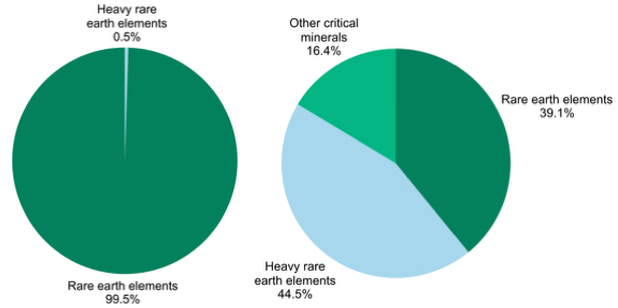
Composition of U.S. rare earth element imports (left) compared with extracts from Appalachian acid mine drainage (right). Adapted from USGS and WVU Water Research Institute
Status in West Virginia
Scientists at West Virginia University’s Rare Earth Recovery Project in collaboration with Virginia Tech are working on scaling up a method of extracting REEs and other critical minerals from acid mine drainage to be commercially viable. Conventional acid mine drainage treatment processes use lime to separate iron and aluminum out of the water, leaving the REEs behind. In contrast, WVU’s process is able to separate out the rare earths, which instead produces clean water as a by-product. The extracted REEs are widely considered to be non-radioactive, unlike conventionally mined REEs. The researchers estimate that there is a potential for extracting up to 2,200 tons of REEs per year from 120 acid mine drainage treatment sites throughout West Virginia, Pennsylvania, Maryland, and Ohio.
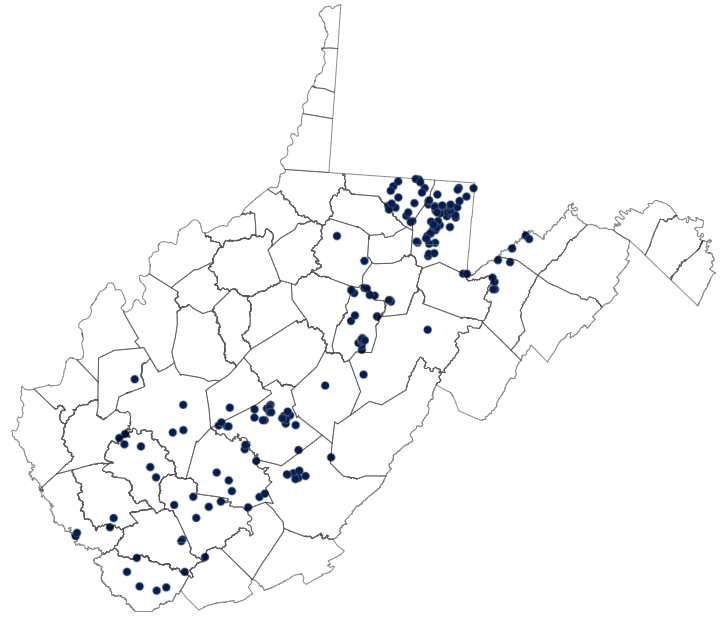
181 abandoned mine sites with confirmed acid mine drainage (AMD) in West Virginia. Source: WV Department of Environmental Protection. Map courtesy of Jillian Walton, PhD
This led to the United States’ first pilot-scale facility for extracting REEs from acid mine drainage, which is located in Mount Storm. The facility is run by a for-profit startup founded by the WVU research team. They are funded and supported by the U.S. Department of Energy (DOE), REalloys, Rockwell Automation, and the federal Infrastructure Investment and Jobs Act (IIJA) through the Abandoned Mine Land Program. Successfully scaling up this technology has the potential to clean up contaminated former coal mining sites in West Virginia and address water quality issues throughout the state.
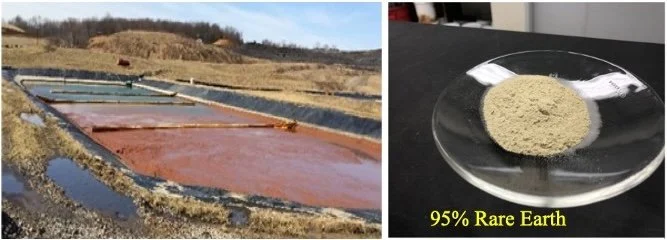
Comparison of raw acid mine drainage sludge (left) and extracted rare earth minerals (right). Source: WVU Water Research Institute
Legislation in West Virginia
West Virginia has promoted REE extraction from acid mine drainage through legislation clarifying ownership and offering tax incentives. HB 4003 (2022) grants ownership of the extracted REEs to the entity that extracted them, while state law exempts project sponsors from liability for water cleanup projects. This encourages private investment. In 2023, the state also exempted REEs and critical minerals from its 5% severance tax for nine years.
West Virginia also receives federal funding for REE and critical mineral recovery from acid mine drainage through the federal IIJA, which supports facilities treating acid mine drainage to restore watersheds and guarantees funding for heavily impacted states over 15 years. West Virginia, Kentucky, Pennsylvania, and North Dakota have collectively received $17.5 million in funding from the DOE and are all developing pilot-scale REE extraction facilities. The 2023 STREAM Act allows states to set aside up to 30% of annual mine land grants in trust funds for long-term water treatment. In 2025, the IIJA’s Abandoned Mine Lands Economic Revitalization (AMLER) program was expanded to cover REE recovery from acid mine drainage.
Policy Options
West Virginia and other Appalachian states are well-positioned to develop this technology through providing regulatory clarity, incentivizing investment, and supporting workforce development. West Virginia and Pennsylvania’s Environmental Good Samaritan Acts currently shield water pollution cleanup project operators from legal liability, however, they do not explicitly mention extraction of REEs from acid mine drainage, which West Virginia could consider clarifying to remove uncertainty. Additionally, investing in workforce development and mining engineering programs may ensure that the state has the necessary infrastructure and trained workforce. State funding to support further research and development could come from West Virginia’s Acid Mine Drainage Abatement and Treatment Fund, which currently authorizes projects relating to the development of surface-mining reclamation and water quality control. West Virginia could consider amending the law to explicitly allow state funding for REE extraction projects to remove any legal uncertainty.
This Science and Technology Note was prepared by David Ramotowski, PhD, West Virginia Science & Technology Policy Fellow on behalf of the West Virginia Science and Technology Policy (WV STeP) Initiative. The WV STeP Initiative provides nonpartisan research and information to members of the West Virginia Legislature. This Note is intended for informational purposes only and does not indicate support or opposition to a particular bill or policy approach. Please contact info@wvstep.org for more information.