Radon Testing and Mitigation in West Virginia
Radon is a naturally occurring radioactive gas that can accumulate indoors and increase lung cancer risk. This Science & Technology Note examines radon exposure, testing and mitigation in West Virginia, and policy approaches used in other states.
Updated August 31, 2026
Research Highlights
Radon is the second-leading cause of lung cancer in the U.S., and the EPA estimates it contributes to approximately 21,000 lung cancer deaths each year.
28.5% of reported West Virginia radon tests are at or above 4 picocuries per liter (pCi/L), the level at which the EPA recommends mitigation.
West Virginia provides free residential test kits but does not currently offer statewide financial assistance for homeowners to lower elevated radon.
West Virginia could continue its current testing and mitigation policies or consider approaches used in other states, including financial assistance for mitigation, radon-resistant new construction, or expanded testing and disclosure requirements.
Radon is a naturally occurring radioactive gas that can accumulate indoors and increase lung cancer risk. West Virginia licenses radon testing professionals and provides free radon test kits, but homeowners still face costs to reduce elevated radon levels. This Science & Technology Note describes the health effects of radon, radon testing and mitigation in West Virginia, and policy approaches used to reduce radon exposure.
Radon and Lung Cancer
Radon is a colorless and odorless gas that is produced naturally as uranium in rocks and soil breaks down and can accumulate in buildings. When radon decays, it produces radioactive particles that can be inhaled and damage the lungs, which overtime can lead to lung cancer. The Environmental Protection Agency (EPA) estimates that radon contributes to approximately 21,000 out of nearly 125,000 lung cancer deaths in the U.S. annually, making it the second leading cause of lung cancer after smoking.
There is no known completely safe level of radon exposure and the CDC suggests reducing exposure as much as practical. The EPA recommends mitigation at 4 picocuries per liter (pCi/L) or higher, and recommends considering mitigation between 2-4 pCi/L. 4 pCi/L is not a threshold of “safe” and “unsafe” exposure. The EPA estimates that among 1,000 people exposed throughout their lives to 4 pCi/L, approximately 7 people who never smoked could develop lung cancer and 62 people who smoke are estimated to develop lung cancer. The CDC estimates 10-20% of lung cancers in the US occur among people who never smoked or smoked fewer than 100 cigarettes in their lifetime. This is relevant in West Virginia, which has a higher smoking rate and a higher lung cancer rate than the national average.
Radon in West Virginia
West Virginia's geology contributes to its radon potential. In parts of the state, uranium-bearing black shales and soils can produce radon, while permeable soils and terrain can allow the gas to move more readily into buildings. However, geology varies across the state and cannot predict radon levels in individual homes. Counties with higher radon potential cannot determine whether an individual building has elevated radon. Testing is the only way to determine a home’s radon level and 10,061 tests were reported from 2008-2017, compared with an estimated 894,956 total housing units, meaning there is one reported test for every 89 housing units. Limited testing makes it difficult to measure radon exposure in West Virginia. Although few residential tests have been reported, 28.5% of reported radon test results were at or above 4 pCi/L and modeling estimates that 38% of buildings statewide may exceed this level.
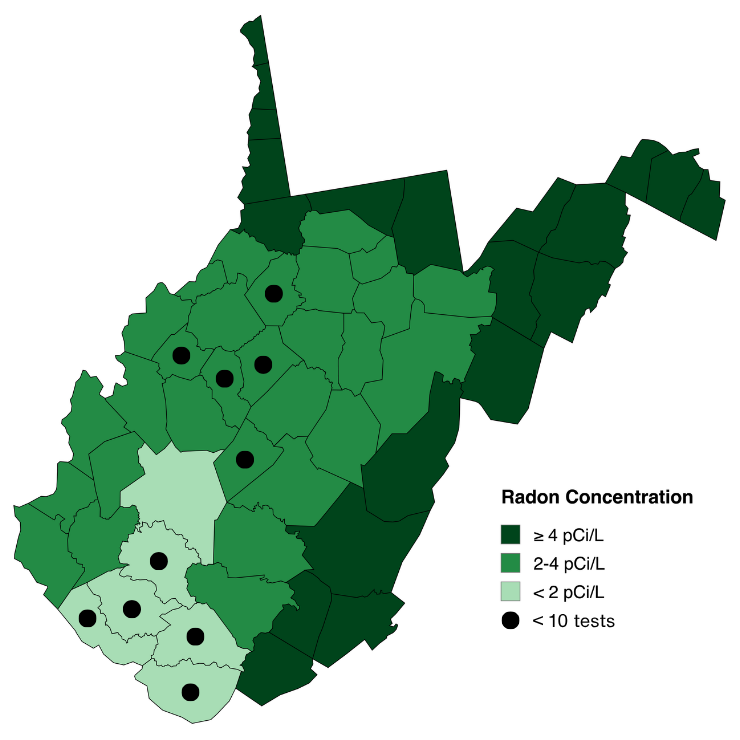
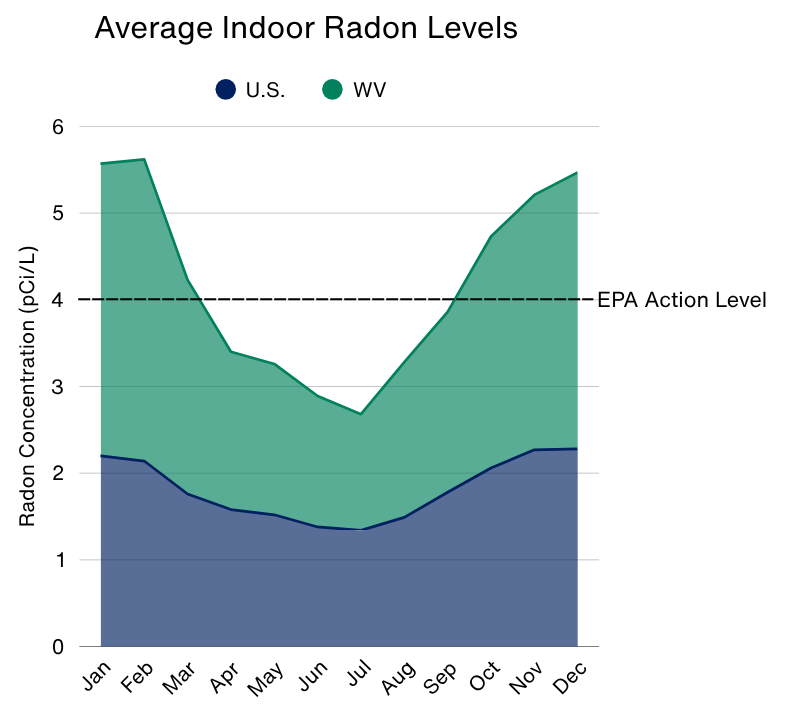
Radon levels vary geographically and seasonally across West Virginia. Many counties report average levels at or above the EPA action level, and statewide indoor radon levels tend to be highest during colder months. Adapted from West Virginia Environmental Health Services Office, Radon Testing Disparities: West Virginia Report, and Airthings.
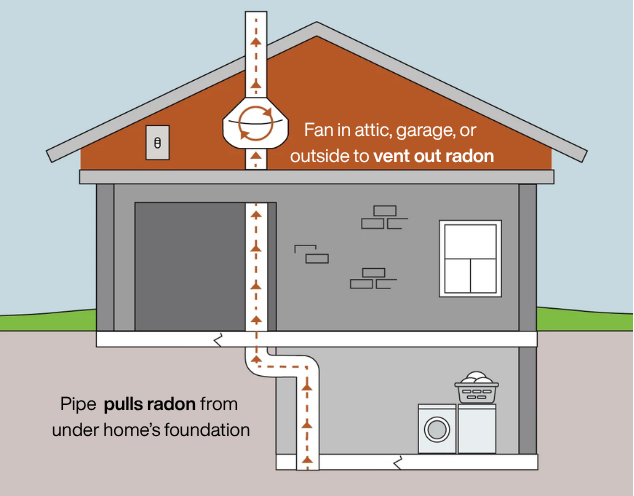
A radon mitigation system uses a pipe and a continuous fan to pull invisible, radioactive radon gas from beneath a home’s foundation and safely vent it outside. Adapted from Protect Environmental.
Current West Virginia Radon Policy
West Virginia licenses radon testers, mitigation specialists, contractors, and laboratories and maintains a special revenue account supported by fees associated with the program under code §16-34. Additionally, newly constructed public school buildings must be tested for radon within the first year of occupancy and at least every five years thereafter under code §18-9E-3. State records reported approximately $12,078 in collections and a $4,085 year-end cash balance for FY2024, suggesting that the account is primarily a regulatory funding mechanism and is not capable of financing mitigation at scale, which would require additional funding, statutory authority, or coordination with other programs.
During the 2026 legislative session, HB 5625 proposed changes to West Virginia's radon licensure framework. Among other provisions, versions of the bill addressed definitions, professional requirements, inspections of mitigation systems, and radon-resistant new construction. The bill advanced in the House but did not complete the legislative process. West Virginia does not currently operate a statewide program specifically providing direct financial assistance to homeowners for residential radon mitigation.
State Approaches to Radon Policy
Colorado created the Low-Income Radiation Assistance (LIRMA) Program in 2016, to provide $100,000 for the Department of Public Health to help low-income homeowners pay for radon mitigation when elevated levels are identified. Originally, it was supported through the state’s Hazardous Substance Response Fund funding but more recently (FY2023-2024) shifted to a larger General Fund appropriation with budget staff recommending $1.151 million to go towards LIRMA. In 2025, 12,500 free radon kits were distributed to residents and over 200 homes were mitigated through LIRMA. Illinois addresses some radon costs through regulation. The state requires radon-resistant features in certain new construction and uses professional licensing fees to support portions of its program. West Virginia’s current framework more closely resembles Illinois in its reliance on professional licensing and regulation, but does not include a statewide residential construction requirement or a dedicated funding mechanism comparable to Colorado’s for mitigation in existing homes.
The West Virginia Office of Environmental Health Services administers the state’s Radon Program. The program licenses radon professionals, collects testing and mitigation reports, provides information to residents, and offers free residential radon test kits. Demand for free tests has increased during recent outreach efforts. In January 2025, nearly 2,000 residential radon test kits were distributed compared with more than 1,000 the year prior. West Virginia enacted the Air Quality in New Schools Act in 1998, which requires routine radon testing and mitigation when tests indicate elevated levels of radon in public schools whose design and construction began after January 1, 1998.
From Testing to Mitigation
When elevated radon is identified, mitigation systems can be installed to reduce the amount entering a building. A common system uses a pipe and a fan to draw radon-containing air from beneath the building’s foundation and vent it outdoors. Mitigation costs vary according to the building and system. The Minnesota Department of Health estimates that residential mitigation typically costs approximately $1,500-3,000. By comparison, the EPA estimates that adding radon-resistant features during construction generally adds $250-$750 to the cost of building a new home. Mitigation is not a one-time solution. It requires monitoring the system, maintenance, and retesting at least every 2 years. For example, fans need to be replaced every 5-10 years and cost $200-$350 including parts and labor. These interventions can reduce indoor radon concentrations by up to 99%.
This Science and Technology Note was prepared by Anika Zaman, PhD, West Virginia Science & Technology Policy Fellow on behalf of the West Virginia Science and Technology Policy (WV STeP) Initiative. The WV STeP Initiative provides nonpartisan research and information to members of the West Virginia Legislature. This Note is intended for informational purposes only and does not indicate support or opposition to a particular bill or policy approach. Please contact info@wvstep.org for more information.