
West Virginia’s Quality of Life
While there are many different ways that quality of life in a state can be measured, one widely used system ranked West Virginia as the state with the 46th best quality of life nationally. West Virginia scored highly for opportunities in the state, but performed poorly on rankings of the state’s education and healthcare systems. This Science & Technology Note explains how these quality of life rankings were calculated and highlights efforts in the state to improve education and health outcomes.
Updated March 10, 2026
Research Highlights
US News and World Report ranked West Virginia 8th in the nation for opportunity, 47th for education, and 49th for healthcare.
West Virginia recently achieved high improvement rates in 4th grade reading and math, potentially due to the Third Grade Success Act.
The Rural Health Transformation Program and Make West Virginia Healthy Act may help to build on existing health promotion programs in West Virginia and impact the state’s healthcare score.
Quantifying Quality of Life
Measuring quality of life is complex, comprising metrics exploring multiple topic areas. One commonly utilized system for comparing quality of life across states is the US News and World Report’s Best States Ranking. This system has been comparing state outcomes since 2017 and compares states across 8 categories: healthcare, education, infrastructure, opportunity, fiscal stability, crime, and natural environment.
The ranking system is based on more than 70 factors across the 8 categories using data from a variety of federal government sources. Categories are weighted based on responses from surveys of the American public. Education and healthcare were found to be the most important issues to the public’s perception of quality of life, and thus contribute a larger proportion to a state’s overall score. The natural environment and crime were found to be the least important issues to the public. In each category, subcategories were weighted equally.
West Virginia’s Quality of Life
Overall, West Virginia was ranked as the 46th best state to live in. West Virginia ranked relatively highly in the opportunity category, at 8th, but ranked poorly in several other categories, including healthcare and education, at 49th and 47th, respectively.
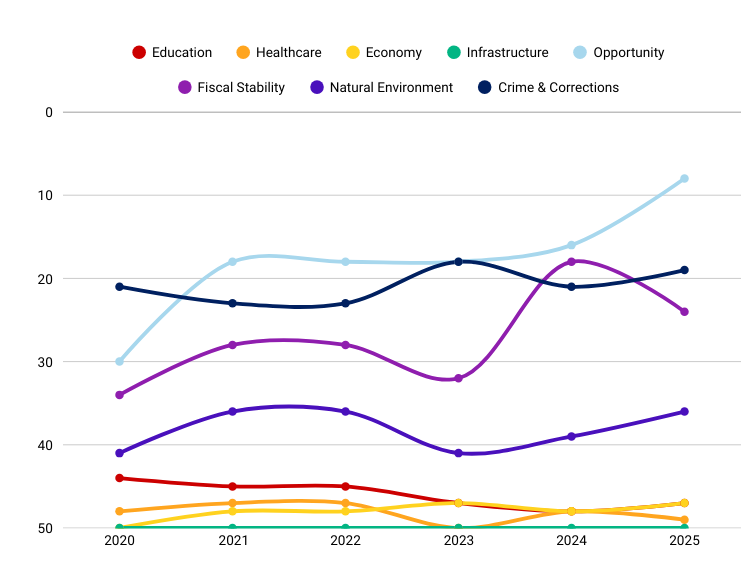
West Virginia’s rankings in each category from 2020-2025. Rankings for opportunity and fiscal stability have increased, while the other categories have remained relatively stable over the past 5 years. Adapted from US News and World Report.
Opportunity in West Virginia
There were 3 subcategories in the opportunity category: affordability, economic opportunity, and equality. West Virginia was ranked 3rd in affordability, due to its lower than average costs of living and housing. The state also scored highly in equality, attributed to a low difference in labor force participation and income between genders and ethnic groups. However, the third subcategory, economic opportunity, saw West Virginia ranked 45th, due to low incomes, high poverty rates, and high levels of food insecurity. West Virginia has made several recent efforts to address food insecurity, including improving access to fresh food through federal grant programs and state legislation aimed at increasing availability of farmer’s markets.
Quality of Education in West Virginia
Education rankings considered both preK-12th grade and postsecondary education. PreK-12th grade education measured preschool enrollment, 8th grade reading and math scores, graduation rate, and college entrance examination scores. In preK-12th grade education, West Virginia received a ranking of 46th. Approximately 50% of 3 and 4 year olds are enrolled in preschool nationally, compared to 40% of West Virginia 3 and 4 year olds. Although West Virginia has universal preK for 4 year olds and some 3 year olds, it is not required. West Virginia has a higher than average high school graduation rate, at 91% compared to 87% nationally. West Virginia students scored below average in reading and math in 4th and 8th grades.
One way that West Virginia has been attempting to improve their educational rankings is through the Third Grade Success Act, passed in 2023. This bill implemented support services and retention guidance for third grade students who do not meet standards for reading or math. Although the retention aspects of the bill will not be fully implemented until the 2026-2027 school year, analysis of student improvement in reading and math showed that West Virginia students had the 6th highest score increase in math and the 11th highest increase in reading between 2022 and 2024.
For postsecondary education, the rankings accounted for graduation rates in both 2 and 4 year programs, total educational attainment, tuition and fees, and student loan debt. West Virginia ranked 40th in the higher education subcategory. West Virginia students completed 4-year degrees less often than the national average, with around 50% of students completing their degree, compared to 60% nationally. The most common reason cited for leaving an educational institution without finishing a degree was financial. Unlike 4-year institutions, slightly more students in West Virginia completed degrees at 2-year institutions than the national average. When West Virginia students graduate from a postsecondary institution, their average debt is approximately that of the national debt, ~$13,500. Around 25% of West Virginia adults over the age of 25 have a bachelor’s degree, compared to 37% of adults nationally. This may be due to high levels of the “brain drain” phenomenon, where more individuals with bachelor’s degrees choose to leave the state rather than stay in the state.
Quality of Healthcare in West Virginia
Healthcare ranking is divided into 3 subcategories: access, quality, and public health. Healthcare access is measured through the number of adults without health insurance, the number of wellness visits and dental visits for both adults and children, and the number of adults who reported not seeing a doctor due to cost. Quality is measured based on rankings of nursing homes and hospitals, enrollment in highly ranked Medicare plans, and preventable hospital admissions. Public health measures include the infant mortality rate, the total mortality rate, mental health reporting, and the rates of smoking, obesity, and suicide. West Virginia had a lower proportion of adults without health insurance compared to the national average, which was 9.1% in West Virginia compared to 10.2%. However, the state ranked lower in other areas, such as the number of preventable hospital admissions and the rate of obesity in the state. West Virginia ranked relatively high in healthcare access, at 30th, but ranked 49th for healthcare quality and 50th for public health.
Efforts through several new programs, including the Rural Health Transformation Program (RHTP), the Make West Virginia Healthy Act (MWVHA), and Food is Medicine initiatives may help to improve West Virginia’s health outcomes and rating. The Personal Health Accelerator arm of the RHTP aims to improve personal health outcomes through encouraging physical activity, smoking cessation, and nutrition, while the Connected Care Grid and Rural Health Link work to increase access to healthcare via telehealth and transportation options. The MWVHA implements Food is Medicine services through Medicaid, continues the work of the Office of Healthy Lifestyles, and coordinates collaborations with other agencies, including the Department of Education and the Department of Agriculture to improve physical fitness and access to healthy foods. Additional funding and attention to these programs could help to expand their impacts throughout the state and improve healthcare outcomes for West Virginians.
This Science and Technology Note was prepared by Madison Flory, PhD, West Virginia Science & Technology Policy Fellow on behalf of the West Virginia Science and Technology Policy (WV STeP) Initiative. The WV STeP Initiative provides nonpartisan research and information to members of the West Virginia Legislature. This Note is intended for informational purposes only and does not indicate support or opposition to a particular bill or policy approach. Please contact info@wvstep.org for more information.