
West Virginia’s Regulation of Prediction Markets
Prediction markets allow individuals to place financial contracts on event outcomes. States have started to regulate prediction markets due to their popularity and similarity to gambling. This Science & Technology Note explains how prediction markets work, highlights potential concerns surrounding prediction markets, and analyzes options for regulating prediction markets in West Virginia.
Updated August 20, 2026
Research Highlights
Prediction markets allow individuals to buy and sell contracts tied to the outcomes of specific events.
Prediction markets have grown rapidly in the last 5 years, leading to increased regulatory actions.
West Virginia could opt for a number of different policies to regulate prediction markets, including a full ban, prohibiting certain individuals from using prediction markets, and taxing prediction markets.
Numerous states that have attempted to regulate prediction markets have faced lawsuits.
Prediction markets have expanded in popularity over the last several years. These platforms allow individuals to place financial contracts on the outcomes of events. States have started to regulate prediction markets, claiming that their similarity to gambling gives the states regulatory and taxation authority. The federal government and prediction markets classify themselves as financial products, arguing that states cannot regulate them. This Science & Technology Note explains how prediction markets work, highlights potential concerns surrounding prediction markets, and analyzes options for regulating prediction markets in West Virginia.
What are prediction markets?
Prediction markets, also known as events contracts, are a kind of financial product that use the outcome of an event to derive profit or loss. They are typically based on yes/no scenarios, have a specific time component, and are usually worth $1. The price paid for an event contract reflects the probability of the outcome - if the WVU football team has a 70% chance to win a game, the contract for a Mountaineers win would cost 70¢. If they win, you would receive $1, and if they lost, you would lose your 70¢. Prediction markets claim that they are different from traditional betting because they make no money from people’s profit or loss, instead charging transaction fees on each contract.
Prediction markets have undergone strong growth in the last 5 years. There are currently 30 prediction markets approved by the Commodity Futures Trading Coalition (CFTC), including Kalshi and Polymarket US. ⅔ of these markets were approved in 2020 or later. In 2020, an average of 5 new contracts were added to prediction markets, while in 2025, prediction markets added nearly 1600 new event contracts every year.
Some are concerned that market manipulation and insider trading may occur in prediction markets. In February 2026, the CFTC issued an advisory about 2 cases of insider trading on a prediction market platform. In both cases, the individuals involved were removed from the platform and faced financial penalties. One study of a prediction market platform identified over 210,000 suspicious bets over a 2-year period. Other concerns exist around the types of contracts offered on prediction markets, including clinical trials. Current federal regulations prohibit event contracts based on terrorism, war, assassinations, gaming, and other unlawful activities.
Although prediction markets provide contracts on many different types of events, the most common is sports. The dominant US prediction markets have between 50 and 90% of their business in sports event contracts. This has gained the attention of problem gambling coalitions. A review of more than 140 studies estimated that 30% of people engaged in online sports betting showed signs of problem gambling. Online gambling and sports gambling were the 2nd and 3rd highest reasons for calls to The Problem Gambling Help Network of West Virginia, according to their most recent annual report.
Policy Options
States have opted to regulate prediction markets through a number of different methods. Connecticut is studying the impacts of prediction markets in the state, including on state revenues, Connecticut’s problem gambling rate, and use of platforms by individuals under 21 years of age. West Virginia could opt to perform a similar study in order to gain information on the effects of prediction markets on the state.
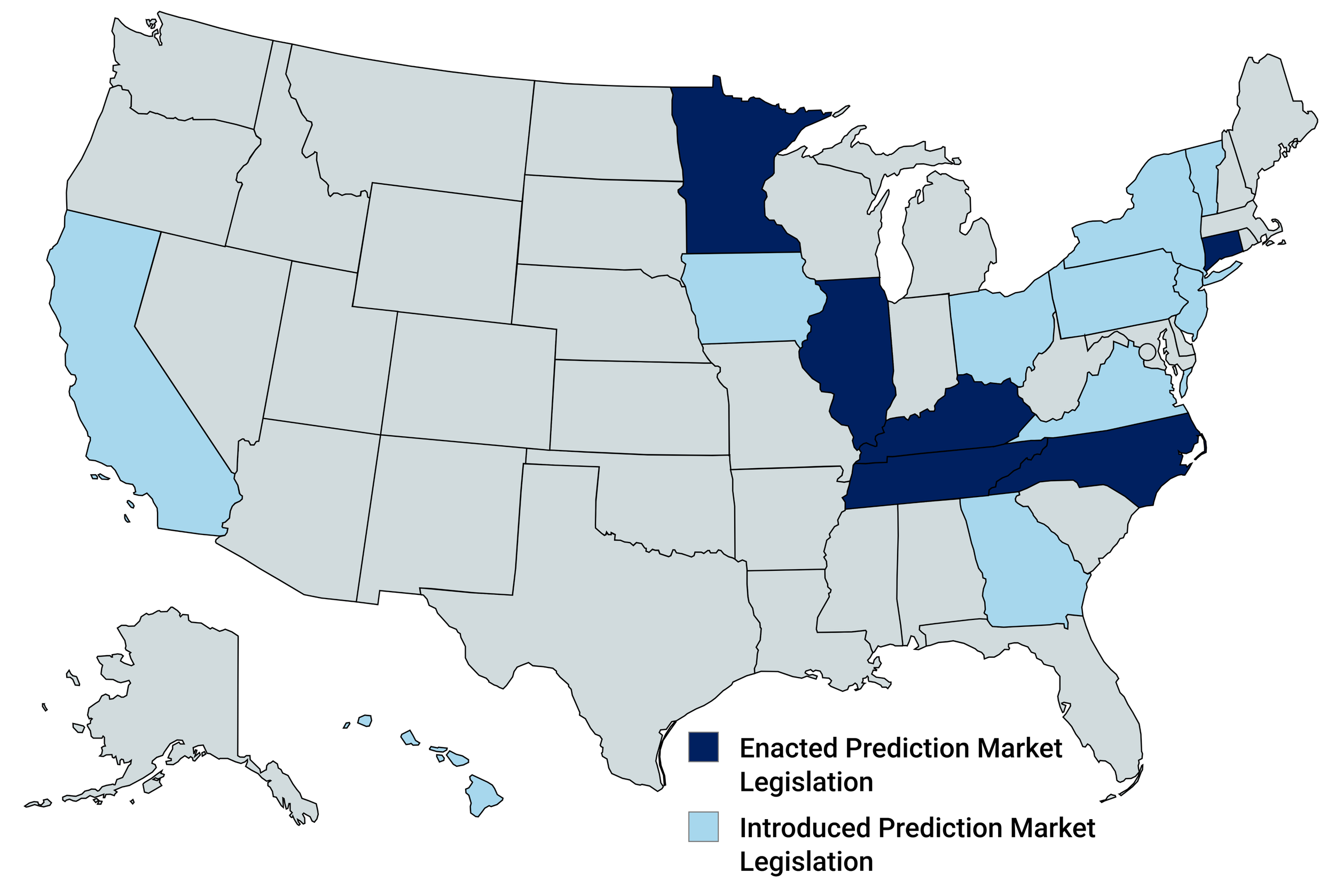
6 states enacted legislation related to prediction markets in 2026, while 10 states introduced prediction market legislation. The most common legislative actions were to impose taxes on prediction markets, prevent insider trading on prediction markets, and to study prediction markets. Adapted from Prediction Markets 2026 State Legislation - National Conference of State Legislatures.
Some states have attempted to outlaw prediction markets. Through SF3432, Minnesota chose to ban prediction markets from operating in the state, however, the law was blocked by the courts. A North Carolina survey found that 67% of respondents were “very or somewhat supportive” of banning prediction markets. West Virginia could opt to ban prediction markets in the state, though this would likely draw a lawsuit. Current prediction market users in the state may be opposed to a ban, as they may view prediction markets as a source of income.
Other states have opted to tax prediction markets, in order to make up what they consider lost gambling revenue. According to the American Gaming Association, states have lost more than $1.2 billion in tax revenue due to prediction markets. North Carolina imposed a 6% tax on prediction markets’ revenue, while Kentucky opted for a 14.25% tax. Kentucky is currently facing a lawsuit against its prediction market tax, while North Carolina has not yet been sued for its tax structure. This could be due to North Carolina’s lower tax rate. West Virginia has allowed sports betting since 2018, and online gambling (referred to as interactive wagering in code) since 2019. Revenue from these sources has been steadily increasing since their introduction. West Virginia collected more than $50 million in tax revenue from online gambling and sports betting in 2025. If the state wanted to impose a tax on prediction markets, a lower level such as North Carolina’s may insulate the state against lawsuits, while a higher tax rate would tax prediction markets more closely to similar activities.
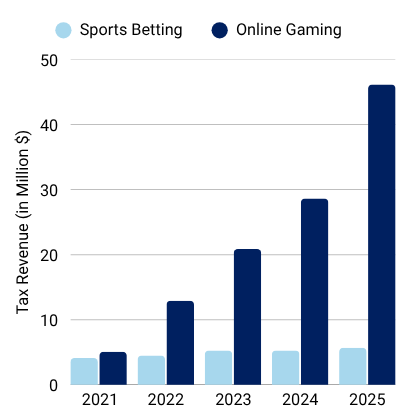
Tax revenues from sports betting and interactive online gaming have been increasing since their introduction in West Virginia. Adapted from 2023 and 2025 West Virginia Lottery Financial Reports.
A final policy option that states have decided to adopt is banning specific people from using prediction markets or criminalizing certain uses of the markets. Tennessee’s SB1992, made it a felony to impact the outcome of an event that an individual had purchased an event contract for. Several states, including Ohio, have introduced bills to prohibit public employees from using prediction markets. In April 2026, the US Senate banned its members from using prediction markets. West Virginia could opt for a similarly narrow restriction on prediction market use for elected officials or public employees, however, some may view this as an unnecessary step, as some platforms already restrict these individuals.
Alternatively, West Virginia could wait for further federal actions or a legal resolution between states and prediction market platforms before taking regulatory action. This would give the state increased legal clarity on its ability to regulate prediction market platforms, potentially avoiding costly lawsuits.
This Science and Technology Note was prepared by Madison Flory, PhD, West Virginia Science & Technology Policy Fellow on behalf of the West Virginia Science and Technology Policy (WV STeP) Initiative. The WV STeP Initiative provides nonpartisan research and information to members of the West Virginia Legislature. This Note is intended for informational purposes only and does not indicate support or opposition to a particular bill or policy approach. Please contact info@wvstep.org for more information.
Addendum: Legal Challenges
In the late 1800s, futures contracts were considered gambling. In 1905, the Supreme Court decision in the Board of Trade of Chicago v. Christie Grain & Stock Co. case stated that futures contracts were not considered illegal gambling. In 1974, the US Congress created the CFTC to regulate futures trading. The first prediction markets were started in 1988 from an academic research project designed to predict election outcomes, the Iowa Electronic Market. Since then, federal control of prediction markets and futures trading has strengthened, especially due to the actions of the 2010 Dodd-Frank Act, passed after the 2008 financial crisis. Today, the CFTC claims that sporting events can be included in prediction markets and that federal jurisdiction preempts state efforts to regulate prediction markets.
However, states have made attempts to regulate prediction markets. States reason that gambling regulation is under purview of the states, and that sports event contracts are “indistinguishable from traditional sports betting”, therefore, events contracts should also fall under state regulatory systems.
In 2026, 6 states passed laws to regulate prediction markets, and an additional 10 states introduced bills. Other states have opted to issue cease-and-desist letters to prediction market platforms, sue the platforms, or issue statewide opinions. The Attorneys General of 44 states signed a comment letter in opposition to proposed 2026 CFTC regulations. Additionally, several Native American tribal groups have sued prediction market platforms, arguing that access to prediction markets on tribal lands is in violation of federal law. Some cities, such as Baltimore, have also opted to sue prediction market platforms for violating consumer protections and misleading consumers.
In response to attempted state and tribal regulation of prediction markets, platforms have sued. They cite consumer safeguards and market regulations designed to protect against gambling addiction and prevent market manipulation, as well as current CFTC regulation. Court responses have been mixed, with decisions in Tennessee and New Jersey in favor of prediction market platforms, while cases in Ohio, Maryland, and Nevada sided with the states.
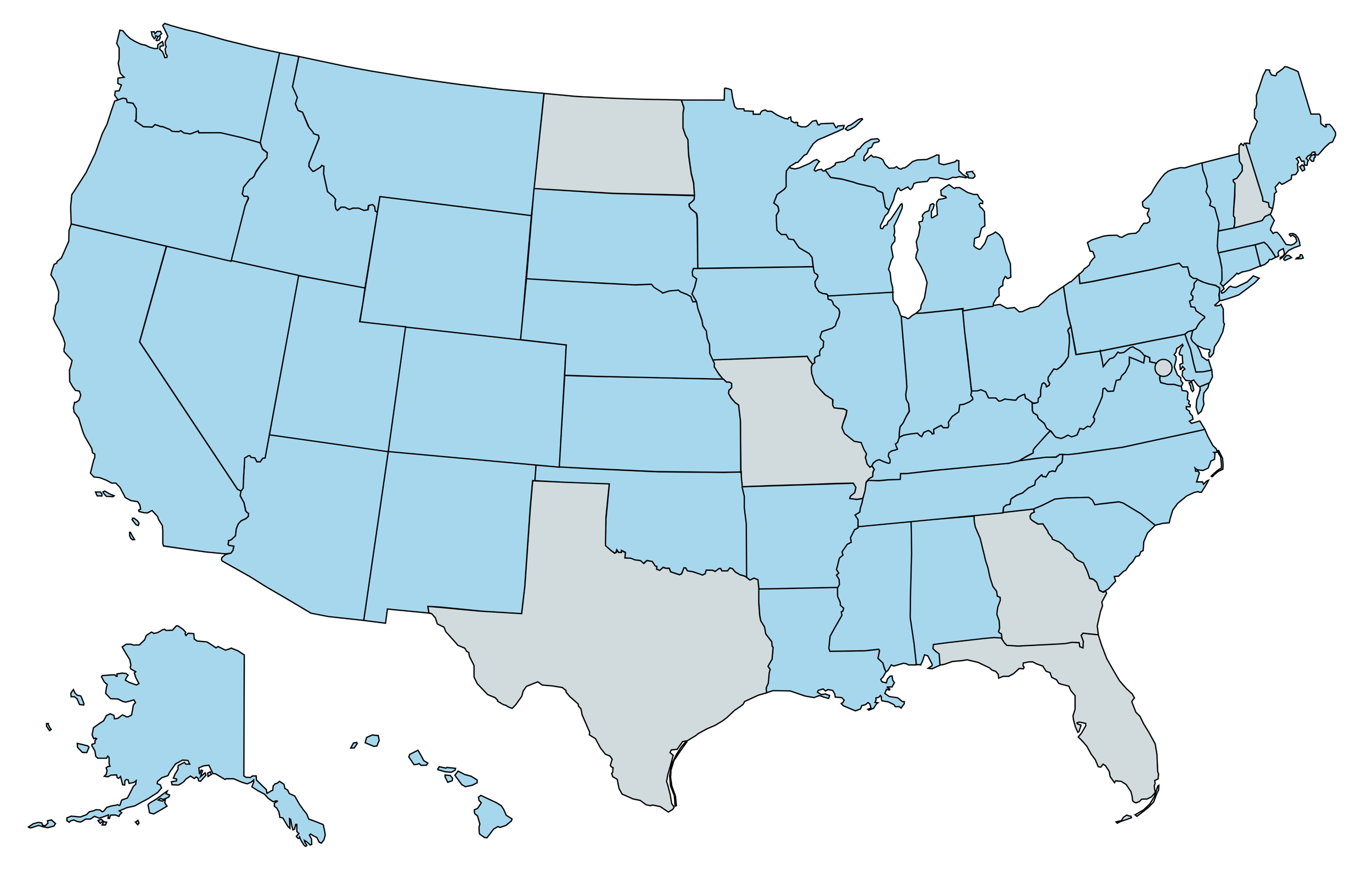
States in blue are those whose Attorney General signed onto the July 2026 letter opposing proposed federal regulations of prediction markets. Adapted from Comment on CFTC-2026-1189, CFTC-2026-1189-0001.
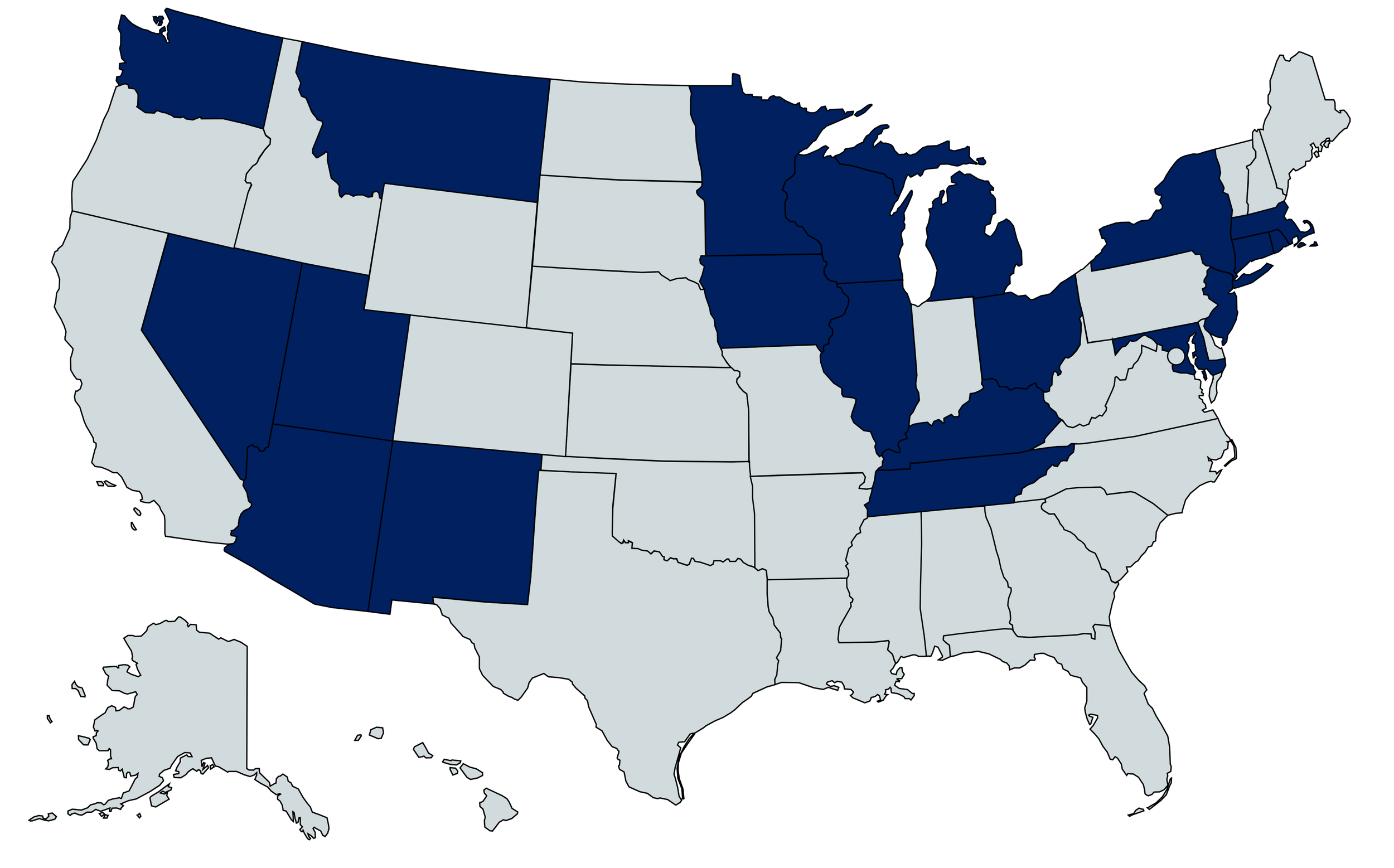
States in blue have issued cease-and-desist letters to prediction market platforms or are actively involved in lawsuits with prediction market platforms or the CFTC. Adapted from Multistate, National Council of State Legislatures, United States District Court - District of Minnesota, State of Rhode Island Superior Court, CFTC, State of Washington King County Superior Court, and Commonwealth of Kentucky Franklin Circuit Court.