
Post Election Audits in West Virginia
Post election tabulation audits ensure that the equipment and procedures used during an election worked correctly and yielded an accurate outcome. Almost all states have a statutory requirement to conduct a post election audit, though the form and extent varies. This Science & Technology Note provides an overview of audit methods, outlines West Virginia’s current procedure, and details post election audit procedures in surrounding states.
Updated February 10, 2026
Post election tabulation audits ensure that the equipment and procedures used during an election worked correctly and yielded an accurate outcome. Almost all states have a statutory requirement to conduct a post election audit, though the form and extent varies. This Science & Technology Note provides an overview of audit methods, outlines West Virginia’s current procedure, and details post election audit procedures in surrounding states.
Use of Post Election Audits
Public distrust in elections has been slowly rising over the past two decades, with a recent Gallup poll indicating that nearly 20% of respondents were ‘not at all confident’ that votes for president would be accurately cast and counted in the 2024 election. As hand counting and verifying each ballot is burdensome and expensive, post election tabulation audits of a portion of ballots can be performed to efficiently increase confidence in the election results. Post election audits are distinct from recounts, as they are performed routinely to check a small portion of ballots, regardless of the margin of victory in the election. However, an audit may trigger a full recount of all ballots if discrepancies are identified.
Research Highlights
Post election audits increase public confidence in elections by ensuring that equipment and procedures worked correctly and generated an accurate outcome.
Most states use batch-level comparisons of hand-counts and electronic tabulations from randomly selected voting machines or precincts in their post election audits.
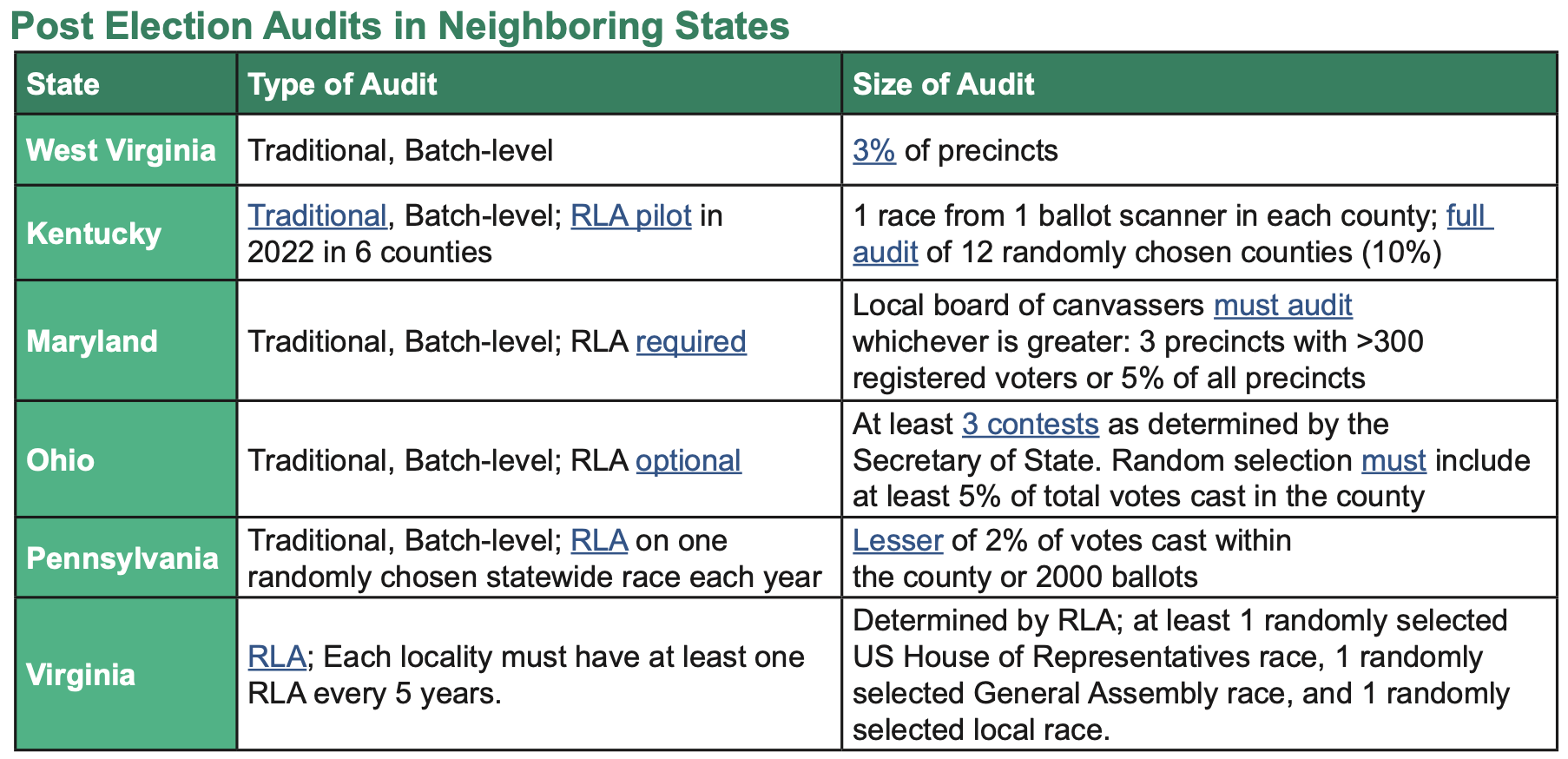
West Virginia requires counties to audit 3% of precincts. States surrounding West Virginia take a variety of approaches to their post election audits, including statewide risk-limiting audits, auditing a single race on a single voting machine in each county, or auditing 2-5% of precincts in each county.
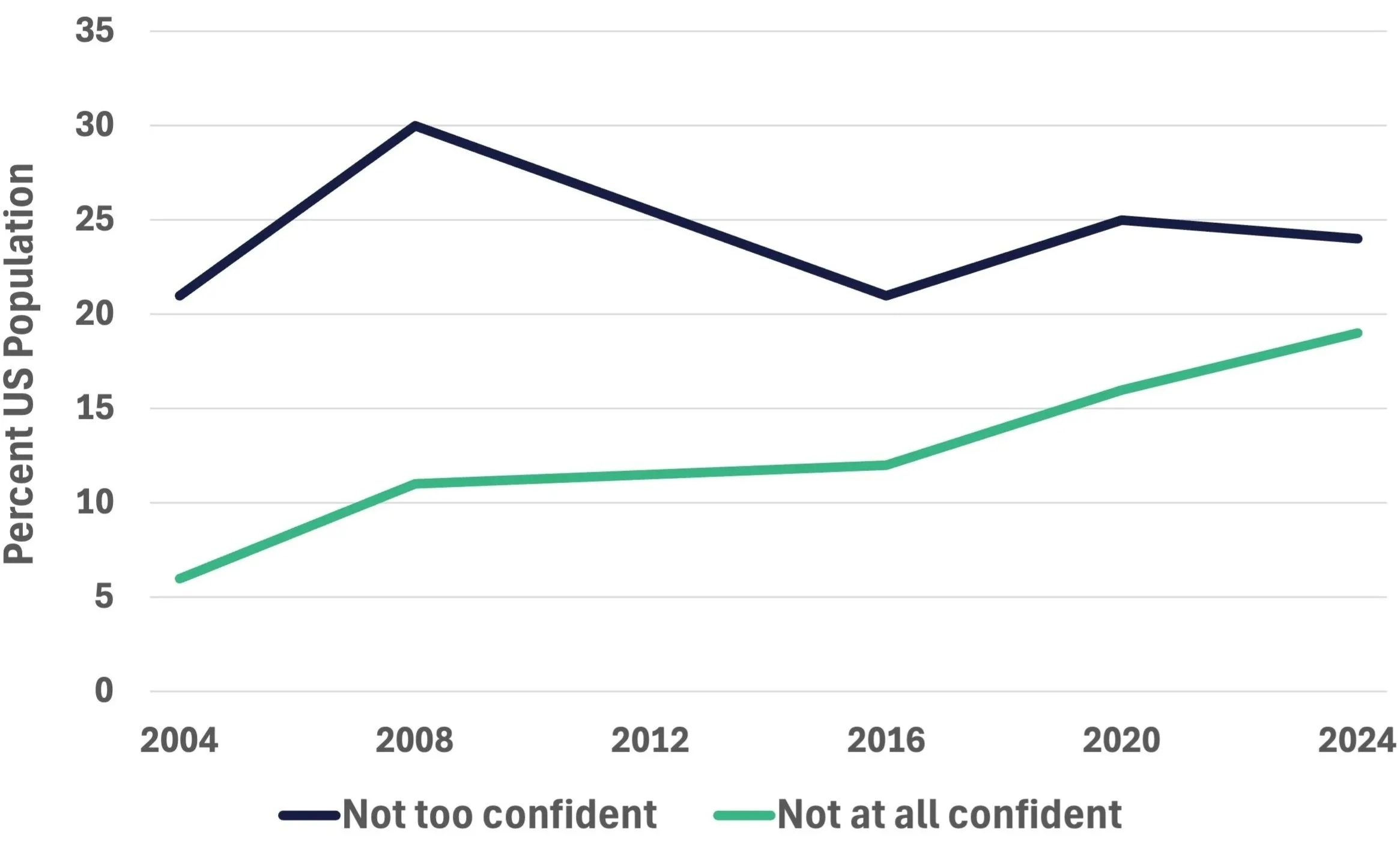
Results from a Gallup poll that asked respondents, “How confident are you that, across the country, the votes for president will be accurately cast and counted in this year’s election?”
Post Election Audit Procedures
There are two main methods used in traditional post election tabulation audits: batch-level comparison and ballot-level comparison.
In batch-level comparisons, an entire subset of ballots (one entire precinct or all votes cast on one individual machine) are chosen at random to be hand counted. The result of the hand count is compared to the originally reported vote totals. All results are aggregated, meaning issues with individual ballots may not be caught if there is an equal-but-opposite mistabulation. These are the most common types of audits, as they are compatible with different voting systems.
In ballot-level comparisons, single ballot cards are hand counted and compared to the machine-reported results for that individual ballot. This is the most efficient method, as fewer ballots have to be checked overall, and ensuring correct tabulation at the most basic level increases confidence in the system as a whole. However, many voting systems do not report identifiable single-ballot results, making ballot-level audits infeasible.
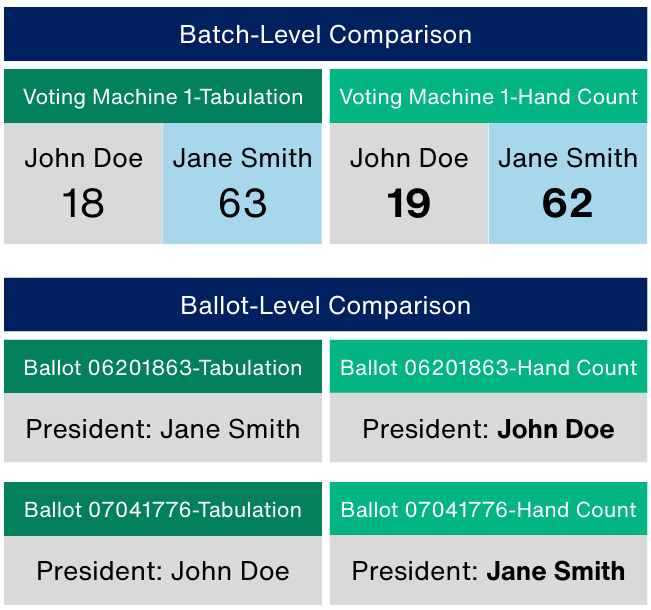
Example of batch- and ballot-level comparisons. While the result of this ballot-level comparison would not change the overall vote count, it could be indicative of a tabulation issue within a machine that may not be apparent in a batch-level comparison.
There are three main ways to determine how many ballots are audited: fixed percentage, tiered, and risk-limiting. Under a fixed percentage audit, the state or county sets a single number (usually 2-5%) of batches/ballots to be audited regardless of the outcome of the election. Tiered audits are similar, but the percentage of ballots sampled increases as the margin of victory decreases (i.e., close races would have a larger percentage audited).
Risk-limiting audits (RLAs) use a complex system of calculations that take into account the margin of victory, a set risk limit (the acceptable chance that flawed results are not caught), and the rolling number of errors found in the batch. The calculations and random selection can be done by RLA software such as Arlo, which is currently used in Georgia, Michigan, Pennsylvania, Nevada, Rhode Island, Virginia, Washington, Texas, and South Carolina. RLAs do not check a set number of ballots, but instead use an iterative process where small batches of ballots are hand counted and checked against the reported results until the sample size is large enough to give statistical confidence in the outcome. In a race with a very low margin of victory or high error rates, the RLA may determine the need to perform a complete recount. On the other hand, when the margin of victory is larger or the reported count is highly accurate, the RLA may only require a small sample size and be very efficient.
Post Election Audits in West Virginia
West Virginia currently requires a batch-level comparison to be performed on 3% of randomly chosen precincts. A single precinct in West Virginia can contain up to 1500 voters, and large counties may have nearly 200 precincts, requiring them to perform 6 hand counts. The Elections Division of the Secretary of State’s Office offers guidance for County Commissions to conduct the audits in the Canvass Best Practices & Procedures Guide.
This Science and Technology Note was prepared by Kensey Bergdorf-Smith, PhD on behalf of the West Virginia Science and Technology Policy (WV STeP) Initiative. The WV STeP Initiative provides nonpartisan research and information to members of the West Virginia Legislature. This Note is intended for informational purposes only and does not indicate support or opposition to a particular bill or policy approach. Please contact info@wvstep.org for more information.