Paraquat in West Virginia
Paraquat is a strong herbicide mainly used in agricultural settings to control weed growth. It is highly toxic to humans, with concerns that exposure could lead to Parkinson’s disease or even death. Therefore, the EPA restricts its use, and it is not available for residential use. This Science and Technology Note explores how paraquat is used, recent studies evaluating its association to Parkinson’s disease, and federal and state e proposals to further regulate paraquat.
Updated June 25, 2026
Research Highlights
Paraquat is a widely used herbicide, and users must pass an exam in order to use it due to its high toxicity.
There is concern over a possible association between paraquat use and Parkinson’s disease, though studies investigating an association are inconclusive.
The Legislature could seek to ban paraquat, similar to Vermont and 70 countries, though this would likely greatly impact corn farmers in the state.
What Is Paraquat?
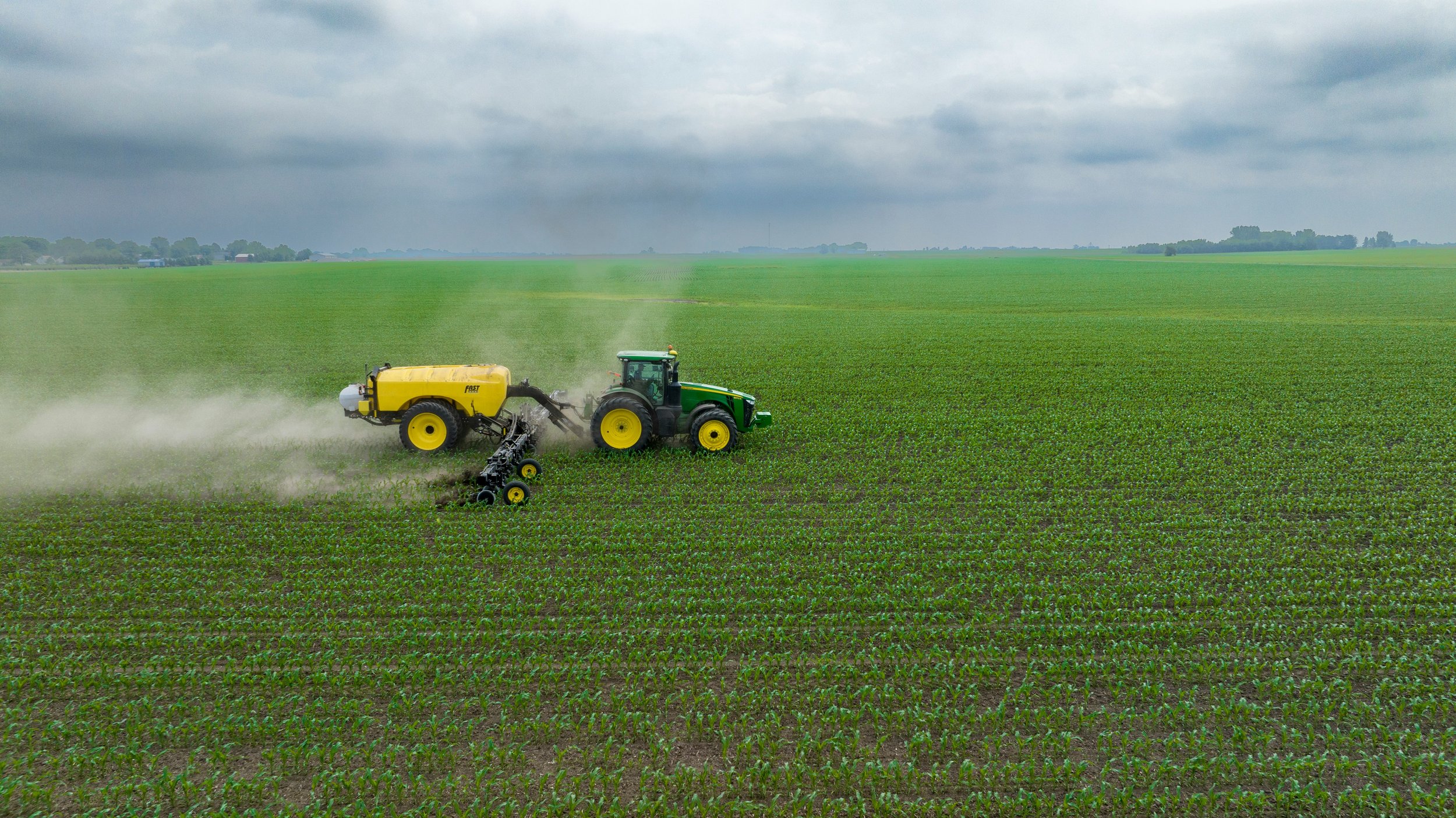
Paraquat is one of the most widely used herbicides in the US for commercial weed killing. It is primarily used in agricultural settings, though it may also be used in non-crop settings including pastures, airports, electric substations, and fence lines. Unlike selective contact herbicides, which are designed to kill specific types of weeds or vegetation, paraquat is a nonselective contact herbicide, meaning kills any vegetation with which it comes into contact. It ultimately works by disrupting their cell membranes, the protective barrier that keeps the cell’s components together, allowing the cellular components to leak out and causing the plants to wilt and die.
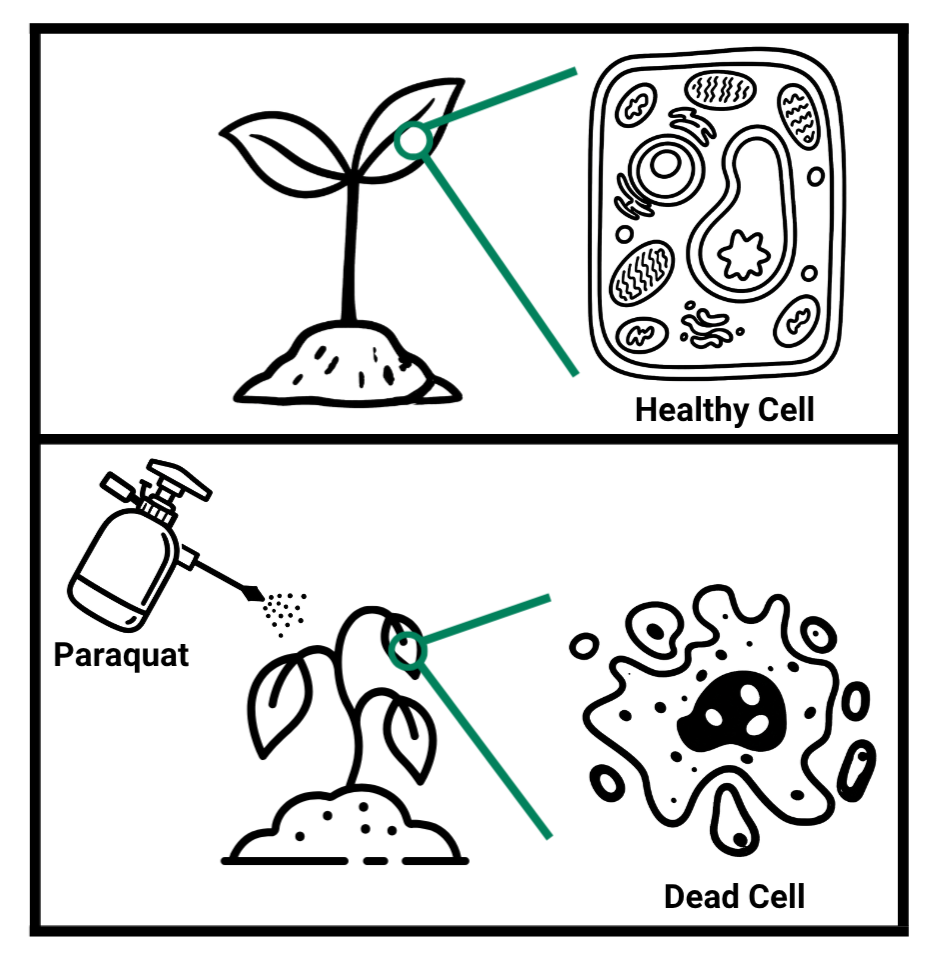
Paraquat works by disrupting cell membranes, causing plants to wilt and die.
Paraquat is classified as a restricted use product (RUP) by the US Environmental Protection Agency (EPA). RUPs cause serious injury to humans and may only be used by a certified user, they are not available for purchase by the public. Currently, the only EPA-approved certification course is provided by Syngenta, the predominant company that produces paraquat. The course is available online for free for anyone with a current pesticide applicator certification and must be retaken every three years. Pesticide applicator certification in West Virginia is overseen by the Department of Agriculture.
Paraquat Health Concerns
Paraquat is highly toxic to humans. Contact can cause rashes, burns, eye and nail damage, and nose bleeds. Ingestion may lead to mouth and throat irritation, stomach pain, vomiting, coma, muscle weakness, trouble breathing, or seizures. Ingesting less than one teaspoon of paraquat is enough to cause death. The EPA reports that there are ~1-2 deaths related to accidentally ingesting paraquat each year, however, additional risk mitigation efforts, including packaging requirements like labeling changes to highlight toxicity, are expected to decrease cases of accidental ingestion. In 2019, the EPA identified potential risks to people up to 150 feet from where paraquat is being used. They passed measures requiring minimum amounts of time before individuals could enter a field following paraquat application.
Paraquat and Parkinson’s
A concern over paraquat use is possible association with Parkinson’s disease (PD). PD is a progressive neurological disease that leads to a loss of movement and coordination. Symptoms generally include tremors, slowness, and rigid muscles. Certain medications help treat PD symptoms. Data from the US Centers of Disease Control and Prevention indicates that between 2014-2024 PD-related deaths, likely due to pneumonia caused by impaired swallowing or injuries from falling, increased in both the US and West Virginia. West Virginia has a higher rate of PD-related deaths than the US. Though it is unclear why, one possibility is an aging population and West Virginia has a higher median age (42.9 years) than the US (39.4 years).
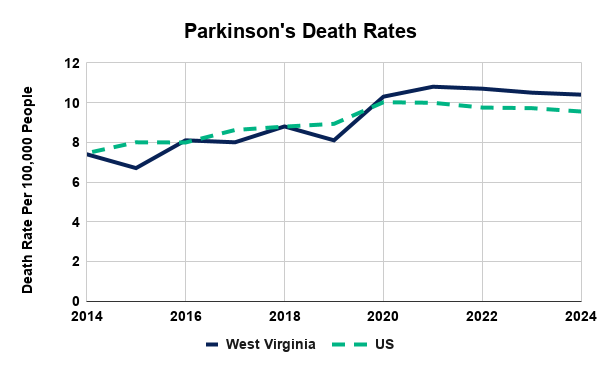
Data adapted from the US CDC.
The cause of PD is unclear, though certain genetic mutations and environmental exposures that are thought to play a role. One possible exposure includes paraquat, which is thought to accumulate in cells that die in PD patients and is molecularly similar to a toxin that has been associated with PD. Other possible risk factors include air pollution and traumatic brain injury.
The EPA performed a pesticide registration review for paraquat in 2019, evaluating its potential health risks. They found that most published results studying paraquat in animals used exposure methods that are not representative of exposure methods in humans. Therefore, it was difficult to make human safety determinations based on these studies. They also found that many studies looking at epidemiological data used differing study parameters, making determinations with available data difficult.
A 2020 EPA study investigated associations between paraquat and PD in North Carolina and Iowa pesticide users. They evaluated users for 20 years by having them answer questions about their pesticide use and PD diagnoses and found paraquat exposure led to an elevated risk of PD, though not statistically significant. This may have been because some participants were lost to follow-up, there may have been incorrect reporting on questionnaires, or there were not enough participants. Overall, the EPA reports that the evidence linking paraquat to PD in humans is inconclusive and more data is needed.
A 2024 study evaluating epidemiological data from California, however, found that paraquat led to an increased risk of PD. They analyzed data from people with workplace exposure to paraquat and residents living within 500 meters (0.31 miles) of a paraquat application area, as paraquat has been reported to drift up to 0.5 mile from an application area. This study found that using paraquat in the workplace increased one’s odds of developing PD by 115%, while residents living nearby had 91% increased odds of PD. Syngenta, a paraquat manufacturer, has argued that this study reports inconsistent data and there are conflicts of interest as two of the study authors are consultants on lawsuits against Syngenta over the possible role paraquat plays in PD.
State Policies
Legislation (HB 4907, 2026) was proposed in West Virginia to ban paraquat application within 1,000 feet (0.19 mile) of schools, however, it did not pass out of committee. This would have impacted croplands near at least 73 schools in West Virginia. A representative from the Department of Agriculture testified this would have harmed farmers’ ability to grow food and that paraquat is already sufficiently regulated. If passed, this would have been similar to 12 other states, including Virginia and Pennsylvania, that recently proposed legislation further restricting paraquat. Internationally, paraquat has been banned in at least 70 countries due to health concerns.
The Legislature could seek to ban paraquat. This would be similar to Vermont, which has a full ban going into effect in 2030. This may decrease potential risks for people working with or living near areas in which paraquat is applied. It may also have adverse effects on farmers that rely on paraquat for farming. Testimony to the Committee on Health and Human Resources indicated that the majority of paraquat in West Virginia is used on corn. As of 2025, West Virginia had 3.5 million acres of farmland, 41,000 (~1.2%) of which are for corn. It is unclear how many of these farmers use paraquat, and a ban would likely cause them to have to find alternative herbicides.
Alternatively, the legislature could yield to the EPA. The EPA regulates paraquat use and requires users working with it to have passed a certification exam. This would not change the status quo of paraquat use in West Virginia and would allow farmers to continue their current paraquat application without interruption. This could also allow time for more studies to demonstrate if there is an association between paraquat and PD. If there is a link between paraquat and PD, however, the EPA may take longer than the state to enact tighter restrictions or a ban, and a delay may put more people at risk of adverse effects.
This Science and Technology Note was prepared by Nathan G. Burns, PhD, West Virginia Science & Technology Policy Fellow on behalf of the West Virginia Science and Technology Policy (WV STeP) Initiative. The WV STeP Initiative provides nonpartisan research and information to members of the West Virginia Legislature. This Note is intended for informational purposes only and does not indicate support or opposition to a particular bill or policy approach. Please contact info@wvstep.org for more information.