Newborn Screening Revisions in West Virginia
Newborn screening can identify serious health conditions before symptoms appear, but states vary in how quickly they adopt new federal screening recommendations. This Science & Technology Note examines how West Virginia updates its newborn screening program and compares approaches used by other states.
Updated October 1, 2026
Research Highlights
There are federal recommendations for newborn screening, but states determine which conditions to include. West Virginia currently screens newborns for 40 conditions.
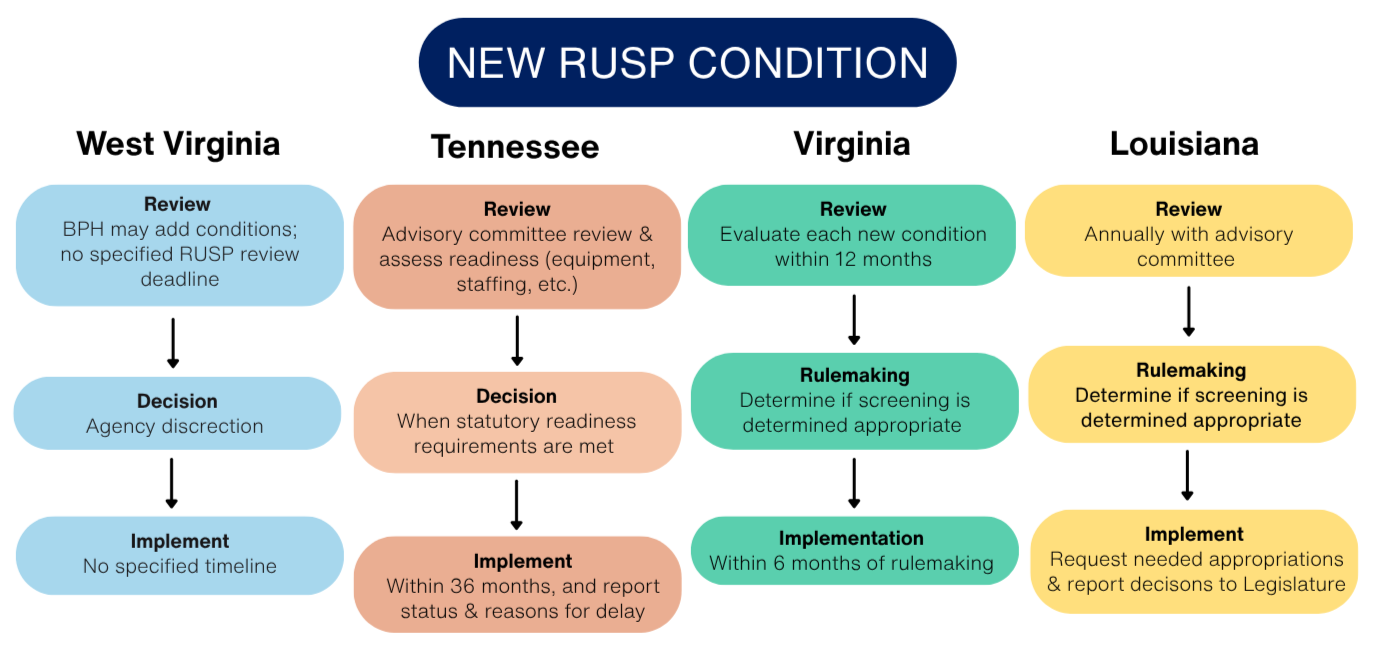
The West Virginia Bureau for Public Health has the authority to modify their screening panels, but state code does not specify a process or timeline for responding to new federal recommendations.
Other states have established approaches for updating their newborn screening panels in response to federal recommendations including review deadlines, expert review, implementation timelines, and legislative reporting.
What is Newborn Screening?
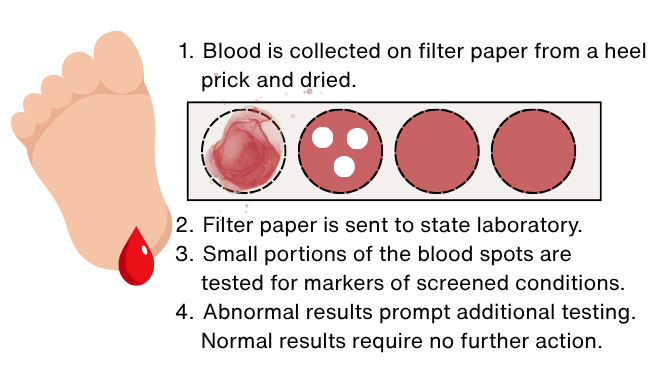
Newborn screening (NBS) is a public-health program that tests all infants for serious conditions that are not apparent at birth but can cause illness, disability, or death without early intervention. An abnormal result does not necessarily establish a diagnosis; additional testing is needed. NBS includes dried blood spot screening to identify genetic, metabolic and other disorders; hearing screening; and pulse oximetry to identify congenital heart defects. More than 3.6 million newborns are screened annually in the US, identifying more than 15,000 infants with conditions.
Early detection can change outcomes. For example, infants with phenylketonuria appear healthy at birth, but without treatment, a substance called phenylalanine can accumulate and cause irreversible brain damage. NBS allows for dietary management and other therapies to begin after birth, leading to normal health and development. Similarly, early identification of cystic fibrosis allows treatment for nutrition, respiratory health, and infections to begin before significant complications develop.
How are New Conditions Added?
The federal Recommended Uniform Screening Panel (RUSP) identifies conditions that the U.S. the Department of Health and Human Services (HHS) recommends for NBS. The RUSP is a national guideline rather than a federal mandate; states determine which conditions are included in their own screening panels. As of December 2025, there are 40 conditions listed. The federal process for evaluating new conditions to be added to RUSP is currently changing. The federal advisory committee that previously reviewed candidate conditions was terminated in March 2025. In August 2026, HRSA announced a new framework that will use a stakeholder workgroup, independent evidence reviews, public meetings, and HRSA review before recommendations are made to the HHS Secretary about RUSP updates.
Newborn Screening in West Virginia
West Virginia law requires NBS and directs the Bureau for Public Health (BPH) to administer the state program. Blood-spot collection is required within 48 hours of birth or before discharge, whichever occurs first, including for births outside a hospital. Birthing facilities, providers, parents or guardians, or others attending the birth are responsible for NBS to occur according to state law. Violation of the newborn-screening article is guilty of a misdemeanor and, upon conviction, may be fined $25–$50. West Virginia’s screening fee is $241.35, which also covers repeat screening if the initial blood sample is inadequate or produces an abnormal result. State code prohibits denying screening because of inability to pay and the BPH may bill the birthing facility. Screening is a covered benefit under PEIA, CHIP, Medicaid, and most health insurance plans. West Virginia is updating its administrative rules for NBS by consolidating the separate rules for blood-spot screening, hearing screening and congenital heart defects screening and establishes requirements for testing, referrals, reporting, and follow-up. State law permits parents to refuse newborn hearing screening when there is no third-party payer but does not specify exemptions for other newborn screening services. Currently, West Virginia screens for 40 conditions, in alignment with RUSP.
Keeping Up with New Recommendations
A federal recommendation does not automatically add a condition to a state’s NBS program. Implementation may require new equipment and testing methods, staff and provider training, follow-up testing, referrals to specialists, access to treatment, and additional funding and affect how quickly a state can begin screening. The BPH can modify West Virginia’s NBS program through statute and legislative rule, but state law does not establish a process for evaluating potential. The 2026 rule proposal consolidates existing screening requirements but does not create such a process.
This Science and Technology Note was prepared by Anika Zaman, PhD, West Virginia Science & Technology Policy Fellow on behalf of the West Virginia Science and Technology Policy (WV STeP) Initiative. The WV STeP Initiative provides nonpartisan research and information to members of the West Virginia Legislature. This Note is intended for informational purposes only and does not indicate support or opposition to a particular bill or policy approach. Please contact info@wvstep.org for more information.
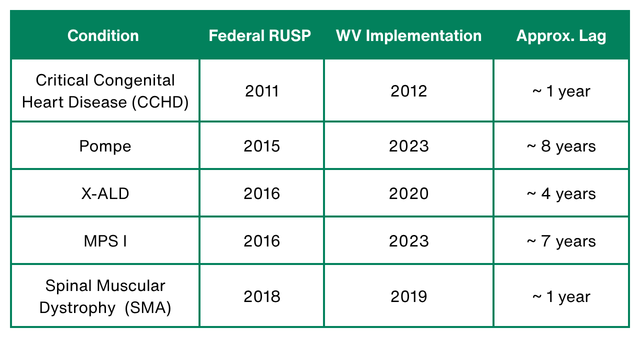
West Virginia's implementation time has varied by condition, from about one year for CCHD and SMA to seven or more years for MPS I and Pompe disease. Data from NewSTEPs (2024).
Approaches in Other States
Historically, adoption of new RUSP conditions has varied considerably across states and within West Virginia. For example, West Virginia implemented screening for critical congenital heart disease and spinal muscular atrophy about one year after federal recommendation. Other conditions took longer: Pompe disease was recommended in 2015 and implemented in 2023. Nationally, implementation timelines also vary; universal adoption took 9 years for severe combined immunodeficiency (SCID) and nearly 7 years for critical congenital heart disease.
Virginia requires its Department of Health to evaluate each RUSP condition, including the estimated cost of adding it to the screening program and the impact on the state’s NBS fee. For conditions added to the RUSP after January 1, 2025, the department must complete its evaluation and begin rulemaking if it determines screening is appropriate within 12 months. If the condition is added, screening must begin within 6 months after the rule takes effect. The law also allows conditions initially rejected to be reconsidered as evidence changes.
Louisiana uses a recurring review model with a goal of implementing RUSP conditions within 2 years. An advisory committee reviews potential additions to the NBS program at least annually, including conditions added to the RUSP. They report decisions to the legislature and may request additional appropriations to implement additional screenings. This approach connects scientific review with legislative oversight and funding decisions.
Tennessee links RUSP recommendations to state implementation and laboratory readiness. State law requires screening to begin after requirements including a reliable test, quality-control materials, advisory committee approval, necessary equipment, test validation, and staffing are in place. If a RUSP condition has not been implemented within 36 months, the Department of Health must report the status and reason for the delay to legislative and advisory bodies and continue reporting annually until screening begins. This approach establishes an expectation for implementation without requiring the state laboratory to begin screening before it is prepared.
Considerations for West Virginia
For West Virginia, review requirements, implementation timelines, and legislative reporting are separate policy choices. A review deadline could provide predictability while preserving BPH's authority to determine whether a condition is appropriate. An implementation deadline could reduce delays but may need flexibility when laboratory testing, confirmatory testing, specialist referral pathways, or treatment capacity are not yet in place. Legislative reporting could provide information about costs and barriers without requiring that every RUSP condition be adopted.