West Virginia K-12 Vaccine Requirements
Vaccines are tools used to help our bodies learn how to fight diseases, and studies suggest they have helped to prevent over a million deaths nationwide. Recent legislation seeks to provide increased accessibility to exemptions from school vaccine mandates. This Science and Technology Note provides an overview of vaccines, proposed legislation, and policy options and insight West Virginia could seek regarding vaccines.
Updated April 10, 2026
Research Highlights
The World Health Organization, among other groups, view vaccines as a life-saving public health measure. However, some are vaccine hesitant due to religious or safety concerns.
West Virginia requires students in school or child care to be vaccinated against 10 diseases.
There are several options West Virginia could pursue modeled after current requirements or other states.
What Are Vaccines?
Vaccines help the body fight diseases. Vaccines train the immune system to recognize an antigen, a specific piece on the outside of a pathogen (something that can make you sick), similar to how we can recognize different people based on their faces. There are various types of vaccines, though the two that are primarily used for childhood vaccines are live-attenuated and inactivated vaccines. Live-attenuated vaccines, like the chickenpox vaccine, use a weak version of the pathogen that does not typically cause disease. This gives your immune system an advantage, like a boxer fighting someone who had just been knocked out in the ring a few minutes prior. Inactivated vaccines, like the flu shot, use dead versions of the pathogens and usually require boosters.
Vaccines are celebrated by public health organizations, considering them to be the “greatest” public health initiative. The US Centers for Disease Control and Prevention (CDC) estimates that vaccinating US children born between 1994-2023 will avoid over 1 million deaths.
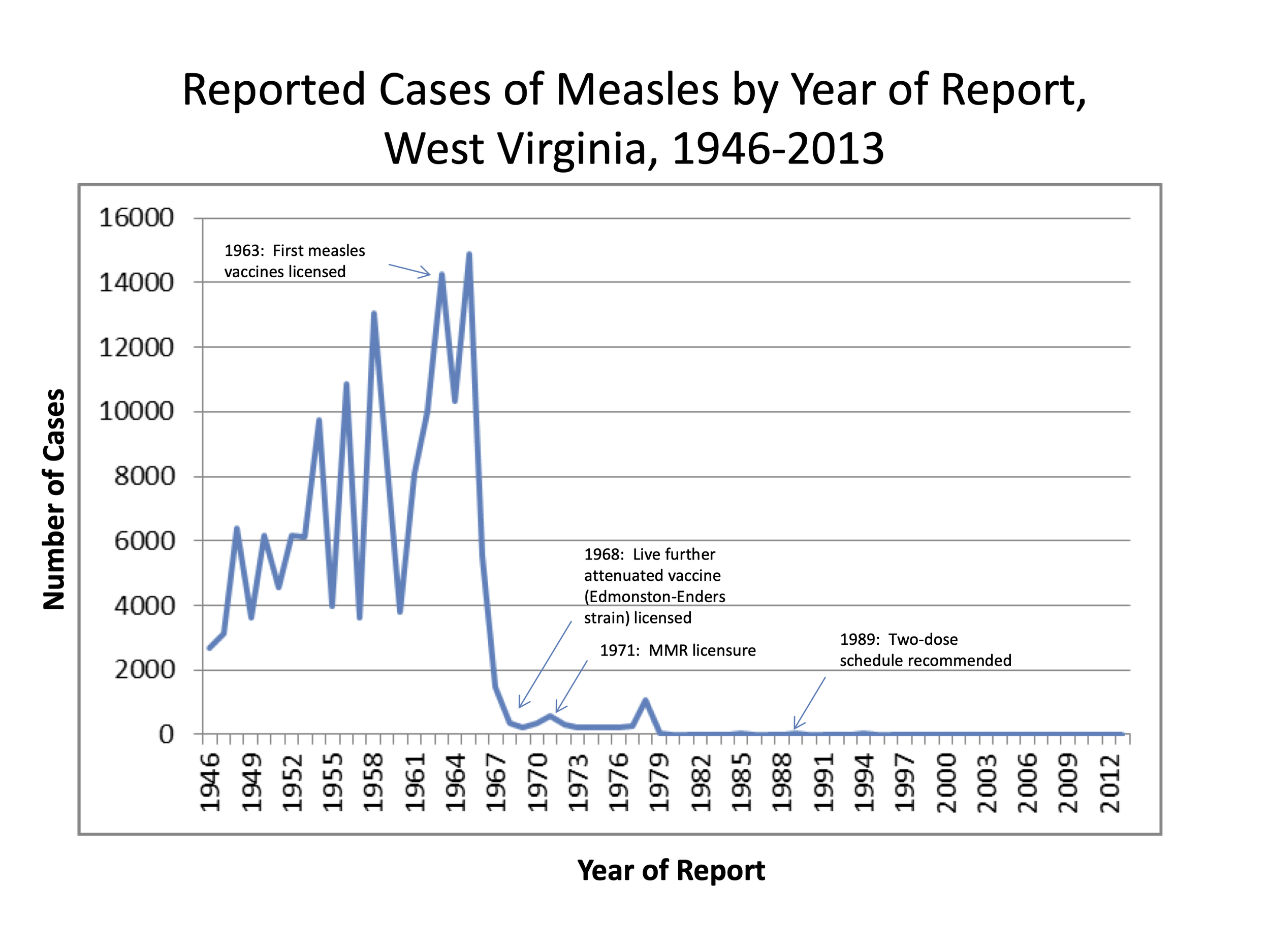
Measles cases in West Virginia have been reduced since the introduction of the vaccine in the 1960s, with zero reported cases between 2009 and 2024.
Courtesy of the West Virginia Office of Epidemiology and Prevention Services
Vaccine Hesitancy
While vaccines are widely celebrated, some individuals worry about receiving a vaccine. One reason people may not receive a vaccine is if their medical provider indicates a contraindication, or a medical reason to not get it. These may include having a severe reaction to a previous vaccine; having an immune deficiency due to conditions like cancer, HIV, or a recent transplant; or being pregnant. Religious beliefs are another reason people may choose not to be vaccinated. Some religions object to vaccines due to certain components used to make them. Others consider vaccines unnecessary because they believe disease, or protection from it, is divine fate. Though religion has been cited as a cause to be hesitant toward vaccines, Jewish, Islamic, Catholic, and Evangelical faith leaders have publicly recommended getting vaccinated and described it as a way to care for yourself and others.
Some worry about vaccine safety and side effects. The US Food and Drug Administration has a strict review process prior to any vaccine being administered. They also monitor and evaluate vaccines after their approval to ensure continued safety and monitor side effects. The most common side effects include mild pain or swelling, chills, fatigue, or a mild fever. More serious side effects are rare (~1 in 1 million people), but may include elevated heart rate, dizziness, or difficulty breathing.
K-12 Vaccines in West Virginia
Students entering school or a child care facility must be vaccinated against 10 different diseases. West Virginia, along with all other states, allow exemptions for medical reasons. To receive a medical exemption, a physician must submit a request to the State Immunization Officer with medical reasoning. About 35 medical exemptions are approved in West Virginia per school year (SY) [1].
Recent efforts have sought to expand exemptions in West Virginia. Executive order (EO) 7-25 (January 2025) allows religious and personal exemptions, similar to 15 other states. However, because West Virginia law requires vaccination, the Department of Education (DEd) advised schools to maintain requirements. A later lawsuit found these exemptions permissible. Shortly later, the Supreme Court ordered the exemptions to be discontinued pending trial. Because of this, DEd is continuing to advise schools to enforce vaccine requirements. At the same time, the Office of Epidemiology and Prevention Services is still taking religious exemption requests. During SY 24-25, 331 religious exemption requests were submitted, rising to 697 for SY 25-26 [1].
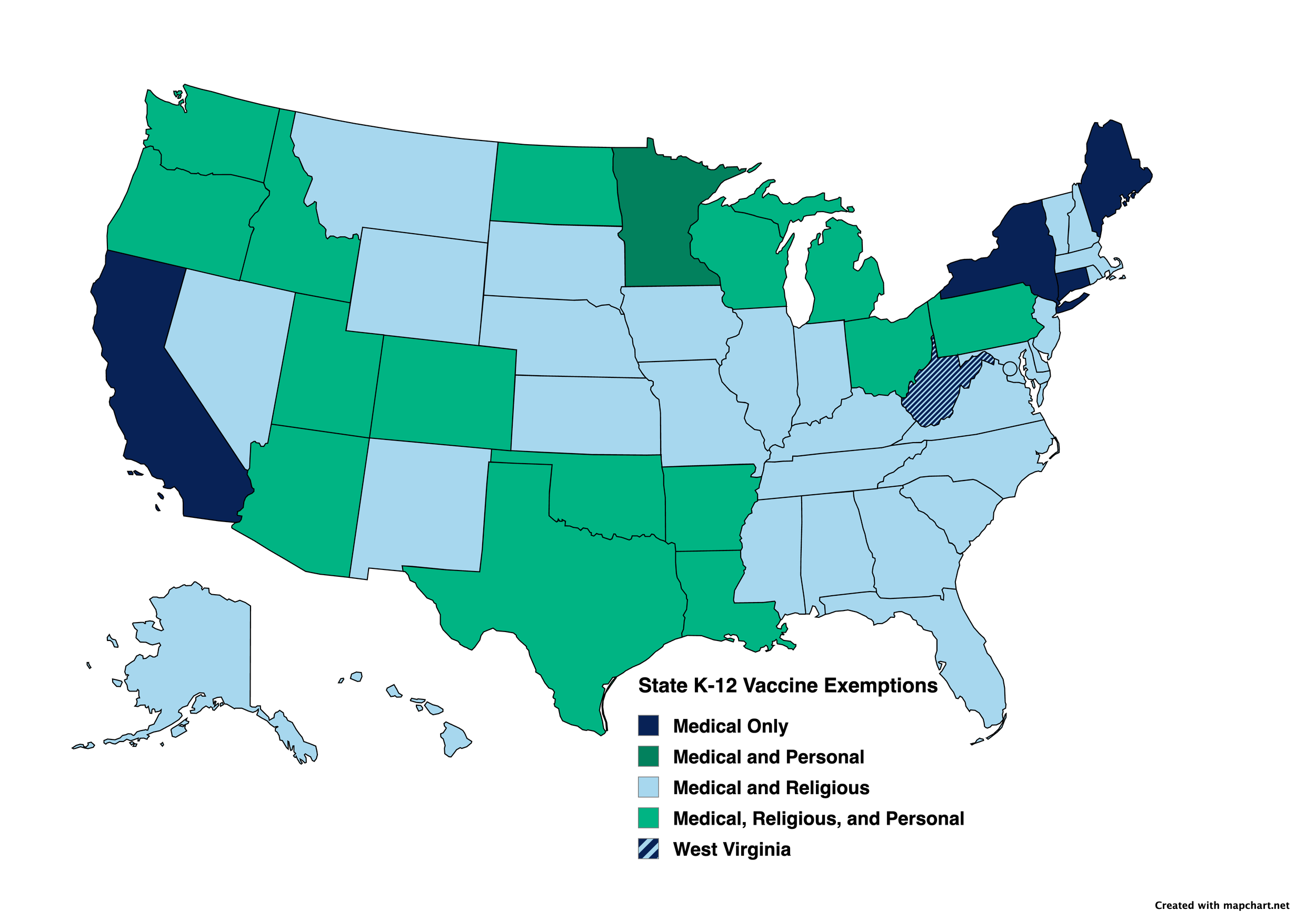
West Virginia is striped due to a pending hearing at the Supreme Court of Appeals. Based on data from the National Conference of State Legislatures.
West Virginia has the lowest kindergarten vaccine exemption rate in the country. In SY 23-24, vaccine exemptions were given for less than 0.1% of all kindergarteners, lower than the national average of 3.3%. There have been few reported diseases for which K-12 students are required to be vaccinated in West Virginia. For example, statewide, there have been 2 reported cases of measles in the past 30 years: one in 1997 and one in 2009. There is concern that lower vaccination rates will lead to increased disease prevalence, as has been seen in the last two years with increasing measles cases nationwide, including a recent outbreak in South Carolina leading to at least 920 cases.
State Actions
Several collaborative efforts have been established between states in response to the CDC changing vaccine recommendations.. These include the Northeast Public Health Collaborative, the West Coast Health Alliance, and the Governors Public Health Alliance. These coalitions seek to share public health information and provide vaccine recommendations, including recommending vaccine guidelines based on the American Academy of Pediatrics, a national group of pediatricians.
Other states have acted to decrease vaccine requirements. This reflects a nationwide trend of decreased kindergarten vaccination coverage. Idaho passed a bill in 2025 to prohibit schools from requiring vaccinations, however this was later vetoed. Similarly, Florida’s governor and surgeon general are pushing to repeal vaccine requirements for several diseases for students.
Several bills have been introduced to alter vaccine mandates in West Virginia, though none of them advanced out of committee. HB 4168 would have permitted medical exemptions to be made to a school administrator rather than the State. SB 237 sought to prohibit vaccine requirements for any purpose. HB 4947 sought to codify the governor's EO and allow religious exemptions for students. HB 4070 would have allowed people that have previously contracted a disease and obtained natural immunity to be considered fully vaccinated. Though the science is inconclusive about whether natural immunity is more or less effective than vaccination, it likely varies by disease and person, and it is unclear what would suffice as sufficient evidence of natural immunity.
West Virginia could seek fewer vaccine requirements as has been proposed by these pieces of legislation. While many people have advocated for fewer vaccine requirements, a recent study from Stanford University suggests that declining vaccination rates will lead to a resurgence of diseases like measles, polio, diphtheria, and rubella. This may increase the need for medical care, potentially straining the medical system.
The legislature could instead seek to reaffirm the current K-12 vaccine requirements. This would maintain that exemptions may only be given for medical reasons. A study from Harvard University found that repealing vaccine exemptions led to higher vaccine rates in children.
[1] Based on communication with the DoH Director of Communications
This Science and Technology Note was prepared by Nathan G. Burns, PhD, West Virginia Science & Technology Policy Fellow on behalf of the West Virginia Science and Technology Policy (WV STeP) Initiative. The WV STeP Initiative provides nonpartisan research and information to members of the West Virginia Legislature. This Note is intended for informational purposes only and does not indicate support or opposition to a particular bill or policy approach. Please contact info@wvstep.org for more information.