Ibogaine in West Virginia
Ibogaine is a drug derived from a Central African plant that has been gaining attention for its use in treating opioid use disorder and mental health conditions, including PTSD, depression, and anxiety. This Science and Technology Note describes opioid use and mental health in West Virginia, studies investigating ibogaine’s use in treating opioid use disorder and mental health conditions, and different ibogaine policies West Virginia could explore.
Research Highlights
West Virginia has high rates of opioid use disorder and increasing rates of PTSD, anxiety, and depression.
Studies have found that ibogaine treatment reduces addiction symptoms and improves mental health, though the studies are small.
West Virginia could fund for ibogaine research similarly to 8 other states or encourage alternative treatments that have already received approval.
What is Ibogaine?
Ibogaine is a psychedelic drug that is obtained from the iboga plant from Central Africa traditionally used in rituals. Studies investigating ibogaine as a treatment option for patients with opioid use disorder (OUD) began in the 1990s with generally positive results. It is also studied for its use in treating mental health conditions like posttraumatic stress disorder (PTSD), depression, and anxiety. Support for ibogaine treatment has been increasing, including from US Health and Human Services Secretary Kennedy. The US classifies ibogaine as a schedule 1 drug, indicating that it does not have a medical use and it has a high likelihood for abuse. It also carries serious side effects including strong hallucinations, abnormal heart rhythms, and seizures. Though still unavailable in the US, ibogaine is legally offered in medical clinics in other countries, including Mexico and Canada.
Opioid Use in West Virginia
West Virginia had the highest rate of opioid-related deaths in the country from 1999-2023. This likely results from the history of the opioid crisis in Appalachia, particularly in West Virginia. The rate of opioid-related overdose deaths in West Virginia has historically been above both the national average and the rates of all surrounding states. Between 2023 and 2025, there were sharp decreases in the number of opioid-related overdose deaths. Some experts attribute decreased opioid prescriptions, thus less access to opioids, as well as reductions in the amount of fentanyl entering the country. Additionally, public access to naloxone to reverse opioid overdoses may also help decrease opioid-related overdose deaths.
Mental Health in West Virginia
Mental health conditions are increasing in West Virginia. The Department of Health’s 2021 Mountain State Assessment of Trends in Community Health report found that 24.3% of West Virginians were diagnosed with depression, anxiety, or PTSD. This increased to 26.3% in their 2023-2024 report. Additionally, an analysis from Mental Health America found that West Virginia had the highest average rates of both depression and PTSD in the region between 2020-2025.
Ibogaine Treatment
Ibogaine may be used to treat opioid drug-seeking behavior and some mental health conditions including PTSD, depression, and anxiety. Ongoing research into how ibogaine functions suggests that it alters receptors on cells that are involved in opioid addiction and anxiety. There have been several studies investigating ibogaine’s effects on both OUD and mental health.
A 2017 study investigated ibogaine to treat patients with OUD. This study found ibogaine lowered withdrawal symptoms immediately after treatment and decreased addiction and depression symptoms one year after treatment. This study analyzed 14 patients, which may not be enough to draw strong conclusions. Additionally, these patients were already seeking OUD treatment, which may have led to higher opioid use cessation. One patient died during treatment, likely due to side effects, though they were not discussed. A review found that ibogaine is more effective than buprenorphine for treating opioid use disorder, however, it concluded more research is needed for definitive results.
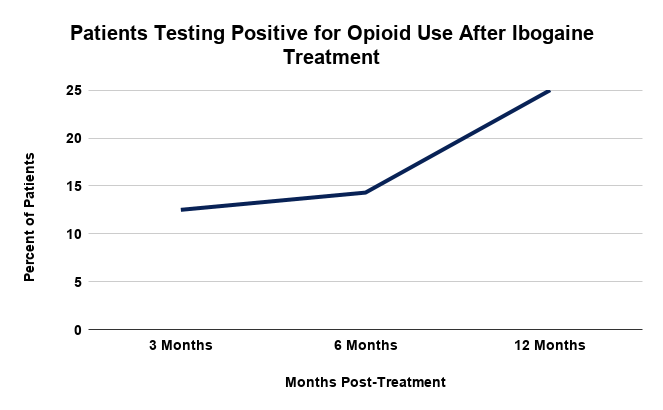
The percent of patients testing positive for opioids after ibogaine treatment increased after 3-12 months. Adapted from Noller et al. 2018.
One 2024 study investigating ibogaine’s effectiveness treating veterans exhibiting PTSD, anxiety, or depression found that ibogaine improved PTSD and anxiety symptoms 1 month after treatment. There were 30 veterans involved in this study. They also reported that they administered magnesium to prevent heart complications. They did not report serious side effects. However they did not investigate ibogaine in women, who may react differently than men.
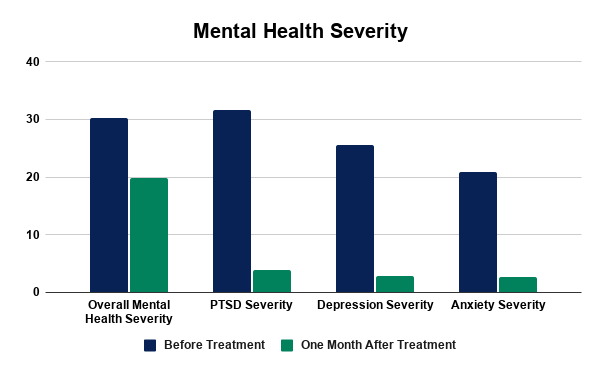
Average mental health severity scores before and after ibogaine treatment among 30 veterans. Higher ratings indicate more symptoms. Adapted from Cherian et al 2024. Tests to evaluate scores were: WHODAS-2.0 (overall mental health), CAPS-5 (PTSD), MADRS (depression), and HAM-A (anxiety).
Some scientists argue ibogaine is not beneficial. Ibogaine does not just impact the brain and can have random effects all over the body. They say this could have other effects, including heart complications which likely played a role in at least 12 of the 19 ibogaine-related deaths reported between 1990-2008. Current research aims to find a synthetic version that would specifically bind to the cells needed to treat relevant conditions. A molecule was identified in a laboratory setting in 2023, however, further testing is needed before human trials.
State Policies
West Virginia passed HB 4626 (2026) to establish a public-private partnership grant program to provide matching funds to perform ibogaine clinical trials. However, Governor Morrisey later vetoed this legislation on the grounds that drug trials should be left to the private sector. Similarly, legislation was vetoed in Kentucky on the grounds that it was too narrow in scope and public money cannot fund private companies. Eight other states, including Tennessee and Maryland, have introduced similar legislation but have not advanced it out of committee.
Texas allocated $50 million to an ibogaine research program in 2025 and plans to tap federal funds from an April 2026 executive order. Advocates applauded Texas for pioneering ibogaine research. Critics said it may be hard to incentivize companies to participate due to requirements to relocate to Texas, match funds, and commit 20% of future sale revenue to Texas.
Arizona approved funding for ibogaine research through their appropriations bill. They approved a $5 million grant program and do not have a funding match requirement from awardees. If West Virginia were to continue to pursue ibogaine research funding, one option could be to include it in the appropriations bill, though it may be vetoed for similar reasons as before. Funding would likely need to be reoccurring as drug development cost estimates are around $2-3 billion dollars, however, costs may be lower because ibogaine has already been developed and would only need to be clinically tested.
West Virginia could seek alternative medications to treat OUD. Some researchers argue that medications already approved for OUD like buprenorphine and methadone are underutilized. One study found these decrease opioid-related deaths up to 59%, though they are not often prescribed. The Legislature could seek medical education requirements for clinicians to learn more about these options, which could provide an alternative to ibogaine use. Many of these medications need to be taken regularly which may be a barrier to care. Furthermore, while they treat OUD, they do not treat mental health conditions.
This Science and Technology Note was prepared by Nathan G. Burns, PhD, West Virginia Science & Technology Policy Fellow on behalf of the West Virginia Science and Technology Policy (WV STeP) Initiative. The WV STeP Initiative provides nonpartisan research and information to members of the West Virginia Legislature. This Note is intended for informational purposes only and does not indicate support or opposition to a particular bill or policy approach. Please contact info@wvstep.org for more information.