Hydroponic Farming in West Virginia
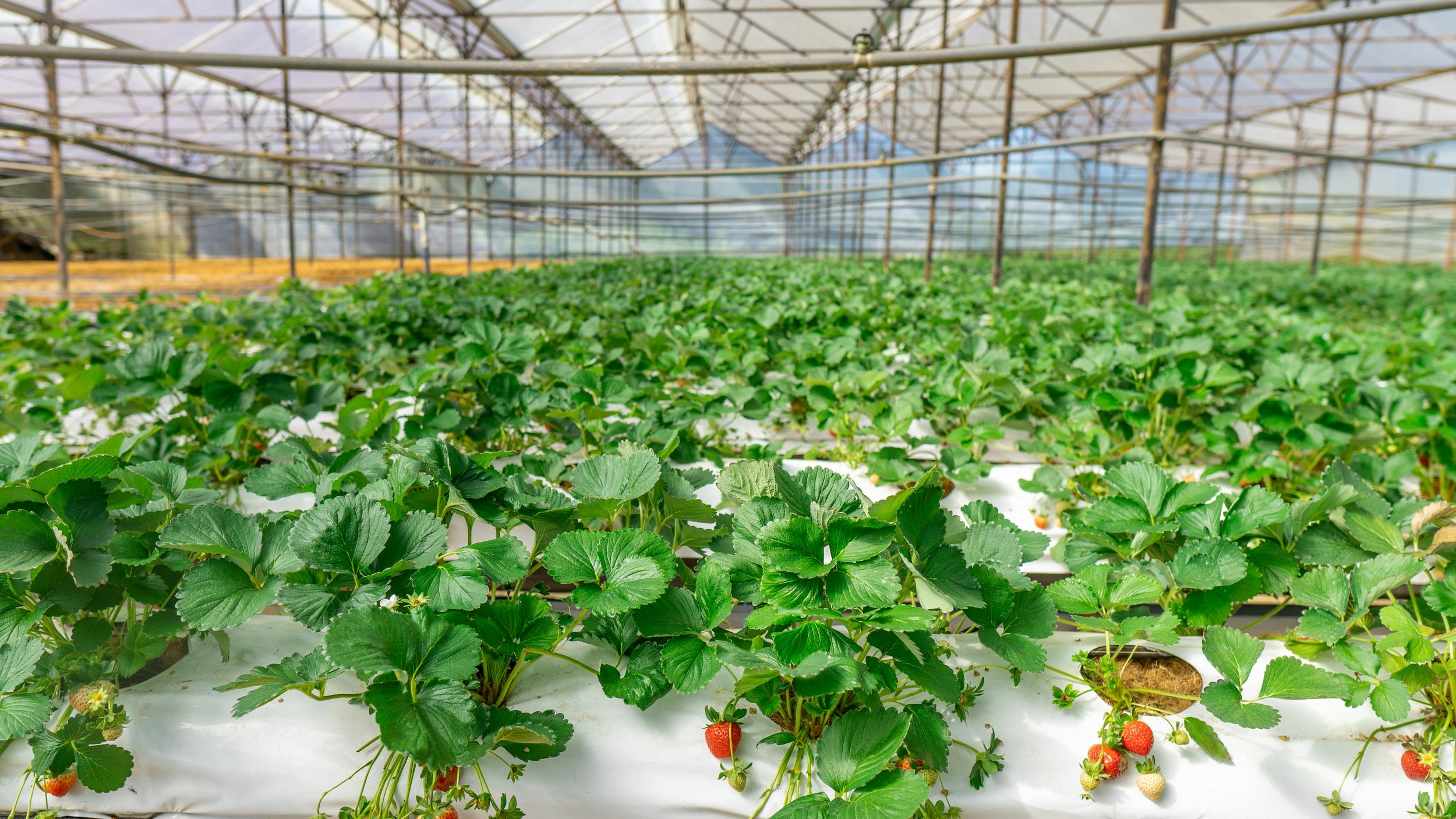
Hydroponic farming enables crops to be grown in a nutrient-rich water solution instead of soil. This allows crops to be grown anywhere year-round, can produce many harvests each year, and could help combat food scarcity. This Science and Technology Note explores how hydroponic farming works, compares different hydroponic techniques, and policies other states are implementing to support this practice.
Updated December 10, 2025
Research Highlights
Hydroponic farms grow plants in nutrient-rich water instead of soil and require less water than soil farms.
There are hydroponic farms operating in West Virginia, including in some schools, which produce hundreds of thousands of pounds of fresh produce each year.
West Virginia offers grants and low-interest loans to growers and taxes agricultural property at a lower rate than commercial property.
An industrial property near Washington, DC was converted into a hydroponic farm, which could similarly be done in some of West Virginia’s 77 industrial properties for sale.
Hydroponic farming enables crops to be grown in a nutrient-rich water solution instead of soil. This allows crops to be grown anywhere year-round, can produce many harvests each year, and could help combat food scarcity. This Science and Technology Note explores how hydroponic farming works, compares different hydroponic techniques, and policies other states are implementing to support this practice.
What is Hydroponic Farming?
Hydroponic farming involves growing plants in water supplemented with nutrients instead of traditional soil. There are several types of hydroponic farming, including deep water culture, nutrient film culture, ebb and flow, and wicking. In general, a nutrient-rich solution is delivered directly to the roots, allowing the plants to grow. As nutrients are delivered directly to the roots, hydroponic farming uses up to 90% less water than traditional farming, where most of the water does not actually make it to the plant roots. The amount of water needed depends on the type of plants being grown as well as the system being used, but generally ranges between 0.5 - 2.5 gallons of water per day. However, these analyses do not generally account for differences in the growth environment including temperature, humidity, and sunlight. One study from Aberystwyth University in the UK found that under the same growing conditions, tomatoes grown in a hydroponic system consumed about 47% of the amount of water that soil-grown tomatoes used, and were more nutrient-dense. In addition, the majority of the water used is recycled after being filtered. The need for pesticides is reduced as there are no weeds, though they may still be used for insects.
Hydroponic farming typically occurs indoors, meaning plants can be grown virtually anywhere, year-round. This enables crop yields up to 20 - 30 times higher than traditional practices. Light sources usually need to be supplied for hydroponic farming. Similarly to water requirements, the amount of electricity to power light sources depends on the size of the system, how long the plants need light, and the type of lighting that is used. Many growers use high intensity discharge (HID) lights, which require large amounts of energy. Growers prefer HID lighting due to their lower start-up costs, their ability to better imitate natural sunlight, and because these lights produce heat that may help plants to grow. Small systems generally use about 200 - 500 watts per day while larger systems require around 1,500 watts. This large amount of power has concerned farmers, especially with rising electric costs. Companies specializing in hydroponic farming have voiced support for switching to light emitting diode (LED) lighting to increase energy efficiency and reduce energy costs.
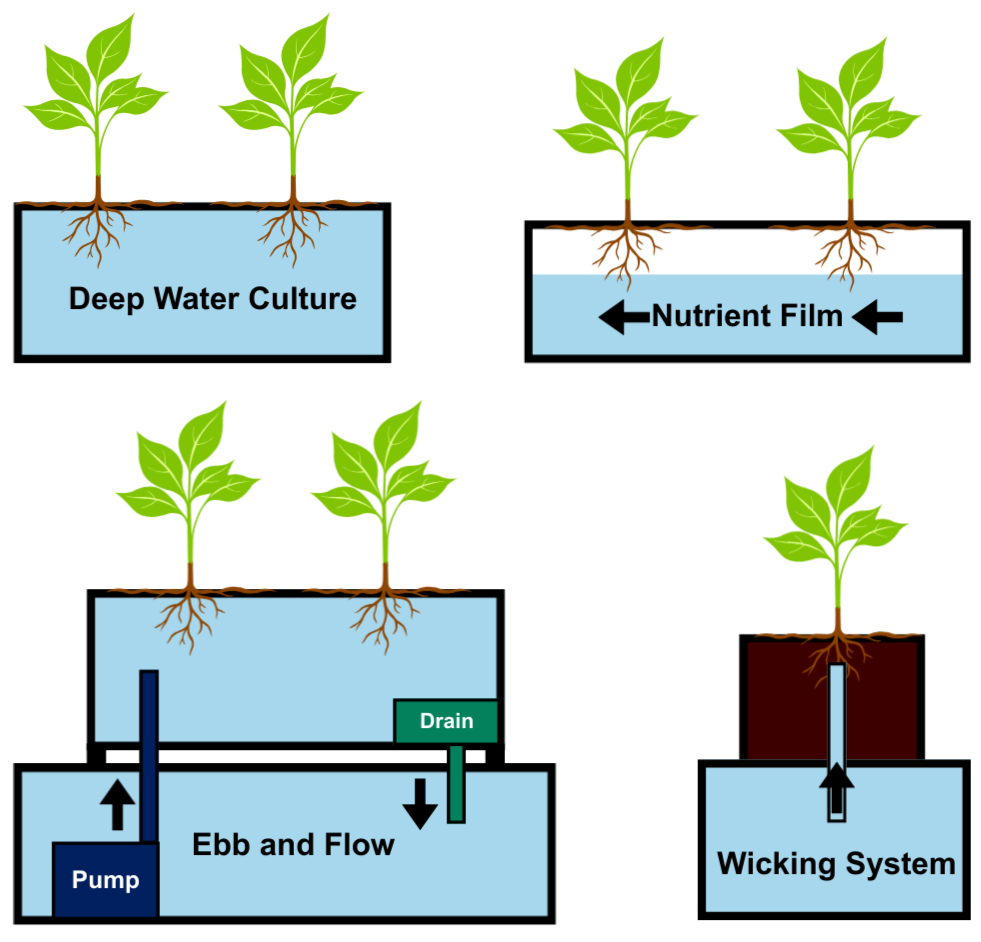
Types of hydroponic farming. Arrows indicate direction the nutrient media (light blue) flows.
| Type of System | Description | Common Plants |
|---|---|---|
| Deep Water Culture | Plants float on a large basin of recirculating nutrient solution. | Herbs, leafy greens |
| Nutrient Film | Plants grow over a shallow, constantly-flowing nutrient solution. | Herbs, leafy greens |
| Ebb and Flow | Plants suspended over a grow tray. Grow tray floods every few hours to temporarily submerge roots in nutrient solution. | Any plant type, especially fruit |
| Wicking | Plants grow in a grow tray and wicks bring the nutrients to roots. | Any plant type |
West Virginia Hydroponic Farming
Hydroponic farming may provide a viable method to farm crops in West Virginia. West Virginia is currently the 9th smallest agricultural state by land coverage, using less than 14% of land for crop production. This is likely due to the predominant type of soil in the state, which has high clay and acidity levels. Hydroponic systems offer an advantage for those with poor soil quality or space availability.
Dunbar-based Paradise Farms converted an old trailer park into a hydroponic farm to supply local residents with fresh produce. Furthermore, Mock’s Greenhouse & Farm is one of the largest hydroponic farms in West Virginia with up to 10 harvests each year. With 30 greenhouses, Mock’s produces 80,000 pounds of tomatoes, 400,000 heads of lettuce, 150,000 pieces of watercress, and 5,000 basil plants each year.
Hydroponic Farming Schools
Hydroponic farming has been introduced to at least 4,000 schools around the country, including in West Virginia. One hydroponic farming system in a school can supply around 400 pounds of fresh produce each year, often cheaper than food procurement costs after initial setup (around $5,000 per system). However, operating these systems may require some level of technical expertise. This type of local food production can also be incorporated into class lesson plans, particularly in science classes where students learn about plants and food systems.
Some West Virginia schools are actively using hydroponic farming systems, including Eastwood Elementary School and North Elementary School in Morgantown. Funds for the system at Eastwood Elementary were from the federal government, while North Elementary funds were awarded by a grant from the school’s parent teacher organization. These systems could be especially beneficial in schools located in areas in the state with lower levels of food security.
Hydroponic Farming in Other States
Many states, including West Virginia, offer financial support for hydroponic farming. The West Virginia Department of Agriculture offers a low-interest loan for agribusinesses through their Rural Rehabilitation Loan Fund, which can be used to support hydroponic farming, including purchasing equipment and greenhouses. This is similar to Texas, which also has a loan program to support hydroponic farming. While these loan programs are helpful to provide funds to farmers seeking to expand hydroponic farming, repayment may cause financial constraints. To combat this, other states such as Missouri and Ohio offer grants that can support hydroponic farming. The Missouri grant can be used for a variety of things, including purchasing or upgrading equipment, as well as facility expansion. Grow Ohio seeks to fund schools to purchase hydroponic systems. This program is funded through the US Department of Agriculture’s Farm to School Grant Program, the same source of federal funding that funded Eastwood Elementary School’s hydroponic systems. If West Virginia were to seek to implement a similar program, the legislature could pass legislation requiring the West Virginia Department of Agriculture to maximize federal funding opportunities for hydroponic systems in schools.
Some states have sought to incorporate new or existing buildings for hydroponic farming. Louisiana offers reduced property taxes for agricultural use, which includes hydroponic use. This is similar to West Virginia, which has class designations for agriculture property that is taxed at a lower rate. At least 16% (138,205 units) of West Virginia homes are unoccupied and there are at least 77 industrial properties for sale as of December 4, 2025. The state could seek incentives to allow some of these to be used for hydroponic farming.
While these incentive programs would likely require zoning or ordinance changes at the local level, they have been successful. A DC-area farm that moved into an old warehouse produces 30 harvests each year with minimal building modifications. Converting these properties would likely support economic development efforts by creating local job opportunities. Furthermore, they would provide a local source of produce and could be a viable way to address West Virginia’s food deserts.
This Science and Technology Note was prepared by Nathan G. Burns, PhD, West Virginia Science & Technology Policy Fellow on behalf of the West Virginia Science and Technology Policy (WV STeP) Initiative. The WV STeP Initiative provides nonpartisan research and information to members of the West Virginia Legislature. This Note is intended for informational purposes only and does not indicate support or opposition to a particular bill or policy approach. Please contact info@wvstep.org for more information.