
Motorcycle Helmet Law in West Virginia
West Virginia currently has a universal motorcycle helmet law, meaning all motorcycle riders must wear a helmet. Helmets decrease the risk of injury and death in the event of an accident. Since 1976, states have been weakening or repealing motorcycle helmet laws, which has been proposed in the West Virginia legislature. This Science and Technology Note explores the research behind wearing motorcycle helmets, analyzes helmet laws in neighboring states and around the country, and provides policy options that the West Virginia Legislature could consider for the state’s motorcycle helmet law.
Updated November 17, 2026
Research Highlights
West Virginia is one of 17 states that has a universal helmet law requiring all riders to wear a helmet. There are no exceptions in West Virginia’s motorcycle helmet law.
Wearing a motorcycle helmet is associated with a 69% reduction in head injuries and a 42% reduction in deaths from accidents.
West Virginia lawmakers have considered repealing the state’s helmet law or applying it only to riders under 21.
Motorcycle riders are at a greater risk for injury and death. When considering occupancy rates, motorcyclists die 38 times more often than car occupants, and while motorcycles make up 0.6% of all miles travelled, they account for 21% of road fatalities. Motorcycle helmets are designed to protect riders from traumatic brain injuries and death from accidents. All helmets sold in the United States must meet standards set by the U.S. Department of Transportation, which includes an impact-absorbing liner, a sturdy chin strap retention system, and a hard outer shell. Helmets reduce the risk of head injury by ~69% and the risk of death by ~42%. Riders without helmets are three times more likely to suffer traumatic brian injuries. Repealing motorcycle helmet laws is also associated with a 10% increase in organ donations from deceased riders, termed the “donorcycle effect”.
There are currently 17 states including West Virginia that have universal motorcycle helmet laws, meaning that all riders must wear a helmet under penalty of a $500 fine for a first offense or possible misdemeanor charges and license suspension for repeat violations. A further 30 states have partial laws that require only certain riders, such as younger or novice riders, to wear helmets. Three states (IA, IL, NH) have no helmet law. While there is no federal motorcycle helmet law, the National Highway Transportation Safety Administration (NHTSA) encourages states to set universal helmet laws citing that helmets help save lives and reduce injuries, helmet laws increase helmet usage, and helmet laws reduce the societal costs resulting from motorcycle accident injuries and fatalities.
A federal requirement in the 1966 Highway Safety Act for states to have motorcycle helmet laws or risk losing 10% of their federal highway funding was repealed in 1976 following heavy opposition and lobbying by motorcycle rights groups. At the time, all but 3 states had universal motorcycle helmet laws. However, states have since been repealing or weakening their helmet laws, which has been associated with increases in fatalities in Arkansas (1997; 21% increase), Texas (1997; 31% increase), Kentucky (1998; 25% increase), Louisiana (1999; 100% increase), and Florida (2000; 25% increase). On the other hand, states that have enacted universal helmet laws have seen decreases in fatalities including California (28% decrease) and Texas (1989; 12% decrease; later repealed).
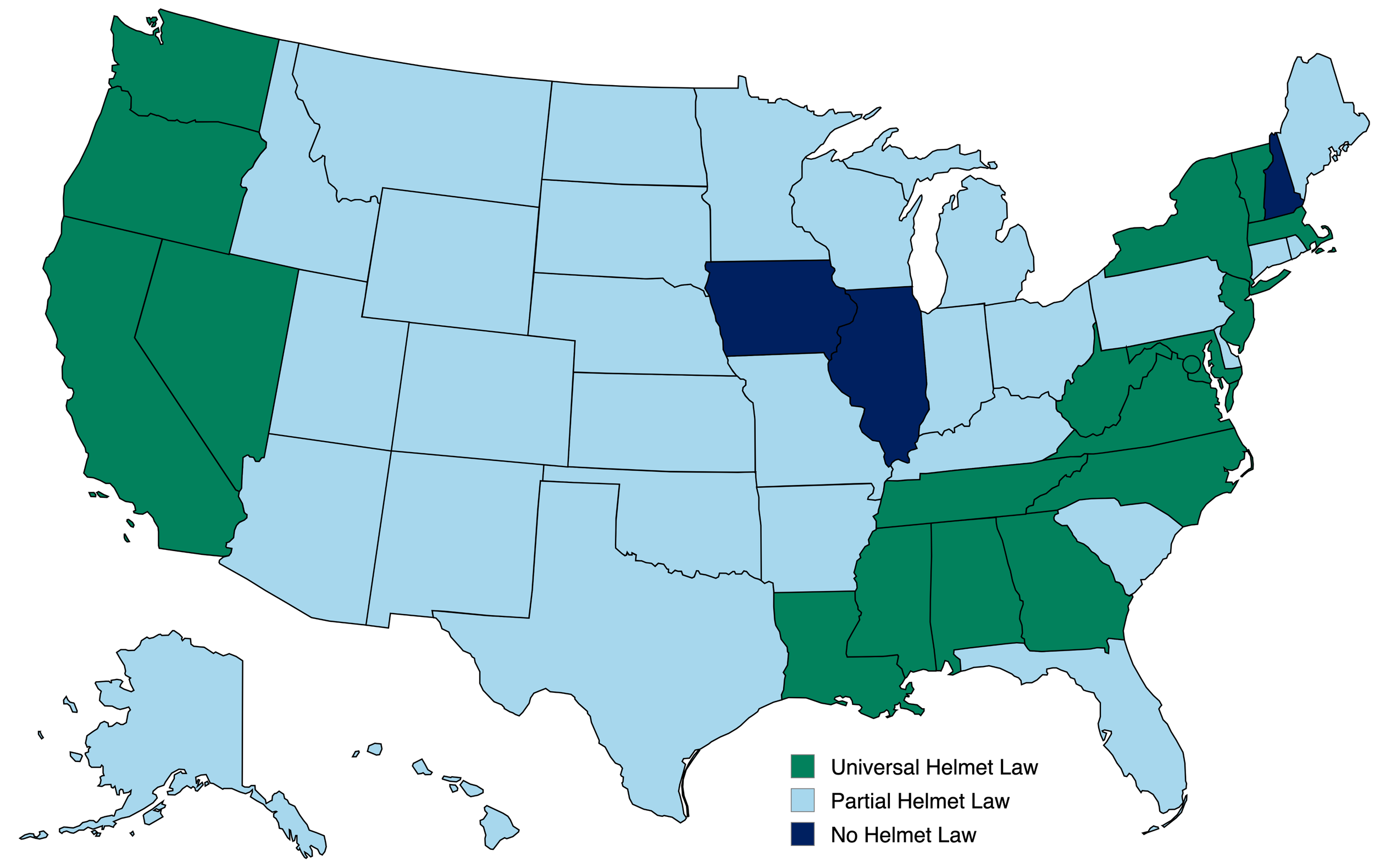
Motorcycle helmet laws by state. Source: IIHS
Status in West Virginia
West Virginia’s law requires all riders to wear a helmet that meets current federal performance standards or those set by the Snell Foundation. Additionally, all riders must wear eye protection such as goggles, a face shield, or visor. West Virginia’s law has no exemptions and is the strictest in comparison to neighboring states. Virginia and Maryland have universal helmet laws, however, there are exemptions for parades and events where speeds are less than 15 mph (VA), and for eye protection if the motorcycle is equipped with a windshield or windscreen (VA and MD). Ohio, Pennsylvania, and Kentucky require riders to wear eye protection and allow riders to ride without a helmet if they are over 18 (OH) or 21 (PA and KY), however, all three states require novice riders with less than one year (OH and KY) or two years (PA) of experience to wear a helmet regardless of age. Novice riders are more likely to crash, with crash rates declining by 42% as experience doubles.
In recent years, West Virginia lawmakers have introduced legislation to repeal the state’s helmet law, however, these efforts have all failed to make it out of committee with HB 4069 in 2026 being the most recent example. In 2021, two bills were introduced to create exceptions to West Virginia’s motorcycle helmet requirement: SB 64 would have allowed out-of-state riders to ride without helmets if their home state did not require them, while SB 665 would have exempted riders participating in parades or ceremonies at speeds of 15 mph or less. Both bills also failed to make it out of committee.
West Virginia passed HB 2752, nicknamed the “Freedom from Leg Cramps Bill”, in 2025 allowing motorcyclists to ride while standing up and facing forward. An amendment was introduced to repeal West Virginia’s helmet law for riders 21 and over, however, this amendment failed 41-54. Arguments for and against the amendment and the bill as a whole centered on West Virginia’s legislative priorities, the debate between personal liberty and personal safety, individual freedom of choice, and potentially higher insurance rates for riders if repealed.
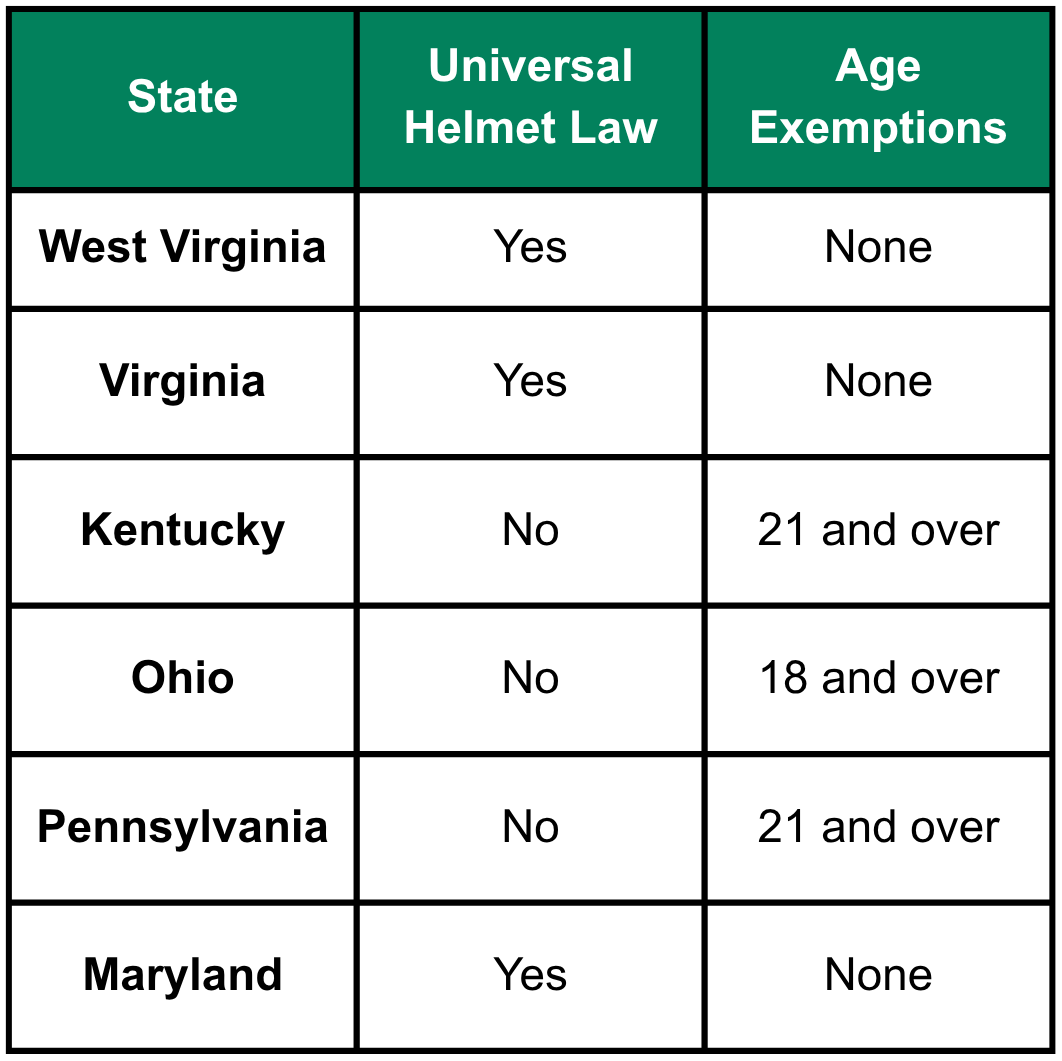
Comparison of West Virginia's motorcycle helmet law with other states. Source: IIHS
Policy Options
Based on policy discussions in West Virginia and an analysis of helmet laws from other states, the West Virginia Legislature could consider different approaches regarding the state’s motorcycle helmet law: stricter regulation, no action, and decreasing regulations. West Virginia already has a universal motorcycle helmet law, however, the legislature could consider strengthening helmet testing standards such as in Pennsylvania’s legislation, which has detailed design and impact testing specifications that helmets must meet. This would likely be supported by medical professionals, the insurance industry, and groups like the Insurance Institute for Highway Safety (IIHA) that advocate for motorcycle helmet use.
Alternatively, West Virginia could eliminate the helmet law entirely, as proposed in HB 4069 in 2026. This would make West Virginia the fourth state in the United States without a helmet law and would likely be supported by motorcycle rights and personal freedom activists and opposed by medical professionals and the insurance industry. The West Virginia Legislature could also consider weakening its universal motorcycle helmet law. This could take the form of a partial helmet law as in Kentucky, Pennsylvania, or Ohio where novice riders are required to wear helmets. West Virginia could consider allowing riders 18 or 21 and over to ride without helmets, which would likely be supported by out-of-state riders that may avoid crossing into West Virginia due to its current universal helmet requirement. The IIHS opposes such age-based requirements as being virtually impossible to enforce. The legislature could also consider requiring unhelmeted riders to carry insurance that covers medical benefits as in Florida’s law and to have completed a motorcycle safety course as in Texas. Such provisions could help prevent a rise in insurance rates for motorcyclists in the state.
Based on the failure of past repeal efforts in the legislature, the state can also choose to keep its universal helmet law in place. West Virginia could consider adding an exemption for parades and ceremonies similar to Virginia or introduce an exception to the eye protection requirement like the laws in Virginia and Maryland. These two provisions would allow for exemptions while preserving West Virginia’s universal motorcycle helmet law and could find broad support in the mountain state.
This Science and Technology Note was prepared by David Ramotowski, PhD, West Virginia Science & Technology Policy Fellow on behalf of the West Virginia Science and Technology Policy (WV STeP) Initiative. The WV STeP Initiative provides nonpartisan research and information to members of the West Virginia Legislature. This Note is intended for informational purposes only and does not indicate support or opposition to a particular bill or policy approach. Please contact info@wvstep.org for more information.