Heavy Metals in West Virginia Baby Food
Many parents rely on baby food to feed their young children. Three independent studies have found high levels of heavy metals in baby foods, and heavy metals have been shown to be associated with behavioral changes and lower IQ. This Science & Technology Note explores how heavy metals get into food, their impact on child development, and how some states are attempting to increase transparency from baby food manufacturers.
Updated April 10, 2026
Research Highlights
Arsenic, cadmium, lead, and mercury in the soil are absorbed by plants and enter into the food supply, including in baby food.
Three independent reports have found that up to 95% of tested baby foods contain at least one heavy metal.
Heavy metals impact brain development and may lead to behavioral changes and lower IQ.
Four states have passed laws requiring baby food manufacturers to publicly publish the amount of heavy metals found in their baby food.
Many parents rely on baby food to feed their young children. Three independent studies have found high levels of heavy metals in baby foods, and heavy metals have been shown to be associated with behavioral changes and lower IQ. This Science & Technology Note explores how heavy metals get into food, their impact on child development, and how some states are attempting to increase transparency from baby food manufacturers.
Baby Food Consumption
The baby food industry is a large market helping to feed West Virginia’s babies. There were over 16,500 babies born in West Virginia in 2022. A baby’s diet changes throughout the first year after they are born. Generally for the first 3-4 months they consume breast milk or formula and then progress to solid foods beginning at ~4 months. Though considered “solid food,” these foods are usually strained or pureed (applesauce, pureed carrots, etc.) and are distinct from liquids like milk. At around 4 months of age, children generally eat up to 4 oz of food per day, though every baby is different. This gradually increases to around 9 oz of baby food per day at 6-8 months, and up to about 12 oz of food around 9-12 months. Baby food containers come in a variety of sizes, with most being 4 oz. The baby food market in the United States is large, growing from $109.02 billion in 2024 to $115.76 billion in 2025.
What Are Heavy Metals?
There are various contaminants that can be found in food, including heavy metals. The US Food and Drug Administration (FDA) considers heavy metals in food to be arsenic, lead, mercury, and cadmium. These metals get into food from the environment in which crops are grown, and the amount depends on the natural geography as well as human activity. Mercury, for example, may be higher in areas with past volcanic activity. Arsenic and cadmium may be found in higher levels where certain phosphate fertilizers were once used. All of these metals may be found around areas that were used for various commercial uses, including smelting, mining, fracking, and fossil fuel combustion. After contaminating the soil, these metals are absorbed through plant roots and end up in the food supply.
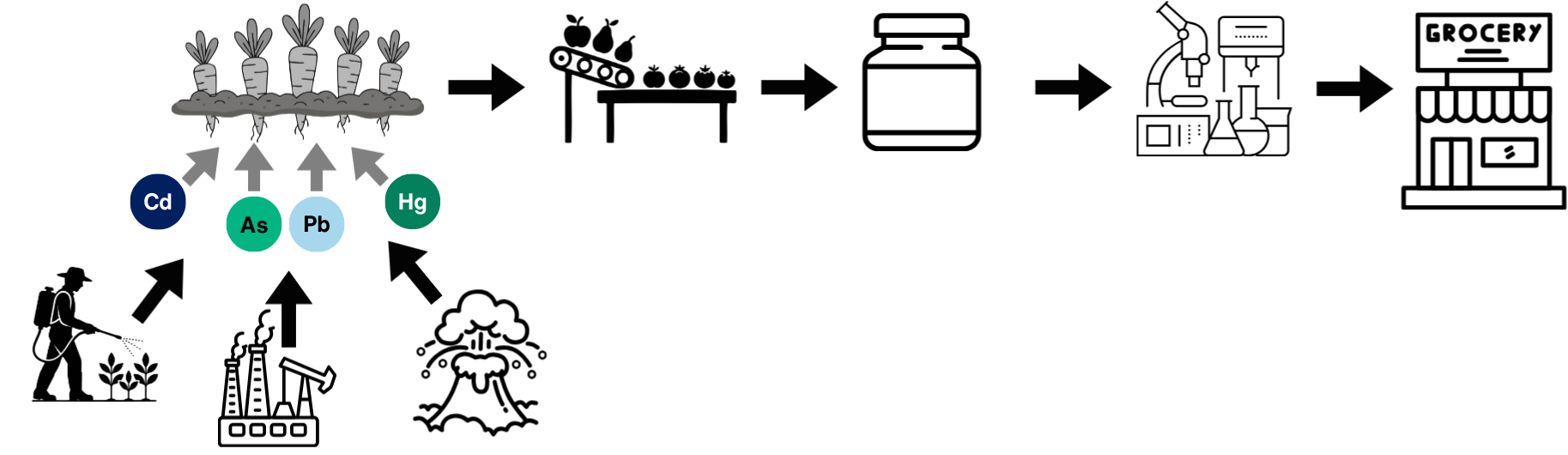
Flow of heavy metals from soil to packaged baby food.
The FDA does not authorize adding any heavy metals to foods or as components in cookware, food contact surfaces, or foodware, and does not consider any amount to be safe. Though the FDA does not set limits specifically for foods, including baby food, they do set limits for bottled water. Bottled water cannot contain more than 5 parts per billion (ppb) of lead or cadmium, meaning for every 1 billion molecules of water, there can be a maximum of 5 lead or cadmium molecules. Similarly, the maximum levels of arsenic and mercury in bottled water are 10 ppb and 2 ppb, respectively.
The US Agency for Toxic Substances and Diseases Registry ranks heavy metals in the top 10 most significant potential threats to health. Consuming heavy metals may impact brain development leading to lower IQ and behavioral changes. One study investigating lead exposure found that high lead levels before the age of 6 was associated with lower academic testing scores in those children in grades 3, 5, and 8. Similarly, an analysis investigating the effects of increased arsenic levels in drinking water on children in grades 3-5 found it was associated with lower IQ levels. Another study found that consuming lead, cadmium, and mercury leads to learning and memory deficits.
Heavy Metals in Baby Food
Three independent studies have found that baby foods contain high levels of heavy metals, including a study from Florida announced earlier this month. Healthy Babies Bright Futures, an organization working to reduce babies’ toxic chemical exposure, commissioned internationally accredited Brooks Applied Labs in 2019 to test baby foods for heavy metals. Their report found that 95% of 168 baby foods from 61 different brands tested had at least one heavy metal, with 66% of foods containing at least three. This analysis found arsenic to be the primary exposure risk among all baby foods.
A 2021 Congressional Staff Report requested internal company testing results and policies from 7 of the largest US baby food producers and reported similar findings. Of the 7 manufacturers contacted, 4 (Nurture, Beech-Nut, Hain, and Gerber) responded to the request and 3 (Campbell, Walmart, and Sprout Foods) did not. This analysis reviewed internal records from all responding companies and found that arsenic, cadmium, and lead were present in baby foods that were sold. They further noted that of the four responding companies, only Nurture regularly tests for mercury, which was also found in sold baby food products. Heavy metal content ranged, though companies reported selling baby food that contained 641 ppb of lead, 10 ppb of mercury, and 180 ppb of arsenic. The report also detailed companies using ingredients and additives with higher heavy metal content. While the report focused on products with high heavy metal content, there was heavy metal content variability between products, including different batches of the same product. Current public testing disclosures also show a wide range in heavy metal levels between products and between batches. This is likely due to different farms having varying heavy metal content in their soil that then gets absorbed by the plants. Furthermore, because of differences between plants, there is likely a difference in heavy metal absorption between each individual plant.
State Legislation
Because heavy metals are absorbed by plants through soil, completely eliminating them from the food source is not possible, though there are efforts to limit exposure. The FDA’s Closer to Zero initiative seeks to limit exposure to chemicals by encouraging best practices including new testing methods, monitoring and regulating levels, conducting food surveys, and measuring exposure. Two possible methods companies could utilize are to source crops from fields with low heavy metal content and use plant strains that take up fewer heavy metals.
Multiple states have taken action to increase transparency around heavy metal content in baby foods. Virginia, California, Maryland, and Illinois require baby food companies to test and publicly publish heavy metal content in baby foods. To date, companies are not federally required to test for heavy metals in these foods, and may choose not to due to the associated costs. These laws require that testing facilities meet international and FDA standards and food packaging contains a scannable link to access the data. This allows parents to make informed decisions about what is in the food they choose to feed their babies. Since these laws were enacted, baby food companies have published their testing results on their websites, however they do not include standard references against which to compare the results nor do they include their company policies or standards. Hain and Gerber, for example, both report that the baby food they sell pass their policies and standards but have been shown to contain 16.3 or 10 ppb of cadmium, respectively. Similarly, Plum Organics (Campbell) finds higher levels of heavy metals in their baby food than the FDA allows in bottled water.
HB 4124 (2026) sought the same testing transparency requirements as other states but did not advance out of committee. Though this is a requirement in some states, depending on the company, baby food batches purchased in West Virginia may not be the same as batches purchased in other states. Thus, companies are not required to disclose testing results for all baby food sold in West Virginia [1]. If West Virginia were to enact this, it would increase transparency from baby food manufacturers. The legislature could also seek to expand on this legislation to require baby food manufacturers to clearly state their company policies on what heavy metal levels are permitted in their foods and have a section on their website dedicated to explaining their effect. Additionally, the legislature could encourage family or pediatric medicine providers to educate parents of the effects heavy metals can have on a child’s development and what to look for when selecting a baby food product.
[1] Based off of phone call with Earth’s Best
This Science and Technology Note was prepared by Nathan G. Burns, PhD, West Virginia Science & Technology Policy Fellow on behalf of the West Virginia Science and Technology Policy (WV STeP) Initiative. The WV STeP Initiative provides nonpartisan research and information to members of the West Virginia Legislature. This Note is intended for informational purposes only and does not indicate support or opposition to a particular bill or policy approach. Please contact info@wvstep.org for more information.