Extended Producer Responsibility in West Virginia
Extended Producer Responsibility (EPR) programs enable the state to charge companies fees to reimburse the public for disposal of their products. Packaging is the newest category of materials to be targeted by US EPR programs. This Science & Technology Note highlights early examples of EPR adoption in the US, explains different ways that EPR fees can be adjusted, and provides EPR policy options for the state of West Virginia.
Updated June 25, 2026
Research Highlights
Extended Producer Responsibility programs typically increase local recycling participation rates.
The number of products sold, along with their weight and material composition, can contribute to Extended Producer Responsibility fees.
7 states, including Maryland, have passed packaging Extended Producer Responsibility laws since 2021.
EPR Programs
Extended Producer Responsibility (EPR) programs are designed to increase recycling of products by holding producers accountable for proper disposal of their products. These programs often require producers to pay additional fees to offset the cost or environmental impact of recycling their products, reducing the amount that the public pays for disposal via taxes or waste utility bills. EPR programs often rely on independent Producer Responsibility Organizations (PROs) to collect fees, ensure legal compliance, and implement program requirements. PROs run the daily operations of an EPR program, while governments provide oversight. Fees collected through EPR programs are distributed to localities to fund investment into recycling infrastructure, including funding recycling centers, upgrading recycling technologies, providing public education programs, and purchasing recycling containers and collection vehicles.
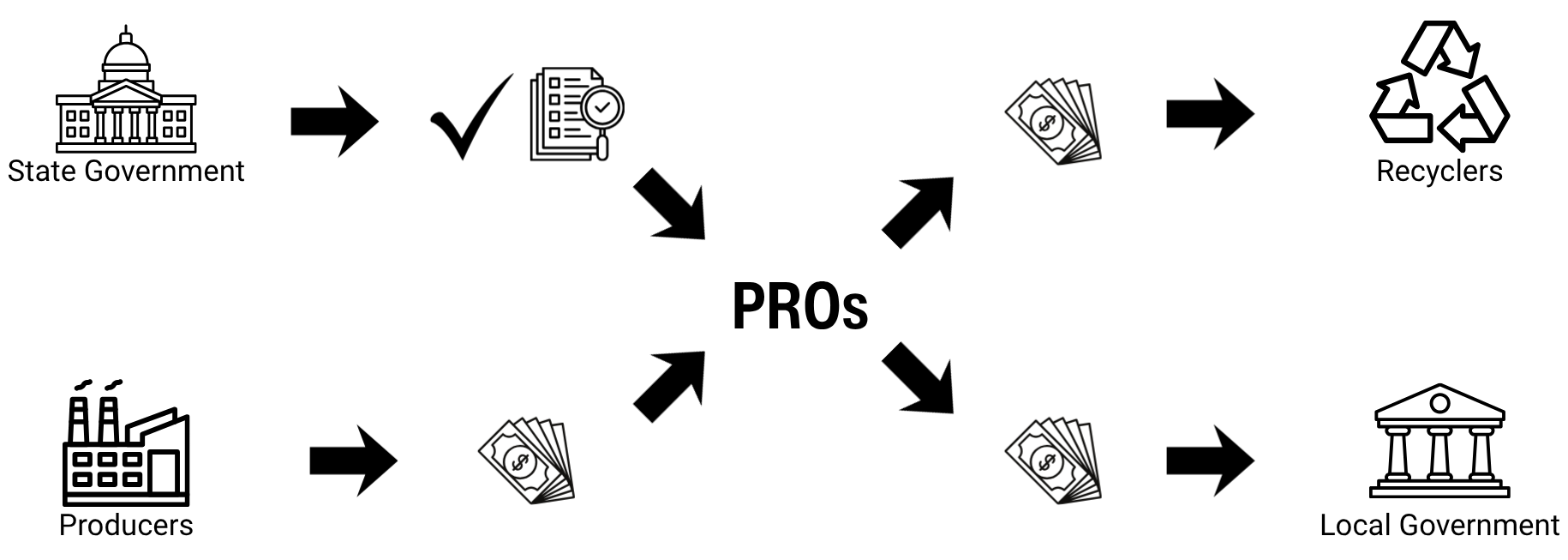
EPR programs often use Producer Responsibility Organizations to coordinate program activities between producers, local governments and recycling service providers, and state governments. Adapted from EPR 101: What Packaging Teams Need to Know and Deep Dive: EPR for Packaging, Explained.
The US has had EPR programs for certain products since the early 1990s, with New Jersey and Minnesota establishing the country’s first EPR programs for batteries in 1991. West Virginia began an EPR program for electronic devices in 2008, requiring companies who want to sell devices in West Virginia to register with the state and operate a device takeback program. Paint, mattresses, electronics, and batteries were common products targeted in early EPR programs. More than 60% of states have EPR programs for specific product categories. Recent policies in the sector have targeted EPR programs that cover product packaging and single-use paper and plastic products, with 21 states passing or introducing a packaging EPR bill since 2021.
EPR programs have experienced successes, likely due to a combination of legal requirements and increased recycling awareness. In locations where no EPR program is in place, the recycling rate of plastic packaging is about 10%. When an EPR program was enacted, this rate rose to nearly 40%. After Connecticut began a mattress EPR program, recycling grew from 30% to 75% in 6 years, saving nearly $10 million in disposal costs.
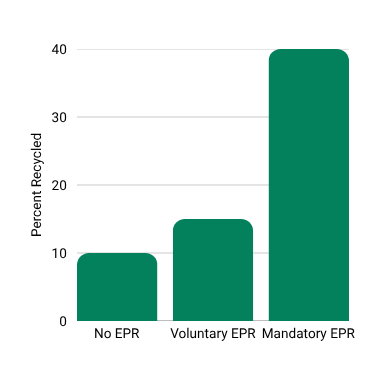
EPR programs result in increasing recycling rates. Adapted from Extended Producer Responsibility - Ellen Macarthur Foundation.
Packaging EPR Program Implementation
Although packaging EPR programs aim to increase recycling of product packaging, there are some products that are often excluded, including medical packaging, hazardous material containers, and papers containing financial, medical, or legal information. For included products, EPR programs typically use multiple methods to calculate fees and assign responsibility. Fees are often calculated per pound of packaging waste, and are differential based on material - Oregon imposes a 5¢ per pound fee on paper products, while flexible #5 plastic has a $1.02 per pound fee. Many jurisdictions also have a flat-rate EPR fee available for small producers.
Eco-modulation is used in many EPR programs to adjust fees charged to producers based on their products. Eco-modulated fees may help to financially incentivize companies to reduce excess packaging or increase the use of easily-recycled materials. In Colorado, companies can be charged an additional 5% fee for contaminated recycling, or receive a 5% fee credit for highly recycled materials.
Packaging EPR Policies
Currently, packaging EPR laws have passed in 7 states, while 14 additional states have considered similar laws. Programs in Colorado and Oregon are collecting fees, while the other 5 states remain in the rulemaking process.
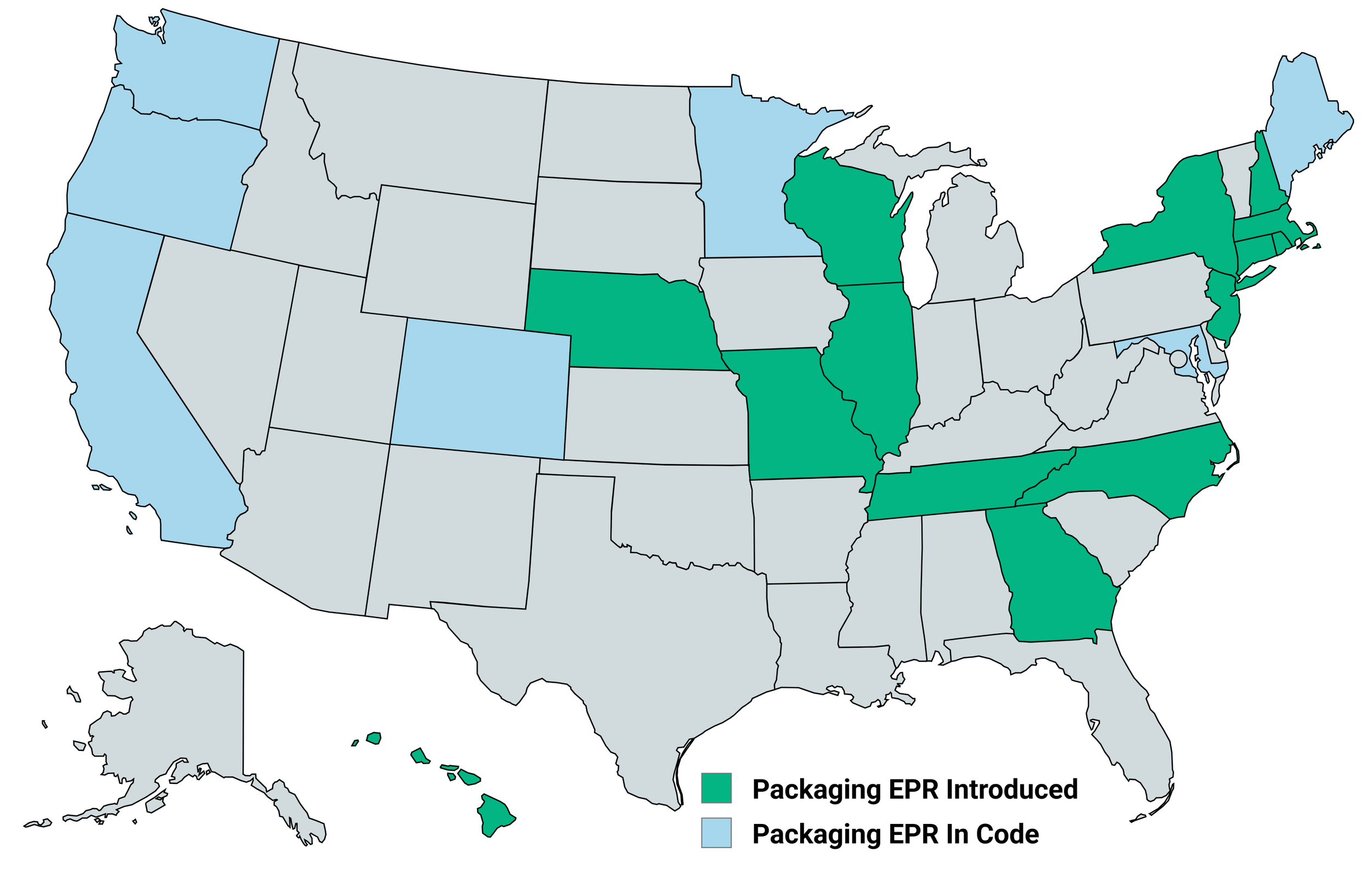
7 states have active packaging EPR laws, while similar laws have been introduced in 14 states. Adapted from EPR Laws: What Businesses Need to Know.
A major concern surrounding packaging EPR is that companies may raise prices in order to compensate for increasing costs, differentially impacting low-income consumers. Some studies predict that packaging EPR fees could raise prices between 0.69% and 6.75%, but others found no correlation between EPR programs and prices. In a 2024 hearing, Senator Capito stated her concerns around EPR programs, citing price increases for consumers and concerns around differing state standards. Differing requirements may make it more difficult for companies to comply with regulations. However, many companies support packaging EPR requirements.
West Virginia’s 2021 Solid Waste Management Plan noted that the state’s waste reduction goals were not met. Expanding EPR programs in West Virginia could be one way to produce additional investment capital, increase recycling access, and raise recycling rates. According to a 2025 study, approximately 58% of West Virginia’s waste is composed of recyclable materials that would likely be covered in a packaging EPR program.
West Virginia could opt to introduce additional EPR programs for specific materials, for example, paint, which 10 states have implemented. Since West Virginia has had an electronics EPR program for nearly 20 years, specific EPR programs may be more acceptable. Alternatively, the state could implement a broad packaging EPR program. If pushback is anticipated, a voluntary program could be considered as opposed to a mandatory one. Concerns about increasing prices would likely be detrimental to a packaging EPR program in the state, but successful implementation could provide additional investments into West Virginia’s recycling infrastructure. West Virginia’s Attorney General recently joined a lawsuit aimed at California’s EPR law, citing price increases and impacts on West Virginians from an out-of-state law.
This Science and Technology Note was prepared by Madison Flory, PhD, West Virginia Science & Technology Policy Fellow on behalf of the West Virginia Science and Technology Policy (WV STeP) Initiative. The WV STeP Initiative provides nonpartisan research and information to members of the West Virginia Legislature. This Note is intended for informational purposes only and does not indicate support or opposition to a particular bill or policy approach. Please contact info@wvstep.org for more information.