Environmental Water Quality in West Virginia
This Science & Technology Note provides information on how the West Virginia Department of Environmental Protection analyzes environmental waters in the state, different considerations for surface and groundwater, highlights West Virginia surface waters that are impaired, unimpaired, or unassessed, and provides policy options to address environmental water quality analysis in the state.
Updated June 11, 2026
Research Highlights
West Virginia’s groundwater is difficult to analyze due to the state’s geologic variation.
Abandoned mine pools are an additional source of groundwater, but are at high risk of contamination.
55% of West Virginia’s surface waters remain unassessed, likely due to resource constraints.
The majority of surface water in West Virginia fails at least one quality standard.
West Virginia contains a large volume of water. The majority of waters in West Virginia are unassessed, but the majority of those that are assessed fail at least one quality standard. This Science & Technology Note provides information on West Virginia’s ground- and surface water quality, how environmental water quality is measured, and policy options for environmental waters.
Environmental Waters in West Virginia
West Virginia contains nearly 55,000 miles of streams and rivers, 400 lakes, and 6,000 underground storage pools. The state receives an average of 44 inches of precipitation per year, and is considered water-rich.
In West Virginia, water used by community drinking water systems, water where trout live and spawn, water used for power production, and recreational waters all have unique quality requirements. Although water quality variations occur naturally, many water contaminants are derived from human activity. The West Virginia Department of Environmental Protection (WVDEP) has primary responsibility for testing West Virginia’s waters, but some responsibilities for water monitoring and improvement are shared between the WVDEP and other jurisdictions. For example, primary responsibility for the Ohio River falls to the 8-state coalition making up the Ohio River Valley Water Sanitation Commission, and monitoring and improvement responsibilities are shared between West Virginia and Virginia for the New River. West Virginia is also involved in the Chesapeake Bay Program and the Interstate Commission on the Potomac River Basin. Common projects to improve water quality include habitat protection, pollution control, and contaminant remediation.
West Virginia’s Groundwater
Groundwater in West Virginia is difficult to evaluate. The complex combination of rocks making up the state means that groundwater supply and quality varies greatly, and needs to be studied at a local scale. Groundwater testing in northwest West Virginia revealed high concentrations of arsenic, manganese, and nitrates, while groundwater in southern regions of the state had high levels of sodium, iron, silica, and barium. Groundwater in southern West Virginia was also often dangerously acidic. Eastern West Virginia’s groundwater is often high in nitrates.
Abandoned mines are an additional source of groundwater in the state. At least 27 community water systems in West Virginia draw water from abandoned mines, however, water found in abandoned mines can be at higher risk for contamination. Groundwater present in mine pools typically has higher levels of metals than non-mine pool groundwater. Additionally, groundwater within 500 meters of oil and gas wells contained higher levels of radium, bromide, and ethane.
West Virginia’s Surface Waters
Surface water includes streams, creeks, rivers, reservoirs, ponds, and lakes. The WVDEP uses visual, chemical, and aquatic life measurements to determine surface water quality. In West Virginia, the most common contributors to poor water quality include agricultural runoff, leaks in public or private wastewater systems, and disruptions caused by construction and mining. Data from 2024 shows that 9% of West Virginia’s streams, creeks, and rivers were unimpaired, or that they met all indicators measured. Approximately 35% were impaired in some way, but the majority of these had plans in place to improve their water quality. Nearly 60% were unassessed, likely due to resource constraints at the WVDEP.
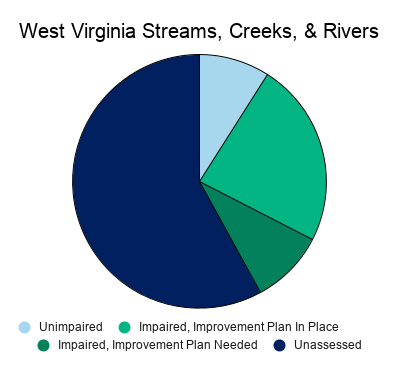
The majority of West Virginia’s streams, creeks, and rivers are unassessed. 9% are unimpaired, and the remainder fail at least one standard. Adapted from 2024 West Virginia Integrated Water Quality Monitoring and Assessment Report.
Similar trends followed for West Virginia’s lakes, ponds, and reservoirs. 13% met all requirements, 44% had some form of impairment, and 43% were unassessed. Unlike the streams, only 0.9% of West Virginia’s impaired lakes, ponds, or reservoirs had an improvement plan in place. The most common measurements of impaired water quality in West Virginia were excess iron, fecal bacteria present in the water, high levels of mercury in fish, and low animal diversity.
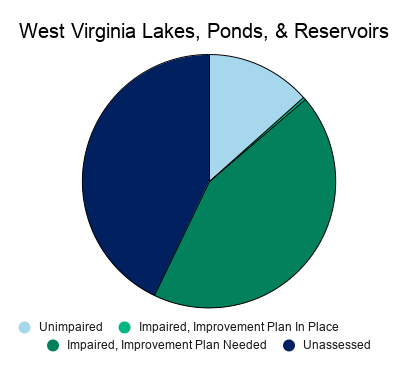
13% of West Virginia’s lakes, ponds, and reservoirs were unimpaired, while 33% remain unassessed. The remainder have an impairment, but many lack an improvement plan. Adapted from 2024 West Virginia Integrated Water Quality Monitoring and Assessment Report.
Environmental Water Policies
Nearly 55% of West Virginia’s surface waters are unassessed, and West Virginia’s groundwater is highly variable. This lack of data means that the water quality and safety in half the state is not known. Assessing the water quality could help to further identify impaired versus unimpaired waters, and implement strategies to improve water quality. Maintaining or improving water quality is associated with benefits to the community, including protection of the tourism and recreation industries. West Virginia could opt to expand environmental water testing programs in order to gain a more complete understanding of water quality in the state. This would likely result in an increased number of impaired water sources that need improvement plans developed. Alternatively, the state could opt to prioritize improvements of known impaired bodies of water, which could result in a reduction of impaired waters in the state, but would not address the high number of unassessed waters.
This Science and Technology Note was prepared by Madison Flory, PhD, West Virginia Science & Technology Policy Fellow on behalf of the West Virginia Science and Technology Policy (WV STeP) Initiative. The WV STeP Initiative provides nonpartisan research and information to members of the West Virginia Legislature. This Note is intended for informational purposes only and does not indicate support or opposition to a particular bill or policy approach. Please contact info@wvstep.org for more information.