
Permanent Daylight Savings Time in West Virginia
The vast majority of Americans oppose the status quo of changing their clocks twice a year in observance of daylight savings time (DST). Making DST permanent has been proposed as a solution. This would result in later sunrises and sunsets during the winter months. This Science and Technology Note explains the positions and research behind DST, provides an overview of passed and pending legislation at the state and federal levels, and provides policy options that the West Virginia Legislature could consider regarding permanent DST.
Updated October 26, 2026
Research Highlights
West Virginia follows the current federal standard, observing daylight savings time from the second Sunday in March to the first Sunday in November.
States are not allowed to adopt permanent daylight savings time under current federal law.
Permanent daylight savings time is generally supported for business and tourism interests.
West Virginia has considered legislation to make daylight savings time permanent if federal law changes to allow it. 19 states have passed similar “trigger laws”.
Federal law mandates that states observe daylight savings time (DST) by moving their clocks forward one hour in the spring and back one hour in the fall. DST was originally introduced as a way to save energy in wartime and to give an extra hour of daylight for outdoor recreation and shopping in the evenings. Nationwide summer DST came into force with the Uniform Time Act of 1966, and the current practice of changing the clocks on the second Sunday of March and the first Sunday in November was set in 2005. Permanent DST was previously adopted twice in the United States: during World War II and the 1973 energy crisis. The 1973 change was a trial run for permanent DST and was widely unpopular, being scrapped after one year due to dissatisfaction with commuting in dark winter mornings, particularly for schoolchildren.
States are able to opt-out of DST, but they are currently not allowed to observe DST year-round. Recent polling has found widespread dissatisfaction with changing the clocks twice a year, with a 2025 poll finding 72% in favor of eliminating the twice-yearly changing of the clocks and another survey finding 62% in favor. However, there is no widespread consensus on support for adopting permanent DST or eliminating it, which would result in earlier sunrises and sunsets from March to November.
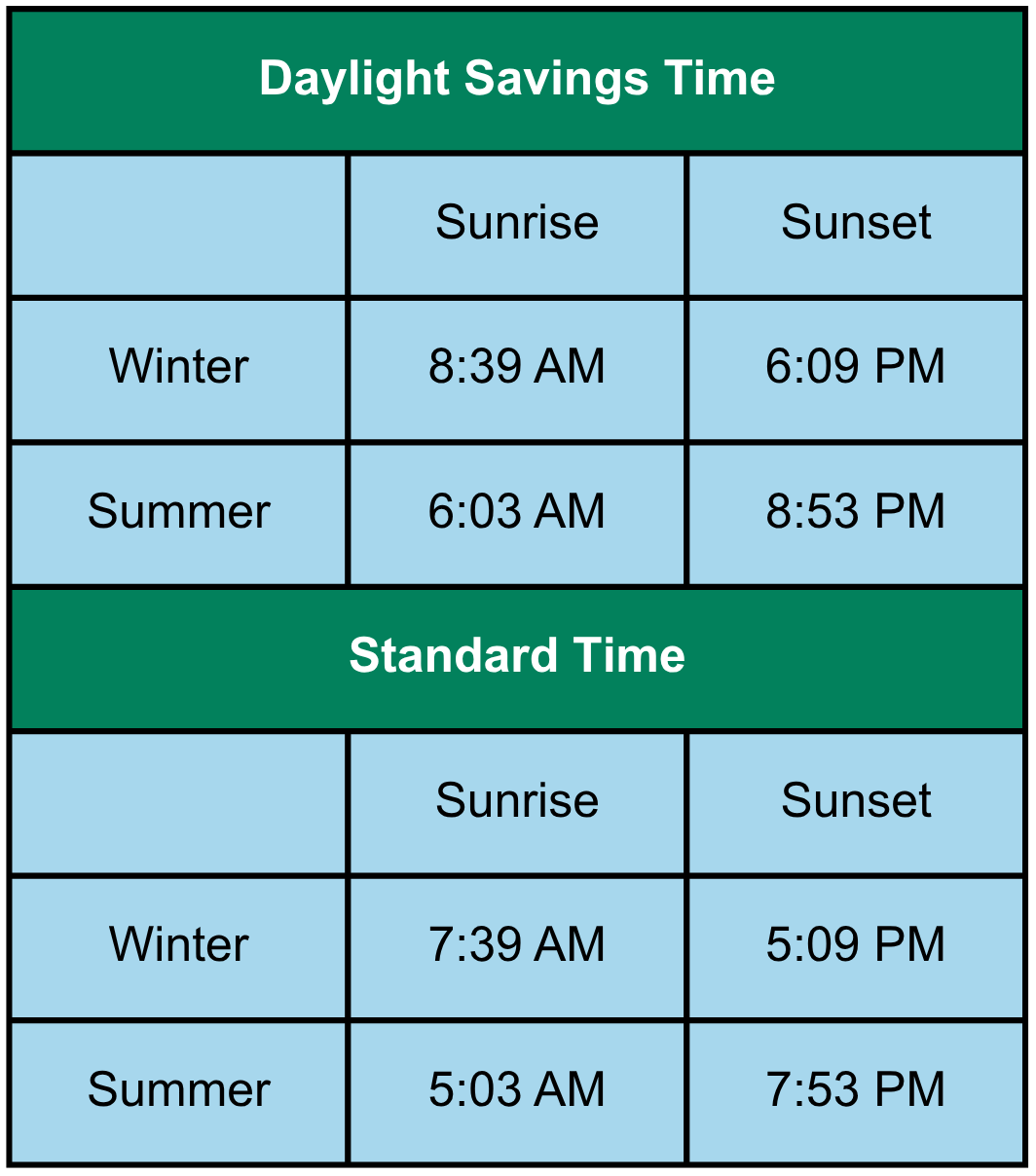
Sunrise and sunset times in Charleston, WV with permanent DST and standard time. Winter and Summer times are on the respective solstices. Source: timeanddate.com
Adopting permanent DST is generally supported by businesses and groups that would benefit from the extra hour of evening daylight. Permanent DST has also been proposed as a way to decrease energy consumption, traffic accidents, and crime. However, studies conducted by the U.S. Departments of Energy and Transportation on behalf of Congress found the effects of extending DST on these factors to be minimal. While no U.S. states can observe permanent DST, Canada allows its provinces and territories to observe permanent DST, with British Columbia, Alberta, Manitoba, and the Northwest Territories having elected to observe permanent DST in 2026. These decisions were driven by survey data indicating that large majorities of residents supported ending the practice of changing clocks twice a year, with a majority of respondents favoring permanent DST.
On the other hand, there has been movement towards eliminating DST and observing standard time year-round. This approach is currently followed by Arizona and Hawaii. Arguments in favor of abolishing DST center on the benefits of early morning sunlight for morning commuters and schoolchildren. The American Academy of Sleep Medicine advocates for abolishing DST while promoting permanent standard time as aligning more closely with the body’s internal clock. Scientific evidence points to moderate risks for strokes, heart attacks, and sleep deprivation associated with moving the clocks forward from standard time to DST each Spring.
Status in West Virginia
West Virginia follows the current federal standard. SB 528 was introduced in 2026 and would have established DST as the year-round official time for the state of West Virginia. SB 528 was referred to the Senate Government Organization Committee and ultimately did not pass. The bill was contingent on federal legislation being passed to observe daylight savings time on a permanent basis. Public sentiment in West Virginia has been split on the issue. West Virginia tourism could benefit from the extra hour of daylight in the evenings. On the other hand, there is concern with drowsy driving due to rural roads, long commutes, and the prevalence of early-morning shifts in the state. School start times have also generated concern as students can have circadian rhythms that keep them up later.
At the federal level, the Sunshine Protection Act of 2025 passed in the U.S. House of Representatives by a vote of 308-117 on July 14, 2026 and is currently pending in the Senate. This act would have made DST permanent with exemptions for states that do not observe DST (AZ and HI). A previous version of the Sunshine Protection Act passed in the Senate by unanimous consent in 2022, however, the House took no action.
Senator Capito raised concerns about the safety of children traveling in the dark and the overall impact on industry in the state. Other senators from midwestern and Rocky Mountain states have expressed similar concerns. Both West Virginia House representatives voted in favor of the act, which is strongly supported by President Trump. However, it faces an uncertain future in the Senate.
Policy Options for Permanent DST
Since 2015, there has been an ongoing movement among state legislatures to adopt permanent daylight savings time, with 47 states proposing legislation to change their observance of DST and 19 states having passed “trigger laws” to switch to permanent daylight savings time if federal regulations change to allow it. This is similar to West Virginia’s proposed bill from the 2026 session. None of West Virginia’s neighboring states have passed similar legislation, although it was recently proposed in Virginia, Maryland, and Pennsylvania.
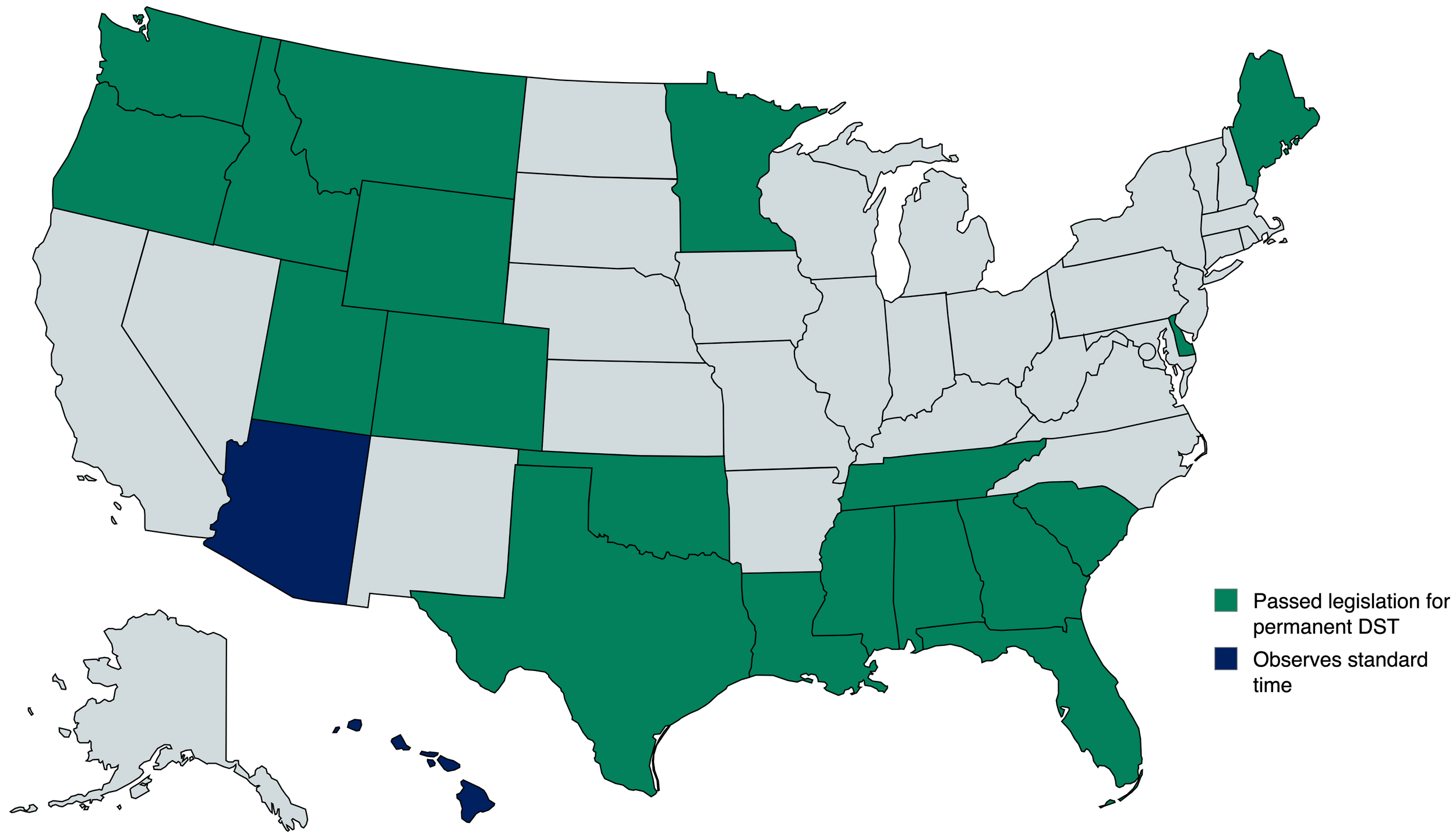
Status of permanent daylight savings time in all 50 states. Source: NCSL Database on State Legislation
West Virginia could also consider passing legislation to abolish DST. Abolishing DST has been proposed in 2025-2026 in Kentucky, Virginia, Pennsylvania, and at the federal level. However, Arizona and Hawaii remain the only two states to exempt themselves from DST, which is allowed under federal law. Abolishing DST in West Virginia would effectively move the state into the Central time zone during the summer months, which would be at odds with neighboring states that observe Eastern Daylight Time. This could create issues with interstate business and financial markets by causing businesses to lose customers who do not wish to drive or be outside at night. Mexico faced this issue when it abolished DST in 2022 apart from exemptions for cities and towns on the U.S. border to avoid disruptions with international trade and business. Lastly, West Virginia could simply maintain the status quo of changing clocks twice a year in observance of DST. This is likely the safest option unless federal regulations on DST change, however, it remains unpopular with the public.
This Science and Technology Note was prepared by David Ramotowski, PhD, West Virginia Science & Technology Policy Fellow on behalf of the West Virginia Science and Technology Policy (WV STeP) Initiative. The WV STeP Initiative provides nonpartisan research and information to members of the West Virginia Legislature. This Note is intended for informational purposes only and does not indicate support or opposition to a particular bill or policy approach. Please contact info@wvstep.org for more information.