
West Virginia’s Child Removal Process
West Virginia has the highest number of children in foster care per capita in the country. This Science and Technology Note explores reasons and methods by which a child can be removed from their home and possible options West Virginia could explore that may decrease the amount of children being removed from their homes.
Updated January 16, 2026
Research Highlights
As of November 2025, West Virginia reported having 6,008 children in foster care.
The most cited cause of child removal in West Virginia is parental substance abuse issues, but other causes include abuse, neglect, and inadequate housing.
West Virginia prioritizes placing children with other family members or family friends, but children may be sent elsewhere for special circumstances like needing medical treatment.
The legislature could seek legislation similar to a Montana proposal that would have prevented child removal for the sole reason of parental substance abuse.
Foster Care in WV
West Virginia has the highest rate of children in foster care in the US. As of November 2025, West Virginia reported having 6,008 children in foster care. The majority, 91% of cases, are placed in-state, while the remainder have been placed out of state. The US Department of Health and Human Services’ Administration for Children and Families (ACF) reported in September 2024 that 17 of every 1,000 children in West Virginia are in foster care, higher than the US average of ~4 per 1000 children.
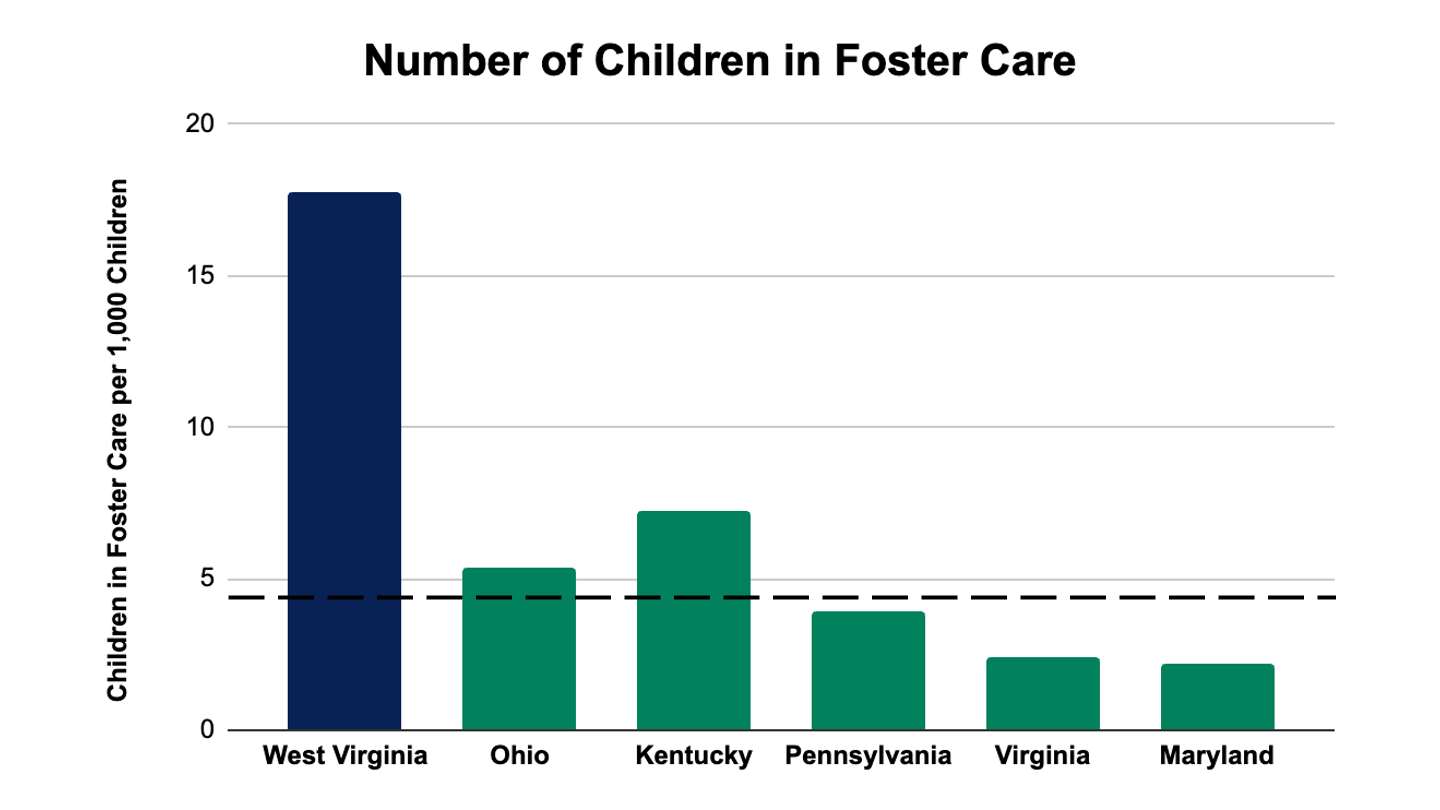
The rate of foster care children per 1,000 total children. Dashed line represents the average rate in the US. Based on data from the ACF.
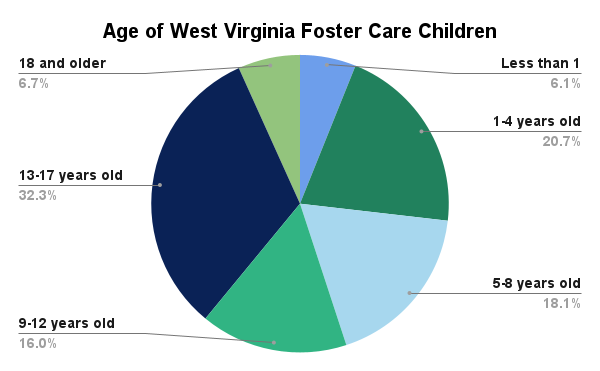
Based on data from the Child Welfare Dashboard.
Child Removal Process
There are multiple circumstances in which a child would be taken from their home and parents, including abuse and neglect, as well as family circumstances such as housing insecurity and parental substance abuse. West Virginia considers a child to be abused when their health or welfare is being harmed or threatened by a parent who knowingly or intentionally attempts or allows the child to be physically, mentally, or emotionally injured; they are sexually abused or exploited; they are sold or attempted to be sold by their parent; they suffer domestic violence; or they are trafficked.
Furthermore, West Virginia considers a neglected child one whose physical or mental health is being harmed by parental refusal, failure, or inability to provide the child with necessities like food, clothing, shelter, medical care, education, or supervision.
According to ACF’s most recent data, child neglect contributes to 28% of child removal cases, while abuse is cited in 34% of child removal cases in West Virginia. There are, however, additional reasons for child removal and multiple reasons may be cited for the same child. In West Virginia, homelessness or inadequate housing and domestic violence are each cited in 16% of child removals. The most commonly cited reason for child removal in West Virginia is parental substance abuse issues, which is involved in 44% of cases.
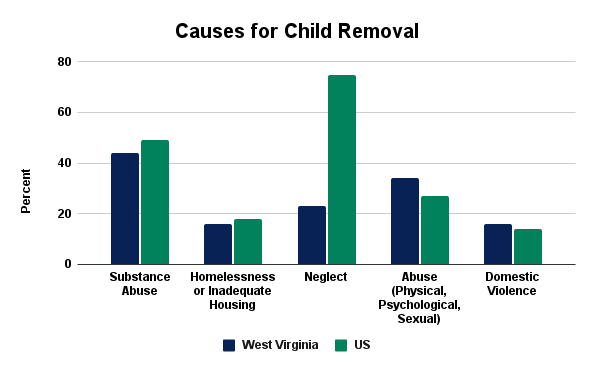
Primary causes for child removal. Based on data from ACF. Total percentages may be greater than 100 as multiple reasons may be cited for the same child.
West Virginia Policies
As substance abuse is cited in a large percentage of child removals, West Virginia could seek policies to prevent substance abuse. One option could be to limit child removal when substance abuse is the sole reason cited for removal. It is unclear when these circumstances may apply or how common they are in West Virginia. Montana proposed this policy in 2023 and included requirements for state welfare agencies to assist parents in obtaining community substance abuse prevention support. The legislation passed Montana’s legislature, though was later vetoed by the governor.
West Virginia could seek to build upon Montana’s legislation with certain stipulations. While it may not be appropriate in all cases, West Virginia could stipulate that children not be taken away solely due to parental substance abuse if, in the opinion of the court, the parent demonstrates clear evidence that they are seeking to stop their substance abuse by actively pursuing treatment at a prevention center. This could operate in a manner similar to court-approved improvement periods. Additionally, the legislature could stipulate that child protective services or other child welfare workers perform frequent assessments on both the child and parent during this period, with requirements, such as drug screening, that must be met to permit the child to remain with that parent during their recovery.
Additionally, the State could seek to support initiatives in place working to reduce parental substance abuse. The legislature could consider actions to supplement funding for existing facilities throughout the state, potentially completely subsidizing treatment for certain individuals, or fund additional facilities through collaboration with the West Virginia First Foundation.
This Science and Technology Note was prepared by Nathan G. Burns, PhD, West Virginia Science & Technology Policy Fellow on behalf of the West Virginia Science and Technology Policy (WV STeP) Initiative. The WV STeP Initiative provides nonpartisan research and information to members of the West Virginia Legislature. This Note is intended for informational purposes only and does not indicate support or opposition to a particular bill or policy approach. Please contact info@wvstep.org for more information.
Related Notes