
West Virginia’s Behavioral Health Licensing and Interstate Practice
Behavioral health workforce shortages can limit access to mental health and substance use disorder services, particularly in rural communities. Interstate licensing agreements and telehealth offer ways to reduce these barriers while maintaining professional oversight. This Science & Technology Note examines West Virginia’s behavioral health licensing policies, approaches used in other states, and evidence on their effects on access to mental health care.
Updated November 17, 2026
Research Highlights
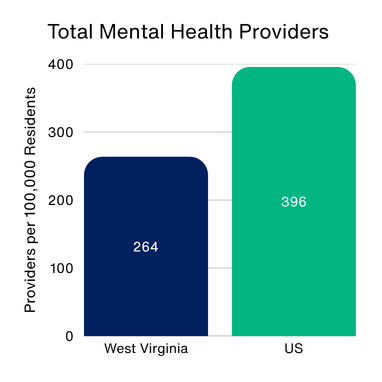
West Virginia has one-third fewer listed mental health providers than the national average.
Interstate licensing compacts can make it easier for providers to practice across state lines while preserving state authority over professional practice and patient safety.
Evidence that behavioral health compacts increase patient access remains limited. Authorization to practice does not necessarily translate into additional appointments or services.
West Virginia has enacted interstate licensing compacts for counselors, psychologists, and social workers, joining other states seeking to reduce barriers to cross-state practice. However, implementation varies and some compacts have not yet become operational.
Interstate licensing addresses provider mobility but does not directly increase the overall workforce. Training, supervision, recruitment, and retention remain important considerations.
Behavioral Health Licensing & Workforce
Behavioral health professionals include licensed professional counselors (LPCs), psychologists, and clinical social workers, who must satisfy different education, examinations, and supervised clinical experience requirements to qualify for their licenses. A state authorizes practice within a defined professional scope. Professionals seeking to serve patients in another state typically need authorization from that state.
States use several approaches to address workforce shortages and facilitate interstate practice. Licensing compacts allow eligible professionals to obtain multistate licenses or practice privileges in participating states. License portability recognizes existing qualifications when professionals apply for another state's license. Telehealth registration allows qualifying out-of-state professionals to provide remote services without obtaining a full in-state license. Requirements, fees, and professional oversight vary across these arrangements.
West Virginia participates in three behavioral health licensing compacts, although their implementation differs. Compact membership alone does not mean providers are actively delivering additional services to residents. State codes establish the legal authority for each arrangement, but that by itself does not confirm that compact privileges are currently available. West Virginia law also allows qualifying out-of-state health professionals to provide telehealth services. Registered professionals remain subject to state professional standards and disciplinary oversight.
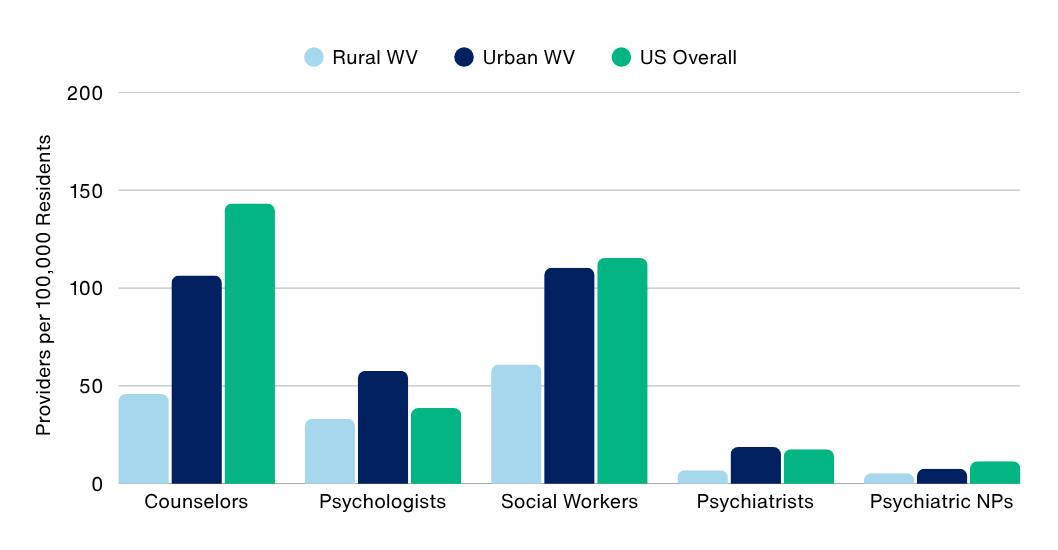
Rural–urban distribution of behavioral health professionals in West Virginia, January 2025. Rural and urban counties are classified using the Federal Office of Rural Health Policy's November 2024 Rural Grant Eligibility Definition. Data from WWAMI Rural Health Research Center.
What Does the Research Show?
Licensing compacts are intended to reduce administrative barriers and allow existing professionals to serve patients across state lines. They may be particularly relevant for rural communities where specialized services are unavailable locally. However, evidence that compacts increase patient access is limited. In 2023, approximately 1% of psychologists licensed in each PSYPACT member state purchased compact authorization and adoption was associated with a 7.7% increase in psychologist listings within one year. The increase was driven by existing in-state psychologists, rather than from out-of-state providers. Interstate practice privileges can expand the geographic reach of behavioral health services through telehealth, however, their effects depend on provider participation, broadband access, insurance reimbursement, and patient needs. This may be particularly challenging in rural West Virginia, where limited broadband connectivity and existing provider shortages could prevent expanded interstate practice privileges from translating into improved access to care.
Approaches in Other States
States are addressing workforce barriers beyond licensing, including expansion of remote clinical supervision, early-career mentorship, and targeted recruitment and retention incentives. Kansas has addressed financial and training barriers through scholarships, funded licensure examination preparation and fees, expanded clinical training opportunities, and recruitment and retention incentives. The state established a Behavioral Health Center of Excellence to coordinate workforce development and had provided retention funding for nearly 200 nursing faculty members. Kansas also passed legislation to increase annual employee bonus caps from $3,500 to $10,000. These initiatives aim to reduce financial barriers to entering the profession and strengthen workforce retention, although their effects on the number of licensed behavioral health professions have not yet been established.
New Mexico streamlined licensing and credentialing through its Behavioral Health Reform and Investment Act. The state has expanded remote clinical supervision and mentorship through Project ECHO to help early-career clinicians, particularly in rural areas, meet licensure requirements. Additionally, Access to Telesupervision New Mexico connects clinicians with remote supervisors, which addresses barriers to completing required clinical supervision. The state also invested in recruitment and retention incentives. For example, a school-based mental health workforce initiative provided $4.3 million in financial support to 540 recipients which included assistance with education, licensure costs, internships, and salaries.
Considerations for West Virginia
West Virginia has adopted several interstate licensing arrangements, although implementation and participation vary by profession. As newer compacts become operational, licensing boards could track interstate practice privileges, provider participation, and services delivered to residents, particularly in rural and underserved communities. Policymakers could also examine how interstate compacts interact with existing telehealth registration requirements to identify administrative duplication or gaps in oversight. Because licensing portability does not increase the overall supply of behavioral health professionals, complementary investments in clinical supervision, workforce training, and retention may be necessary like in Kansas and New Mexico.
This Science and Technology Note was prepared by Anika Zaman, PhD, West Virginia Science & Technology Policy Fellow on behalf of the West Virginia Science and Technology Policy (WV STeP) Initiative. The WV STeP Initiative provides nonpartisan research and information to members of the West Virginia Legislature. This Note is intended for informational purposes only and does not indicate support or opposition to a particular bill or policy approach. Please contact info@wvstep.org for more information.