Automated License Plate Readers in West Virginia
Automated license plate readers (ALPRs) have recently come under scrutiny due to concerns regarding privacy and data security. ALPRs can be operated by law enforcement agencies and private businesses. This Science and Technology note gives an overview of the technology, current status in West Virginia, and provides policy options from neighboring states and Congress that West Virginia could consider to regulate ALPRs.
Updated October 9, 2026
Research Highlights
Automated license plate readers (ALPRs) have recently come under scrutiny due to privacy and data security concerns.
There are an estimated 232 ALPRs mounted in West Virginia. Six West Virginia law enforcement agencies employ the technology in public areas.
West Virginia has not passed legislation regulating ALPRs.
West Virginia could consider Virginia’s approach of defining appropriate uses for the technology, data retention limits, rules on data sharing, and audit trail requirements.
Automated license plate readers (ALPRs) have recently come under scrutiny due to concerns regarding privacy and data security. ALPRs can be operated by law enforcement agencies and private businesses. This Science and Technology note gives an overview of the technology, current status in West Virginia, and provides policy options from neighboring states and Congress that West Virginia could consider to regulate ALPRs.
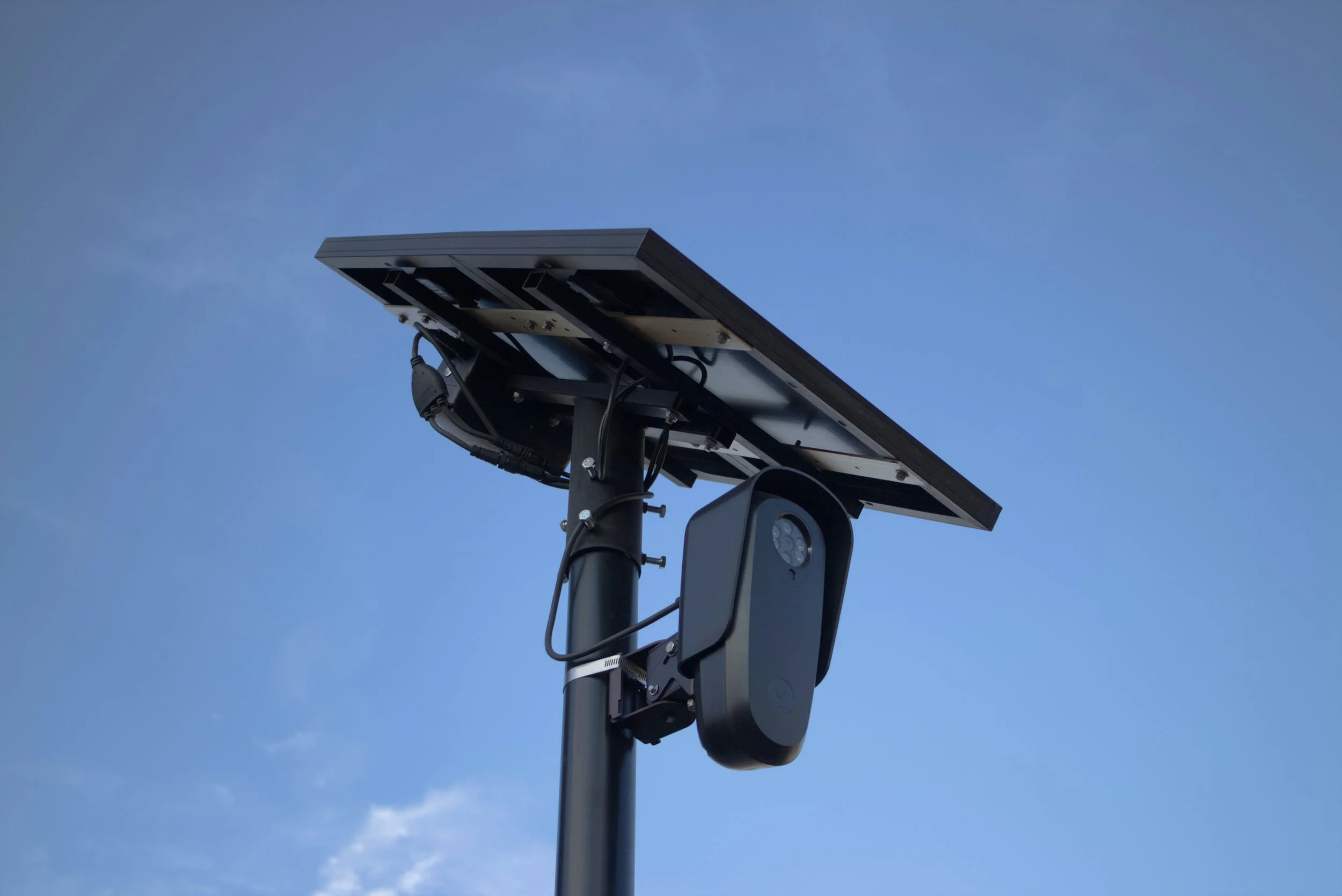
ALPRs are cameras that are designed to take pictures of passing vehicles and record their license plate numbers along with the location, date, and time. The cameras can be placed on fixed mounts or they can be mounted on law enforcement vehicles. More advanced ALPRs use artificial intelligence to note vehicle characteristics (color, make, model, bumper stickers, roof racks, etc.). The cameras can also record the personal characteristics of people captured in images, which has generated concern over the potential to identify individuals using facial recognition technology.
Captured license plate numbers can be used with various databases that law enforcement agencies may opt into, which contain vehicles of interest. If there is a match, officers can be alerted in real time. Currently, there is no consensus that ALPRs alone lead to reductions in crime due to the difficulty in ruling out other factors like body-worn cameras on police officers and the speed of ALPR expansion. In general, ALPRs are estimated to be responsible for reductions in vehicle thefts and are associated with decreases in shootings and general property crime.
Concerns About ALPRs
ALPRs have come under scrutiny due to concerns about mass surveillance and privacy, including misuse by officers tracking individuals not under investigation. Federal and state courts hold that items exposed to public view are not subject to protection under the Fourth Amendment, meaning that law enforcement does not need a search warrant to access the data. For comparison, cell phone location data is subject to Fourth Amendment protection because it is generated automatically and courts have found that carrying a cell phone is indispensable to participation in modern society.
Concerns have also been raised regarding data ownership and security. Data is often transmitted to cloud-based third-party servers. These servers may be vulnerable to hacking, which could expose sensitive personal information. The amount of time that users are allowed to retain data is also inconsistent. For example, Flock Safety recently lowered its recommended default data retention from 30 days to 7 days, however, the customers are ultimately responsible for choosing how long they will retain the data and how it is shared.
Status in West Virginia
According to community-sourced data from DeFlock, a website that tracks locations of ALPRs, there are approximately 232 ALPRs mounted in the mountain state, with more likely deployed on law enforcement vehicles. Deployment of ALPRs has been slower compared to neighboring states, with approximately 1,024 in Maryland, 1,863 in Kentucky, 3,485 in Virginia, 3,732 in Pennsylvania, and 5,564 in Ohio. Flock Safety is the largest vendor in West Virginia (estimated at 83% of all ALPRs), with other vendors including Motorola Solutions, Genetec, Leonardo, and Axis Communications.
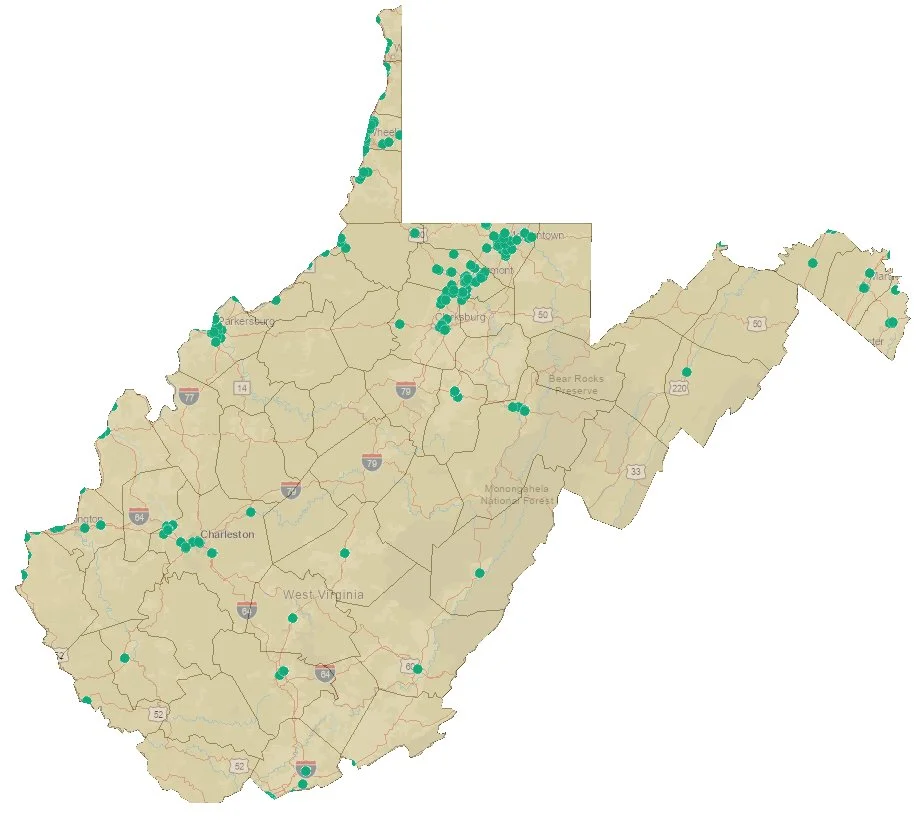
Locations of automated license plate readers in West Virginia. Map boundaries are approximate. Source: Community-sourced data from DeFlock
Several communities in West Virginia have delayed plans to install or activate ALPRs in their jurisdictions: Putnam County has not activated their eight Flock ALPRs that were placed in June 2025, the Barboursville police chief said that they would not install Flock ALPRs on Fourth Amendment grounds, and St. Albans recently became the first city in Kanawha County to pass an ordinance rejecting Flock Cameras. The Huntington City Council revised their standards for how ALPRs can be used after public outcry over a five-year $2.1 million contract with Flock Safety. West Virginia lawmakers have recently expressed dissatisfaction regarding a lack of transparency from Flock Safety.
Legislation in West Virginia
West Virginia does not have any legislation specifically covering ALPRs. The Protecting Everyone from Excessive Police Surveillance (PEEPS) Act (HB 4628) was proposed in 2026. The Act would have banned government officials from accessing historical location data except for a limited number of approved uses, set a 10-day limit for data retention, and prevented municipalities and other political subdivisions from enacting less stringent standards. The Privacy Protection Act (HB 2500) was proposed in 2023 and would have created a Personal Privacy Oversight Committee composed of experts in the field and a State Privacy Officer who would conduct a review on data collection, use, and storage for technology containing personal data including ALPRs. The State Privacy Officer would develop best data management practices on the recommendation of the committee, and be required to terminate the use of technology found to violate personal privacy standards. Both of these acts did not make it out of committee.
Policy Options From Other States
Among neighboring states, Virginia, Maryland, and Kentucky have passed ALPR-specific statutes, with Virginia’s being the most comprehensive. Virginia requires ALPR vendors to certify they will not share or sell data, sets a 21-day limit on data retention, requires audit trails to be generated, and regulates data sharing between law enforcement agencies. West Virginia could consider introducing similar ALPR legislation, which would increase transparency and unify regulations regarding state and local law enforcement agencies’ use of ALPR systems. Alternatively, West Virginia could move to further restrict or ban the use of ALPRs, however, this would likely be unpopular among law enforcement agencies in the state.
Congress is considering legislation that would penalize states that have not regulated ALPRs. H.R. 10366, the No Federal License-Plate Observation and Camera Keeping (No FLOCK) Act, was introduced in 2026 and would strip 10% of federal highway funds from states that do not ban the use of ALPRs except for toll collection and approved police investigative work. H.R. 10211, known as the Flock-Off Act, was also introduced in 2026, and would prevent federal funds from being used for acquiring and operating ALPRs except for border security and tolling. Both of these acts are pending in committee. West Virginia could consider enacting provisions clearly defining the allowed uses of ALPRs from pending federal ALPR legislation to ensure that it will not face potential penalties for noncompliance.
Most states’ statutes only cover law enforcement activity and government use, however, Iowa requires all users of ALPRs to adhere to a 30-day data retention limit under penalty of committing a simple misdemeanor with exceptions for active law enforcement investigations. West Virginia could consider extending proposed guardrails to cover private sector use of ALPR technology, which would likely be supported by privacy advocates and potentially opposed by businesses that use the technology.
This Science and Technology Note was prepared by David Ramotowski, PhD, West Virginia Science & Technology Policy Fellow on behalf of the West Virginia Science and Technology Policy (WV STeP) Initiative. The WV STeP Initiative provides nonpartisan research and information to members of the West Virginia Legislature. This Note is intended for informational purposes only and does not indicate support or opposition to a particular bill or policy approach. Please contact info@wvstep.org for more information.