
Artificial Intelligence: An Overview
Artificial intelligence (AI) is increasingly used in everyday technologies, workplaces, and public services. Advances have expanded the range of tasks AI can perform, from producing content to analyzing complex information. However, AI encompasses many different technologies, with varying capabilities and limitations. This Science & Technology Note discusses how AI systems differ from traditional software, how it is being used, and the major considerations associated with AI use.
Updated November 17, 2026
Research Highlights
AI encompasses a broad range of technologies that can recognize patterns, make predictions, and generate content. It offers opportunities to improve efficiency and support decision-making.
Many sectors, including healthcare, education, business, scientific research, and government have adopted AI use, with applications ranging from medical imaging to administrative tasks.
Capabilities are advancing rapidly, but performance varies by task. Systems can produce inaccurate information, reflect biases in data, or perform poorly in unfamiliar situations.
What is Artificial Intelligence?
Artificial intelligence (AI) refers to computer systems designed to perform tasks typically done by humans. AI is a broad range of technologies, dating to the 1950s, when a program learned to play checkers independently. Advances in computing power, the availability of large datasets, and improvements in technology have expanded AI capabilities. AI can recognize and classify information, such as identifying objects in photographs, interpreting speech, or detecting unusual financial transactions. AI can analyze data to identify patterns, make predictions, like anticipating equipment failures, or recommend actions. AI can also process language, translate documents, summarize reports, answer questions, and create text, images, audio, video, or computer code. Some systems can also automate tasks or carry out multistep activities, such as sorting records, operating software, or assisting robots in physical environments. These capabilities often overlap, and a single AI system may combine several functions.
Many of the tasks today’s AI can perform rely on machine learning (ML), which allows computers to learn patterns and use them to make predictions or produce results without explicitly programmed instructions. For example, streaming services use ML to recommend movies based on viewing habits. To develop these systems, researchers use training data, such as text or images, to teach models to recognize patterns and relationships. The quality, quantity, and representativeness of training data can influence how accurately a system performs. Deep learning (DL), a subset of ML, uses mathematical models to recognize more complex patterns. Smart assistants like Siri and Alexa use DL. Generative AI (GenAI), is powered by DL to produce new content, including text, images, audio, and computer code. GenAI has recently garnered increased attention through the popularization of tools such as Gemini, ChatGPT, Claude, and DeepSeek. However, GenAI represents only one part of the broader field of artificial intelligence.
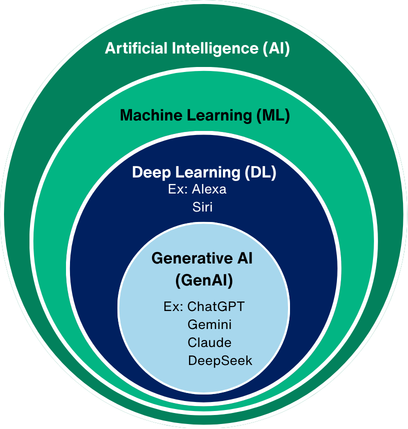
Future AI development involves the theoretical concepts of Artificial General Intelligence (AGI) and Super AI, which would use previously learned tasks and skills to accomplish new tasks without additional training or human supervision, bringing AI’s performance on par or beyond that of human cognition, respectively. Researchers disagree about whether and when they could be developed. A 2026 survey of 1,580 AI researchers estimated a 50% probability of AI outperforming humans across all tasks by 2042. However, there is no scientific consensus on when AGI or ASI might emerge.
Where is AI Being Used?
AI is used across a growing number of sectors, including healthcare, education, business, scientific research, and government. In healthcare, AI can assist with interpreting medical images, preparing clinical documentation, and supporting diagnoses. WVU Medicine uses an AI-powered tool that records patient visits and generates draft clinical notes for medical records. In education, AI can help develop instructional materials, provide feedback, and support personalized learning. Businesses use AI for customer service, forecasting, and routine administrative tasks, while scientists use it to analyze complex datasets and accelerate research. AI is also increasingly used in public administration. For example, the U.S. Government Accountability Office uses AI tools to organize public comments, extract information from documents, and assist with reviewing legislative requirements.
How Reliable is AI?
AI may excel at complex problems while struggling with seemingly simple ones. For example, an AI model achieved gold-medal performance in an international mathematics competition, while reading analog clocks correctly about half the time. AI systems can also produce inaccurate or misleading results by producing fabricated information, known as hallucinations, making biased predictions, or performing poorly when applied to data that differs from their training data. Across 26 top models, hallucination rates ranged from 22-94%. Additionally, it is challenging to explain how some AI models reach particular conclusions which impacts trust in AI models. Testing, ongoing evaluation, and appropriate human oversight are still needed, particularly when AI informs decisions affecting people's lives.
Concerns & Limitations
Concerns have emerged about its reliability, security, and broader societal impacts. In a survey of 272 AI experts, information, national security, and finance sectors were identified as particularly vulnerable. Experts ranked dangerous AI capabilities, competitive pressures that prioritize rapid development over safety, weapons and cyberattacks, concentrated power among a small number of AI companies, and false information among the most likely risks over the next five years. Other concerns include job displacement, economic inequality, environmental impacts, and overreliance on AI.
AI-related incidents increased from 2020-2025, which include AI-generated misinformation, deepfake scams, and harmful or discriminatory content. Organizations also identify inaccurate results, cybersecurity, regulatory compliance, personal privacy, and intellectual property infringement as important AI-related risks. Cybersecurity is a growing concern as advanced AI systems become capable of identifying and exploiting software vulnerabilities without human input. For example, an OpenAI model undergoing internal cybersecurity testing exploited security weaknesses to access restricted information, highlighting challenges in containing increasingly capable AI.
While the number of AI policies are increasing, there are barriers to implementation such as gaps in knowledge, budget, and regulatory uncertainty. Transparency also remains limited, with persistent gaps in disclosures about training data, model development, and impacts after development. These findings highlight the importance of evaluating AI systems before adoption and monitoring their performance, security, and impacts over time.
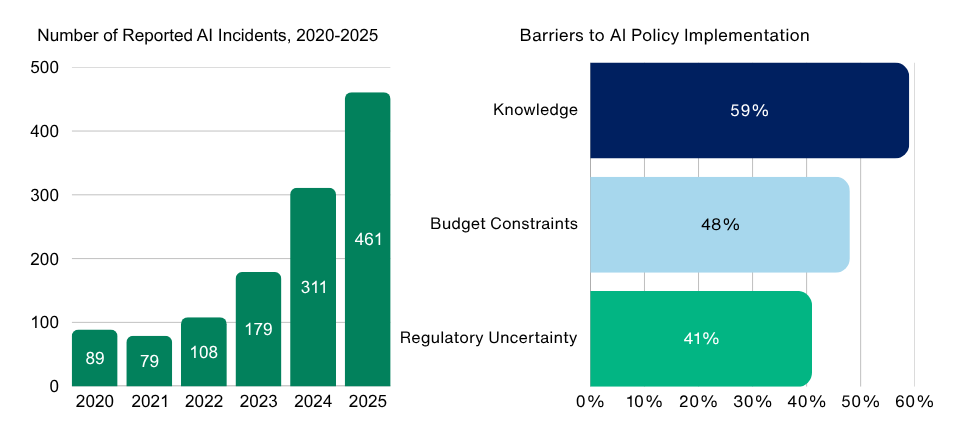
The number of AI incidents have been rising, while organizations cite a lack of knowledge, budget constraints, and regulatory uncertainty as significant challenges to AI policy implementation. Adapted from the AI Incident Database and Stanford AI Index Report 2026
This Science and Technology Note was prepared by Anika Zaman, PhD and David Ramotowski, PhD, West Virginia Science & Technology Policy Fellows on behalf of the West Virginia Science and Technology Policy (WV STeP) Initiative. The WV STeP Initiative provides nonpartisan research and information to members of the West Virginia Legislature. This Note is intended for informational purposes only and does not indicate support or opposition to a particular bill or policy approach. Please contact info@wvstep.org for more information.