
Abortion Reversal in West Virginia
West Virginia prohibits abortions, including medication abortions, except in specific circumstances. There is pending legislation that would permit state funding to be used to provide medication for abortion reversals, a controversial practice for which there has been limited research. This Science and Technology Note explores how abortion reversals are thought to work, the research behind them, and the policy currently being considered.
Updated April 10, 2026
Research Highlights
Progesterone plays an important role to prepare and support pregnancy.
Mifepristone is one component of medication abortions that works by blocking progesterone.
Abortion reversal is a controversial practice in which a high dose of progesterone is thought to compete against mifepristone, allowing a pregnancy to continue.
West Virginia is considering legislation to allow state funding to provide progesterone for abortion reversals.
Abortion Laws in West Virginia
Abortions are processes that result in termination of a pregnancy. They can be done surgically by a clinician or by using prescription medication. West Virginia has outlawed abortions since 2022, except for certain circumstances including a medical emergency, ectopic pregnancy, a nonviable embryo, sexual assault, or incest.
Progesterone in Pregnancy
Progesterone is a naturally made hormone important for the female reproductive system. Progesterone helps to prepare the uterus for pregnancy by causing the uterine wall to thicken. It does this by binding to receptors in the uterus. Similar to how locks only open for certain keys, some receptors only work when certain hormones, like progesterone, attach to them. The amount of progesterone made varies throughout a repeating ~month-long cycle. During pregnancy, the body continues making progesterone, and the thick uterine wall provides support and nourishment for the embryo. In the absence of a pregnancy, progesterone levels naturally fall, causing the uterine wall to shed, leading to a menstrual period.
What is Medication Abortion?
Medication used to induce abortion through 10 weeks of pregnancy has been approved by the US Food and Drug Administration (FDA) since 2000. Two drugs are used: mifepristone and misoprostol. Mifepristone blocks progesterone by attaching to the same receptor, preventing the receptor from functioning. This is similar to how someone can jam a lock with the wrong key, keeping the door from opening even when the correct key is present. This causes the uterine wall to shed. Misoprostol is taken up to 48 hours later, causing contractions to help expel the pregnancy. These are fairly common; over half of all abortions in the US are with medication.
Access to medication abortion varies and is prohibited in West Virginia. Additionally, SB 173 (2026), which prohibits distributing medication abortion in West Virginia, including through telemedicine and the mail, passed the Senate and currently awaits action by the House.
What is Abortion Reversal?
Abortion reversal attempts to counteract a medication abortion to allow a pregnancy to continue. This involves taking high doses of progesterone to counteract the effect of mifepristone before misoprostol is taken. Continuing the key-lock analogy, this would be like throwing hundreds of “progesterone keys” at a lock, hoping to beat a single “mifepristone key”.

Progesterone binds to its receptor to prepare the uterus for pregnancy. Mifepristone blocks progesterone from binding its receptor. Abortion reversal seeks to overwhelm mifepristone, allowing progesterone to bind to the receptor and maintain the uterine lining for pregnancy.
Abortion reversal has been met with controversy. The American Medical Association, representing over 271,000 physicians and medical students, argues it is an experimental practice with no approved FDA protocol. Similarly, the American College of Obstetricians and Gynecologists, representing 62,000 medical students, physicians, and health professionals, states that it is not supported by science and does not meet clinical standards. The American Association of Pro-Life Obstetricians and Gynecologists, representing medical students, physicians, health professionals, and non-medical individuals to promote the idea that life begins at fertilization and help patients make life-affirming choices, says abortion reversal is safe and effective.
There are limited studies on the effectiveness of abortion reversal. One 2018 study analyzed 547 medical reports on abortion reversal and found progesterone led to an average of 48% of pregnancies continuing after mifepristone, with two reports citing pregnancy continuation rates of 64% and 68%, though they did not analyze the rate of continuing pregnancies with mifepristone alone.
A 2023 study concluded that most data investigating the effects of progesterone in abortion reversal, including those in the 2018 study, is poor quality with varying methodologies and ethics concerns. Overall, they confirmed that patients that take progesterone continue their pregnancy in 48% of cases, though they argue it does not differ from a separate 2015 study that found mifepristone alone results in continued pregnancy up to 46% of the time, without additional progesterone
One study directly tested whether progesterone led to continued pregnancies after mifepristone. This group found that 4/5 pregnancies given progesterone continued compared to 2/5 pregnancies that continued without progesterone, though the study ended prematurely due to safety concerns. They reported women were hospitalized due to large amounts of blood loss regardless of whether or not they received progesterone and postulated that taking mifepristone without later taking misoprostol would lead to excess bleeding.
Abortion Reversal Policies
Abortion reversal policies vary. Colorado banned abortion reversals in 2023, stating that they are dangerous and not supported by science. A court challenge, however, found that the State did not have compelling reasoning to regulate it. Conversely, as of 2021, 14 states, including West Virginia, require clinicians to counsel patients about mifepristone. Language varies but can be categorized as either explicitly stating that it may be possible to reverse the effects of mifepristone, or by generally stating that mifepristone is not always effective.
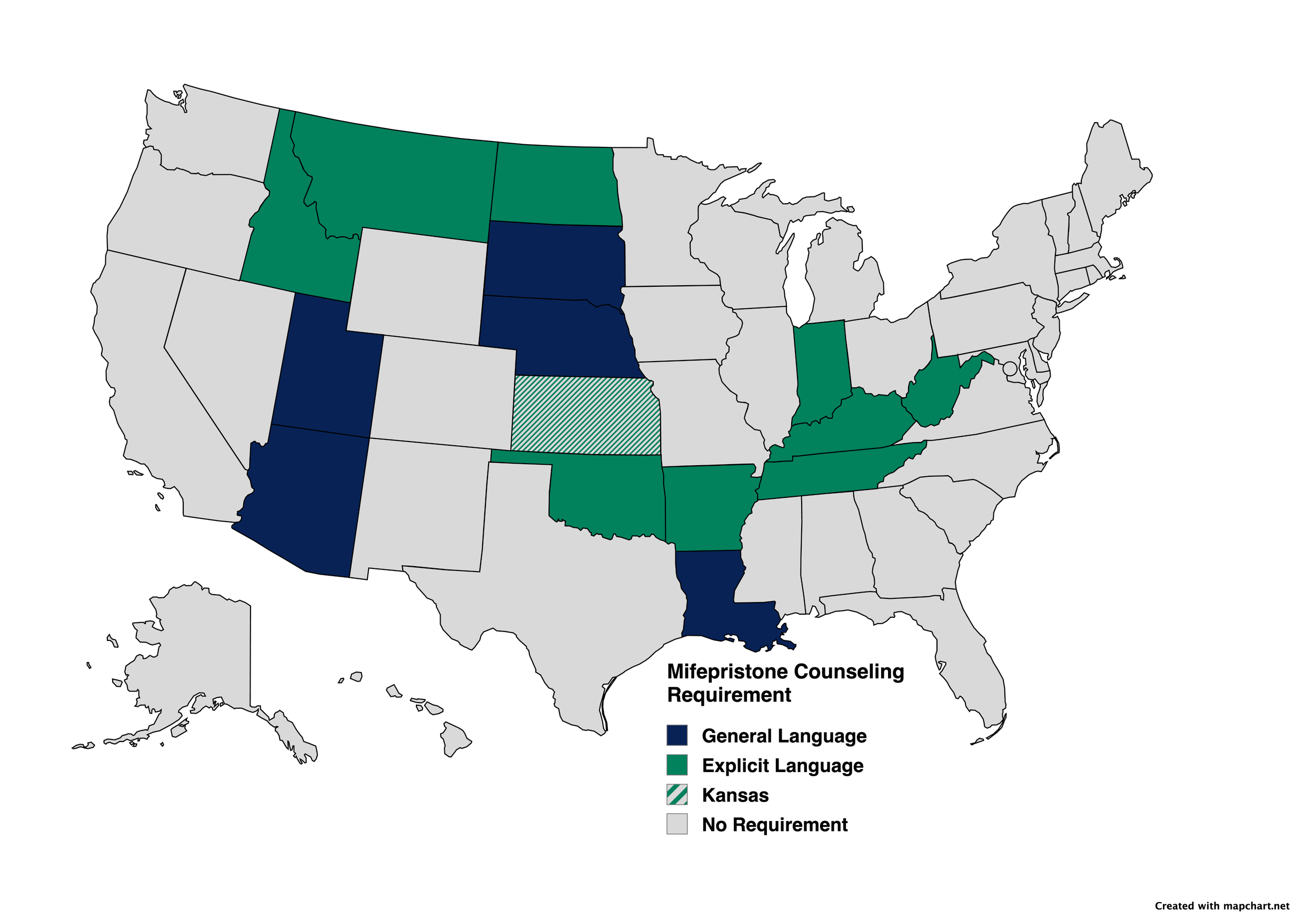
State mifepristone counseling requirements as of 2021. Kansas legislation requiring explicit language was ruled unconstitutional, leaving current policy unclear.
Legislation in West Virginia sought to promote abortion reversal. SB 805 (2026) passed the Senate but did not pass out of committee in the House, would have enabled State funding from the West Virginia Mothers and Babies Support Program to supply progesterone for abortion reversals. This program is managed by the West Virginia Pregnancy Center Coalition (WVPCC), which, as of 2023, supports 35 pregnancy resource centers (PRCs). In general, PRCs provide support, resources, classes, and some medical testing for patients. Concerns have been raised regarding PRCs providing abortion reversal medications. Progesterone requires a prescription, thus PRCs would need someone with prescription authority. A study analyzing over 600 PRCs across 9 states found that 25% had nurses and 16% had a physician. The WVPCC does not have clinicians on staff, though it is unclear how many West Virginia PRCs have a clinician.
West Virginia could encourage PRCs to refer patients to a provider with prescription authority and provide pharmacy benefits or reimbursements for progesterone. Additionally, the legislature could mandate progesterone be covered by insurance. The legislature could also reallocate funding that would go to providing progesterone to instead support studies to better understand abortion reversals, though this would likely be costly with possible ethical implications.
This Science and Technology Note was prepared by Nathan G. Burns, PhD, West Virginia Science & Technology Policy Fellow on behalf of the West Virginia Science and Technology Policy (WV STeP) Initiative. The WV STeP Initiative provides nonpartisan research and information to members of the West Virginia Legislature. This Note is intended for informational purposes only and does not indicate support or opposition to a particular bill or policy approach. Please contact info@wvstep.org for more information.