
1890 Extension Services in West Virginia
Extension services are offered by land-grant universities in each state to increase educational opportunities in every US county. West Virginia has two land-grant universities that provide extension services: West Virginia University (WVU), which began offering extension following federal legislation in 1914; and West Virginia State University (WVSU), whose extension service began following federal legislation in 1997. This Science and Technology Note explores extension services in the state with a focus on programs offered following the 1890 legislation, as well as federal and state funding for extension programs.
Updated June 25, 2026
What are Extension Services?
Extension programs bring education to every US county and are only offered by land-grant institutions. Land-grant institutions were established in each state using federal land donated through the Morrill Act of 1862. Their original mission was to provide a practical education by teaching agriculture, military tactics, engineering, and classical studies. The Second Morrill Act of 1890 established an additional 19 land-grant institutions specifically designated to provide education for Black citizens.
Congress passed the Smith-Lever Act in 1914, creating the Cooperative Extension System, enabling institutions founded as part of the Morrill Act of 1862 (1862 institutions) to offer extension programs. Institutions founded under the Second Morrill Act of 1890 (1890 institutions) were able to begin offering extension services in 1997 with the passage of the National Agriculture Research, Extension, and Teaching Act (NARETPA).
Research Highlights
Extension programs, offered through land-grant institutions in order to bring education opportunities to every county in the nation, are funded by both the federal and state governments.
West Virginia has two land-grant institutions: WVU and WVSU, both of which offer extension programs.
The legislature could align with federal matching obligations for WVSU’s extension programs similarly to WVU’s programs, which could increase programing around the state and potentially create jobs.
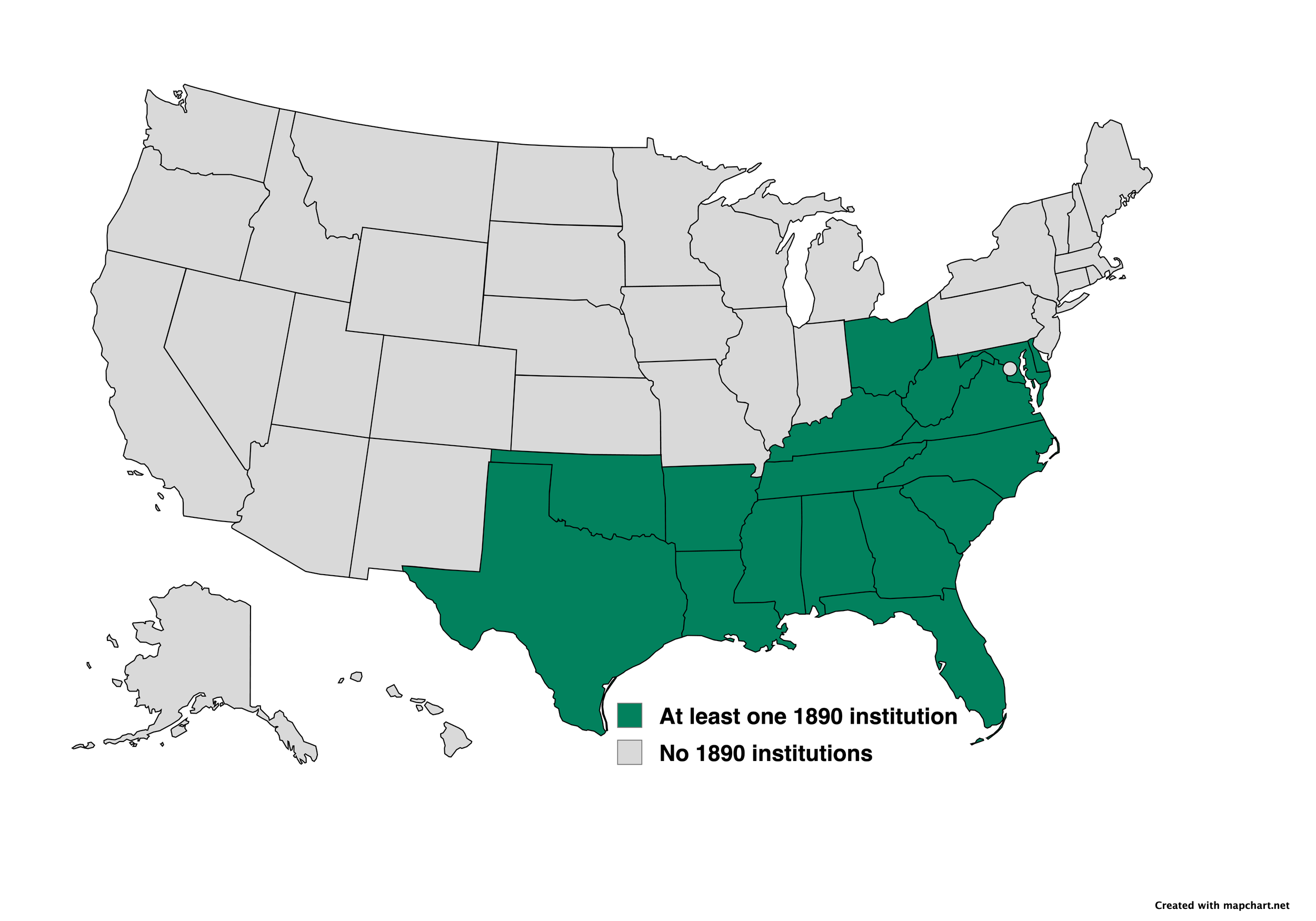
Based on information from the Association of Public Land-Grant Universities.
West Virginia 1890 Extension Services
West Virginia offers extension programs through WVU and WVSU. WVU was founded under the Morrill Act of 1862. WVSU is an 1890 institution, founded under the Second Morrill Act of 1890. Extension instructors from both universities are county-based, giving residents local access to university expertise.
WVSU Extension Services offer programs in 6 categories. The Agriculture and Natural Resources program offers assistance to farmers, commodity groups, and agribusinesses on issues including horticulture and pest management. Their Family and Consumer Sciences programming is offered in 18 counties in southern West Virginia, providing assistance managing finances, raising children, maintaining good health, and staying active. The statewide Healthy Grandfamilies program supports grandparents that are raising their grandchildren, including education on legal issues, digital media, school systems, and grief. There are 4-H programs offering partnerships with educators, schools, community organizations, and public libraries to encourage youth development. Community Vitality and Economic Development programming in both central and southern West Virginia focuses on community development and revitalization and supports small business development. Finally, the Economic Development Center in Kanawha County provides a coworking space for small businesses and offers courses for business owners.
Extension Services Funding
Extension programs are funded in part by the federal government. Federal funding for 1862 institution extension programs, including WVU’s extension programs, is allocated through the Smith-Lever Act. 1890 extension programs, like WVSU’s extension programs, are funded through Section 1444 of NARETPA. Both are administered by the US Department of Agriculture (USDA).
Smith-Lever and Section 1444 extension program funding is congressionally allocated. The total sum of federal funding allocated to Section 1444 extension programs must equal at least 20% of the total federal funding allocated to Smith-Lever extension programs. Funding determinations for individual institutions are formula-based. 20% of Section 1444 funding is shared equally among all 1890 institution extension programs; 40% is allocated among the programs based on the state’s rural population; and the remaining 40% is allocated among programs based on the farming population in the state. 1862 institution extension programs are funded by the Smith-Lever program based on the same formula.
States must match federal funding for 1862 and 1890 institution extension programs. The USDA secretary may waive up to 50% of the match on a case-by-case basis if the state cannot match federal funding. If the state does not match funding and does not receive a waiver, all unmatched funds are forfeited back to the USDA. WVSU has received waivers for Section 1444 funding for 11 years between 2011-2025, which led to a more than $5 million funding deficit for WVSU extension programs in that timeframe. West Virginia has met its obligations for 1862 institution extension programs every year between 2011-2025 and exceeded its required match both in 2019 and 2023, leading to a surplus of over $63,000.
Policy Options
The legislature could opt to continue to not match Section 1444 funding and rely on WVSU’s extension programs getting waivers from the USDA. This could save West Virginia money, as less money would need to be allocated to these programs. If a waiver is not granted, federal funding could be at risk for these programs and services could be interrupted or cancelled. Decreasing funding could also limit the program’s ability to hire employees and may lead to layoffs.
The legislature could meet its 1890 extension program funding match obligation, similar to 2024 and 2025. Because a waiver would not be needed, there is not a possibility that one would be denied, guaranteeing federal funding. This may also lead to a continuation of services through these programs and enable them to plan for the future.
Alternatively, the legislature could increase funding to 1890 extension programs. This could alleviate the funding deficit these programs have faced since 2011. This would not increase federal funding, however. Additional funding may help programs grow capacity and expand services around the state, which may lead to more jobs to support programming. Increased program capacity may also help families. WVSU’s 4-H program, for example, offers various day-long summer programs that provide activities for students during the summer while their parents work, reducing the need for childcare.
The legislature could compel WVSU and WVU to collaborate. WVSU and WVU extension both, for example, offer financial literacy programs. Collaborating could prevent overlapping efforts in similar parts of the state. This may bring costs down for both programs, allowing more of their funding to be used for programs that are unique to them. This could also be important with regard to potential federal funding decreases. Since 2011, federal funding for both the Smith-Lever and 1890 extension programs has increased. The proposed budget for 2027, however, requests large decreases in funding for both of these programs. If passed, this would decrease funding for WVSU and WVU’s extension programs and likely necessitate more stringent use of funds.
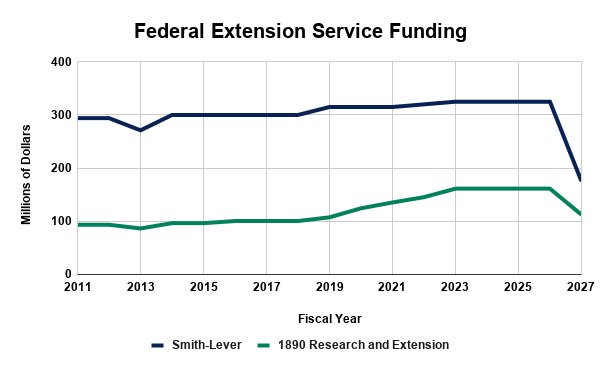
Based on USDA budget summaries. Proposed 2027 budget awaits approval.
This Science and Technology Note was prepared by Nathan G. Burns, PhD, West Virginia Science & Technology Policy Fellow on behalf of the West Virginia Science and Technology Policy (WV STeP) Initiative. The WV STeP Initiative provides nonpartisan research and information to members of the West Virginia Legislature. This Note is intended for informational purposes only and does not indicate support or opposition to a particular bill or policy approach. Please contact info@wvstep.org for more information.
Addendum: State Funding Allocation to Extension Services
West Virginia has two land-grant institutions that offer extension services throughout the state: West Virginia State University (WVSU) and West Virginia University (WVU). Extension services receive funding from both the federal government and the state. WVSU’s extension program receives federal funding from Section 1444 of the National Agriculture Research, Extension, and Teaching Act. WVU’s extension receives funding from the Smith-Lever Act. The state is required to match federal funding for both programs or be granted a waiver for up to 50% of the funds by the US Department of Agriculture secretary. This Science and Technology Note Addendum summarizes the federal and state funding allocated to both WVSU and WVU’s extension programs from 2011-2025.
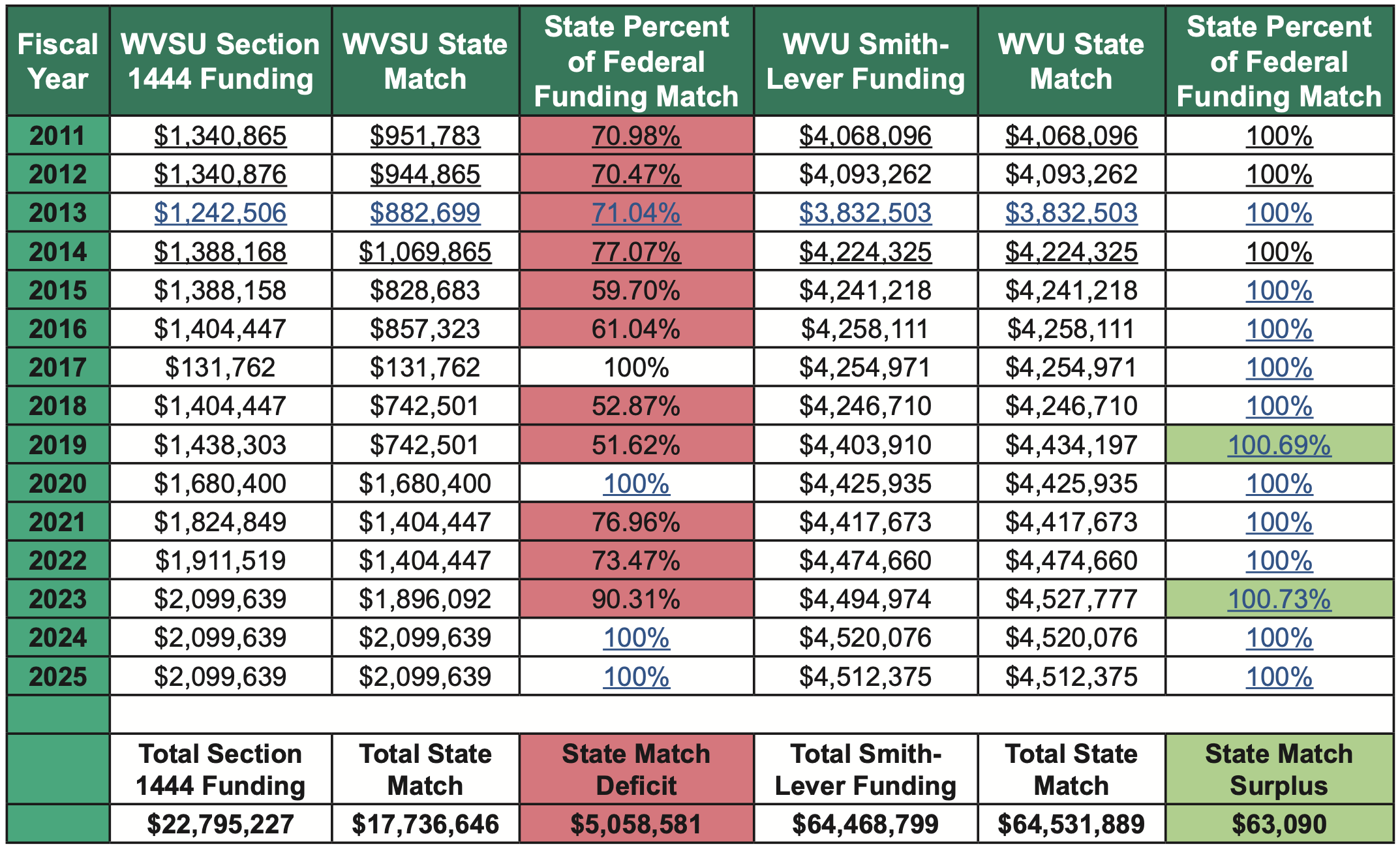
Based on data from the National Institute of Food and Agriculture’s Capacity Program Allocation and Matching database.